

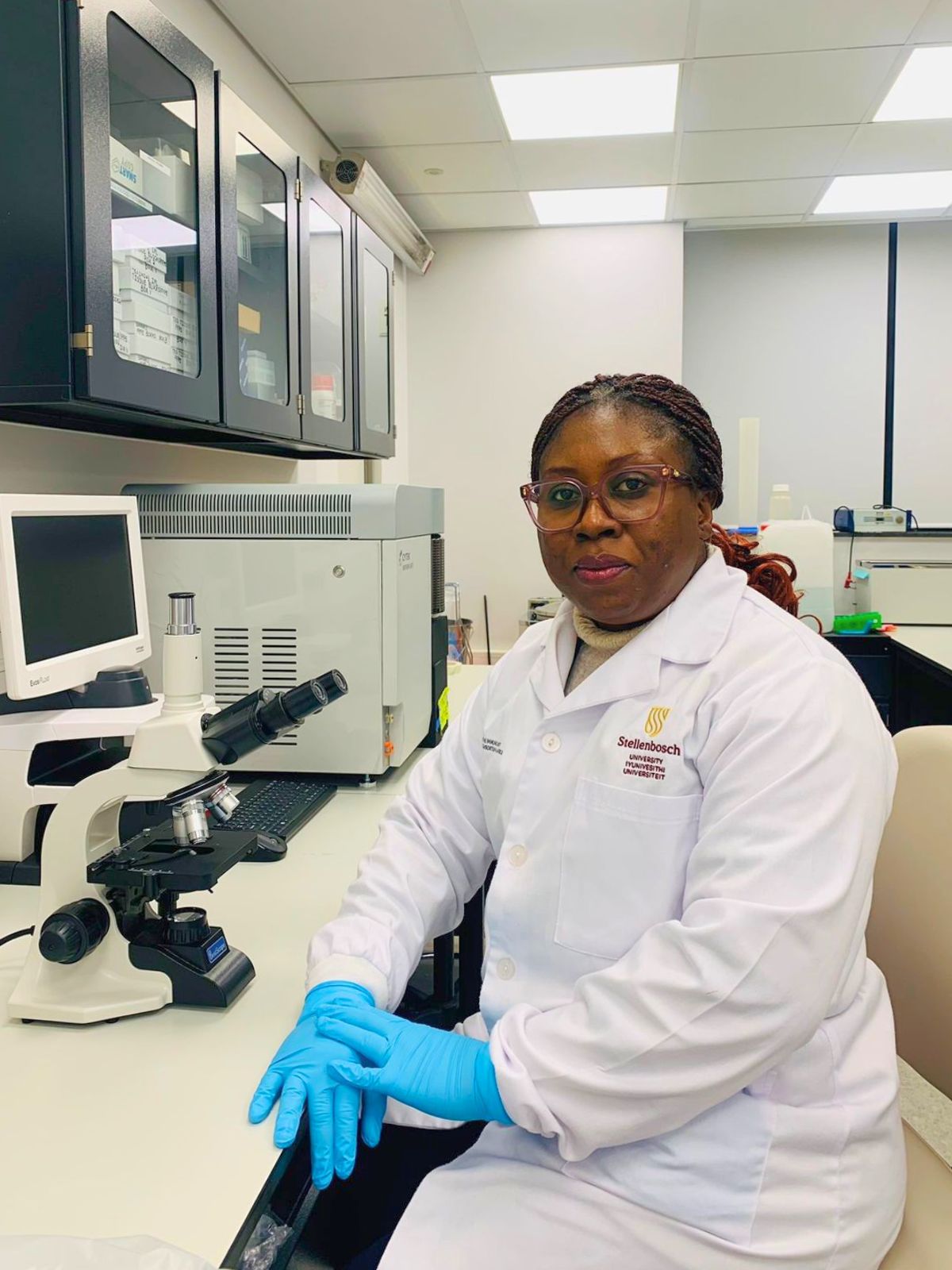
 Dr Carine Kunsevi-Kilola is a Post-Doctoral Fellow at the Reproductive Immunology Research Consortium in Africa (RIRCA) at Stellenbosch University, South Africa, and a compelling voice in maternal and reproductive immunology and, therefore, women’s health.
Carine was born and raised in the Democratic Republic of Congo (DRC). After completing a diploma in science in the DRC in 2006, she moved to South Africa, where she earned a BTech and Honours degree from the Cape Peninsula University of Technology. Carine then joined Stellenbosch University in 2010 as a technical officer in a TB clinical trials laboratory. She then obtained her master’s degree in 2014 from Cape Peninsula University of Technology before beginning her PhD at Stellenbosch University, where she examined the underlying mechanisms affecting individuals with Type 2 Diabetes who are close contacts of tuberculosis (TB) patients and are vulnerable to Mtb. Carine has recently published a paper showing that Type 2 Diabetes impairs lung immunity against Mtb by weakening immune cell function and gene expression at the site of infection (the lung). It explains why people with diabetes get TB more easily and become much sicker.
During her PhD from 2015 to 2022, Carine was pregnant twice, which is an experience that has profoundly shaped her commitment to maternal health research. Since joining RIRCA, Dr Kunsevi-Kilola has directed her expertise towards one of Africa’s most pressing public health challenges: improving pregnancy outcomes for women living with HIV. Her research investigates how the timing of antiretroviral therapy affects placental vascular development, with disruptions potentially triggering devastating outcomes such as preterm birth and low birthweight. Using global plasma proteomics, she is working to identify biomarkers that could meaningfully improve maternal and neonatal health across the continent.
She is an African Postdoctoral Training Initiative (APTI) fellow, supported by the African Academy of Sciences and the Bill & Melinda Gates Foundation, and a 2025 NIH Intramural AIDS Research Fellow. In 2019, she received the prestigious L’Oréal-UNESCO for Women in Science Young Talents Sub-Saharan Africa Award. A mother of two, she is also a passionate mentor to the next generation of African scientists.
Can you briefly explain what the complement system does and why its role during pregnancy matters so much?
The complement system is a key part of the innate immune system that helps fight infections, clear damaged cells, and promote inflammation.
During pregnancy, it plays a crucial role by maintaining a carefully balanced state and actively supporting placental development, while protecting both the mother and the foetus from infection and preventing excessive inflammation that could harm foetal development or lead to complications. It is also plays a critical role by remaining strictly regulated to prevent the maternal immune system from attacking the developing foetus.
Your current project investigates how the timing of antiretroviral therapy affects placental blood vessel development. Why does it matter not just whether a woman receives ART, but when she starts it?
When ART is started matters because it can influence placental development, and it is not just about maternal viral control.
The timing matters because the placenta builds its blood vessels early in pregnancy, and HIV drugs can disrupt this delicate process. Starting these powerful medicines before or during the first few weeks of pregnancy can change how blood vessels grow, which sometimes causes poor blood flow to the developing foetus and leads to premature birth or low birth weight. However, waiting too long to start treatment allows the HIV virus to cause harmful inflammation to the mother and the foetus. Our study will help doctors to find the perfect balance to keep the mother healthy while protecting the growing baby from drug side effects.
In short, timing affects foetal environment meaning, early ART can shape how placental blood vessels grow, which may influence outcomes like foetal growth and birth complications, not just whether HIV is treated.
How has the rise of omics technologies changed the way reproductive immunology is studied? What is most exciting about this field?
The integration of high-throughput multi-omics platforms has truly transformed the field of reproductive immunology. Today, scientists can look at individual cells from whole tissues. By using tools such as single-cell sequencing, spatial transcriptomics, and advanced proteomic networks, scientists can precisely map where these cells reside, their spatial organisation, and how they behave within the tissue. This is exciting because investigators can finally understand the unique “conversation” between a mother’s immune system and her developing foetus, facilitating the discovery of non-invasive biomarkers for early pregnancy complications, such as pre-eclampsia.
Adverse birth outcomes are common in HIV- and HIV+ affected pregnancies across Africa. How close are we to having reliable biomarkers that clinicians can use to identify at-risk pregnancies?
Clinicians are getting closer to using reliable biomarkers to find risky pregnancies in Africa, but there are still steps to go. Researchers have found clear biological warning signs during pregnancies, like changes in immune cells, persistent cytokine inflammation, and elevated vascular damage markers, which can predict miscarriages or preterm births in both HIV-positive and HIV-negative mothers. While these discoveries are very accurate in labs, the big challenge now is turning these complex medical discoveries into cheap, fast finger-prick tests that small clinics across Africa can actually use without expensive laboratory equipment.
It was the International Day of Women’s Health on the 28th May. What do you believe are the most urgent and under-resourced gaps in women’s and maternal health research in Africa?
Research on African women’s health misses big pieces of the puzzle because it focuses too much on medical problems and ignores everyday life. We do not have enough information on how poverty, long travel times to clinics, and bad treatment by doctors affect pregnant women. There is also very little data on how extreme heat and droughts harm unborn babies, or how mental health impacts mothers. To make matters worse, local African women do not get enough funding or support to lead these research projects themselves. Fixing this means giving more power and money to local researchers who truly understand these struggles.
You were awarded the L’Oreal-UNESCO for Women in Science Sub-Saharan Africa Young Talents Award. How has this award shaped your career? And how important are these awards in sustaining and encouraging women in Africa?
The L’Oréal-UNESCO for Women in Science Sub-Saharan Africa Young Talents Award transformed my career by providing me with global visibility, credibility, funding, a strong network, and the opportunity to mentor the next generation by assisting them with their applications. The program also focuses on leadership training. I am grateful to have attended the leadership training, which empowered me as a female scientist to secure more grants and lead major projects.
Beyond individual career growth, this award is vital for sustaining women in STEM across Africa because it amplifies underrepresented voices, builds pan-African research networks, and creates visible role models that inspire future generations, effectively combating the gender gap and retaining top talent on the continent.
What does African-led science mean to you, and why does it matter that research on African women’s health is conducted by African researchers?
African-led science means African researchers decide which health problems to study and how to address them. Having local scientists lead research on African women’s health is vital because they truly understand the culture and daily challenges women face. They know which specific health problems are being ignored and can find solutions that people actually trust and use. This keeps expert skills within Africa, creates local role models, and builds a stronger, fairer health system for everyone.
What advice would you give to a young woman today who is passionate about science but facing the very real pressures of balancing study, work, and family?
To balance science, work, and family is not easy, but you must set clear boundaries and organise your time strictly. Focus fully on your studies at work and switch off your work mind when you are with your family. This work-life balance is very important for your mental health. Also, you need a support system. It helps to build a strong team of friends, family, and mentors who can support you when things get busy. Understand that you cannot do everything perfectly every day, so it is okay to change your focus when your family or your lab needs you more. Pacing yourself is the best way to keep your passion for science alive without burning out. Also, have some time for meditation!
Interview by Bonamy (Bon) Holtak