

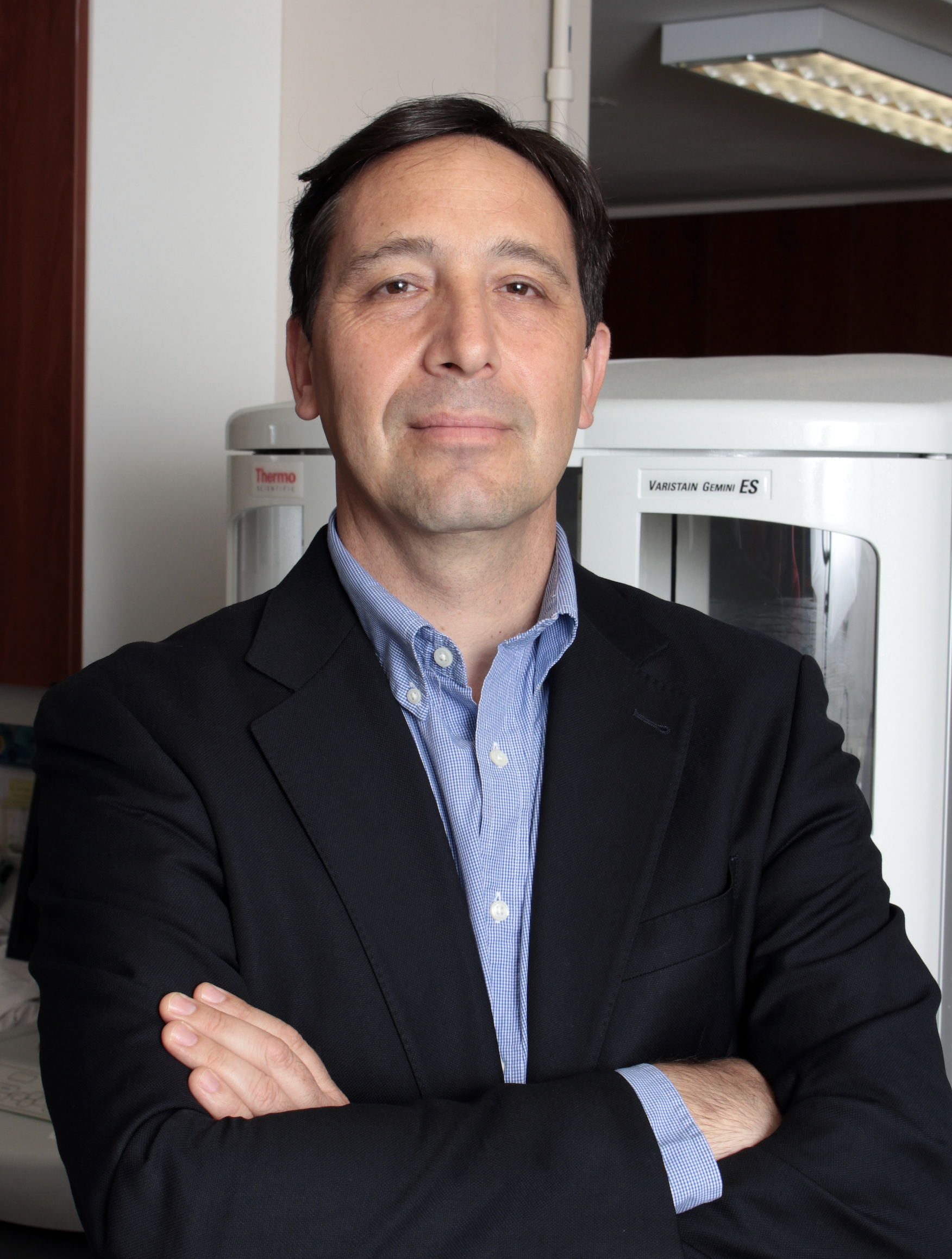
 Professor Alexis M. Kalergis is an internationally recognised immunologist, microbiologist, and biochemist whose work has significantly advanced our understanding of antiviral immunity, respiratory viral pathogenesis, and vaccine development. He is a Full Professor at the Pontificia Universidad Católica de Chile and Director of the Millennium Institute on Immunology and Immunotherapy (IMII), a Scientific Center of Excellence in Chile recognised by the Federation of Clinical Immunology Societies (FOCIS). At the IMII, he leads research on infectious diseases, host–pathogen interactions, and immune regulation.
Prof. Kalergis completed his undergraduate training in Chile, followed by his MSc and PhD training at Albert Einstein College of Medicine. He then completed his postdoctoral training at both Albert Einstein College of Medicine and The Rockefeller University. Throughout his career, his research and collaborations have taken him across the globe, including France, Switzerland, Japan, Greece, China, and the United States, where he has contributed to international research and scientific education in immunology and microbiology.
His laboratory’s pioneering work, first described in RSV infection more than a decade ago, revealed that respiratory viral infections can extend beyond the lungs to affect the central nervous system; a discovery that gained global relevance during the SARS-CoV-2 pandemic and the emergence of long COVID.
Beyond his scientific contributions, Prof. Kalergis is widely recognised for his leadership in science policy, mentorship, and public engagement. He has advised government and international scientific bodies, delivered hundreds of scientific lectures worldwide, published numerous peer-reviewed articles and patents, and trained hundreds of young scientists. In recognition of his impact on immunology, innovation, and scientific leadership, he was named among Cell Press’ “50 Scientists that Inspire.” Prof. Alexis Kalergis has also recently received the prestigious “2026 Distinguished Alum Award” from the Albert Einstein College of Medicine Alumni Association.
Throughout his career, he has remained committed to advancing collaborative science, strengthening biomedical research capacity in Latin America, and fostering closer ties among science, industry, governments, and society.
Can you tell us about your current role and the main scientific questions your laboratory is focused on today?
I am currently a Professor at the Pontificia Universidad Católica de Chile and Director of the Millennium Institute on Immunology and Immunotherapy. Our laboratory focuses on understanding how respiratory viruses, including Respiratory Syncytial Virus, human metapneumovirus, and SARS-CoV-2, interact with the immune system and how these interactions determine disease severity and long-term complications. A major part of our work examines how respiratory infections can affect organs beyond the lungs, particularly the central nervous system and the blood-brain barrier, and, more recently, the impact of these viruses during pregnancy on maternal immunity and foetal neurodevelopment. We are also conducting clinical trials of a recombinant BCG-based RSV vaccine developed in our laboratory and of immunotherapies for autoimmune diseases, aimed at inducing safe, durable, and effective immune protection.
More broadly, our goal is to connect fundamental immunology with translational medicine, leveraging modern technologies and multidisciplinary collaborations to develop solutions to pressing public health problems while strengthening biomedical research capacity in Latin America.
Your work spans immunology, microbiology, biochemistry, and translational research. What initially drew you toward studying the immune response to infectious diseases? How did your early scientific experiences shape your career path?
From early in my training, I was fascinated by the complexity of the immune system and by how the body distinguishes between protection and pathology. Infectious diseases were especially interesting to me because they represent a dynamic interplay between the pathogen and the host, in which evolution, immunity, inflammation, and tissue damage are interconnected.
During my graduate and postdoctoral training at the Albert Einstein College of Medicine and The Rockefeller University, I worked in highly interdisciplinary environments that combined immunology, microbiology, and biochemistry. Those experiences taught me the importance of integrating basic science with clinically relevant questions.
Over time, this naturally expanded beyond infectious diseases and vaccine development to include immune dysregulation and autoimmune diseases. In many ways, studying infections and autoimmunity requires addressing the same fundamental questions: how the immune system balances effective defence with the need to avoid excessive inflammation and tissue damage, and how we can use that knowledge to treat or prevent these conditions.
I think those early experiences shaped my career by reinforcing the idea that science should be collaborative, translational, and ultimately aimed at improving human health.
You have described science as a process that can challenge established paradigms and reveal previously unknown biological phenomena. What does scientific innovation mean to you today?
To me, scientific innovation is not only about developing new technologies or making discoveries, but also about changing how we understand biological systems and applying that knowledge to solve real problems facing society.
Many important advances in science begin when researchers are willing to question assumptions once considered established. Today, I believe innovation also requires integrating many disciplines and sciences in ways that were not possible before. Meaningful innovation is measured not only by publications or pure scientific knowledge, but by whether scientific knowledge can improve people’s lives.
Your group was among the first to demonstrate that respiratory viral infections such as RSV could contribute to neurological and cognitive dysfunction. How did this discovery reshape the way you approached viral immunopathology?
That work significantly broadened our perspective on respiratory viral diseases. Traditionally, respiratory viruses such as Respiratory Syncytial Virus were studied primarily in the context of lung pathology and airway inflammation. However, our findings suggested that the impact of these infections could extend far beyond the respiratory tract, affecting the central nervous system through inflammatory mechanisms and disruption of the blood-brain barrier. This changed how we approached viral immunopathology by reinforcing the idea that infectious diseases must be understood as systemic processes rather than isolated organ-specific events.
It also underscored the importance of studying the long-term consequences of infection, including cognitive and neurological changes that may persist after viral clearance. Later, during the COVID-19 pandemic, many of these concepts gained broader relevance as neurological complications and long COVID emerged. I think this experience taught us the importance of exploring unexpected biological connections and remaining open to observations that challenge conventional views of disease.
Long before the COVID-19 pandemic, your laboratory was already studying how respiratory viruses affect the nervous system. How did it feel to see many of these concepts later reflected in the global discussion around long COVID?
It was a very interesting and also humbling experience. For many years, our group had been studying how respiratory viral infections could affect the central nervous system, even when these viruses were traditionally considered mainly respiratory pathogens.
When the COVID-19 pandemic emerged and neurological symptoms associated with long COVID became widely recognized, many of those earlier observations gained new relevance. In some ways, this reinforced the importance of basic and translational research, because findings that may initially seem very specific or unconventional can later become highly important for understanding emerging diseases.
A major theme throughout your career has been translating fundamental immunology into vaccines and therapeutic strategies. How do you balance curiosity-driven basic science with real-world clinical application?
I do not view basic science and clinical application as separate processes; I see them as complementary parts of the same continuum. Curiosity-driven research is both fun and essential because it helps us uncover fundamental mechanisms we would otherwise not understand. But staying attuned to unmet clinical needs helps guide scientific questions toward areas where discoveries may eventually have a tangible impact.
You have trained and mentored hundreds of young scientists throughout your career. What has mentorship taught you personally as a scientist and leader?
Personally, mentorship has consistently challenged me to keep learning and adapting. Young researchers often bring new perspectives, new technologies, and different ways of thinking that enrich the scientific process. In many cases, the most innovative ideas emerge from open discussions within the laboratory.
I have also learned that a leader must build strong scientific communities because, in the long term, the impact of science depends not only on current discoveries but also on the next generation of researchers who will continue advancing knowledge and addressing future health challenges. Ultimately, one of the greatest contributions a scientist can make is to inspire and empower future generations to continue pushing the boundaries of knowledge.
Your career has included collaborations and research experiences across multiple countries and scientific systems. How have these international experiences shaped your scientific perspective?
International experiences have been crucial in shaping how I approach science. Working in different countries and research environments exposed me to diverse scientific cultures, methodologies, and ways of thinking about biomedical problems. These experiences also reinforced my commitment to strengthening scientific capacity in Latin America and to promoting collaborations that connect regional research with the global scientific community. I believe that diversity of perspectives and experiences is a major driver of innovation in science.
You have spoken extensively about the importance of stronger connections between science, industry, governments, and society. What changes do you believe are most urgently needed to strengthen scientific innovation globally?
A major challenge is the need for long-term investment in science and education. Scientific innovation requires continuity, infrastructure, and the development of highly trained human capital over many years. Short-term approaches are often incompatible with the time required for meaningful biomedical advances. I also think we need to address public trust in science. The recent global health crises demonstrated that science plays a central role in protecting societies and highlighted the importance of communication, transparency, and collaboration across sectors and countries.
Public trust in science and vaccines became especially important during the COVID-19 pandemic. What role do you think scientists should play in public communication and policy engagement?
I believe scientists have a responsibility not only to generate knowledge but also to communicate it clearly and responsibly to society. During the COVID-19 pandemic, we saw how scientific information directly influenced public health decisions, individual behaviour, and vaccine confidence. Therefore, engagement with policymakers is essential. Effective public health strategies require evidence-based decision-making, and scientists can provide the data and scientific context needed for those decisions. At the same time, this interaction must remain collaborative and independent, always prioritising the well-being of society. Strengthening the dialogue among science, society, and public policy is essential for addressing future global health challenges.
As a scientist working extensively in Latin America, what opportunities and challenges do you think exist for strengthening immunology research and biomedical innovation in the region?
Latin America has extraordinary scientific talent and enormous potential for biomedical innovation. The region also faces significant public health challenges, which I see as a major opportunity to build collaborative networks among universities and private entities across the region. At the same time, key challenges include limited long-term funding, unequal access to infrastructure and advanced technologies, and the need for more stable career opportunities for young researchers. With sustained investment and regional collaboration, Latin America has the capacity to become a major contributor to global biomedical research and innovation.
What advice would you give to students and early-career researchers who hope to pursue impactful careers in immunology and biomedical science?
I would encourage young scientists to remain intellectually curious and patient, because impactful science often requires persistence over many years. I would also emphasize the importance of collaboration and mentorship. Science is not an individual effort; it advances through teamwork and openness to new ideas. Scientific research can be demanding and sometimes frustrating, because progress is often slow and uncertainty is part of the process. However, few experiences are as rewarding as realizing that your work may eventually contribute, even in a small way, to improving people’s lives and advancing society.
What areas of immunology or vaccine research do you believe will have the greatest impact on global health over the next decade?
I believe the next decade will be shaped by deeper integration among immunology, translational medicine, and emerging technologies. This includes the development of next-generation vaccines, cellular and immune-based therapies, and major advances in immunotherapy for cancer, inflammatory, and infectious diseases, all of which are rapidly transforming how we prevent and treat disease. At the same time, understanding immune dysregulation in conditions such as autoimmunity, neuroinflammation, and chronic inflammatory diseases will remain a major priority. In parallel, advances in systems immunology, genomics, and precision medicine, increasingly supported by artificial intelligence and computational modelling, will enable us to analyse complex biological data more efficiently and develop more personalised and predictive approaches to human health. These advances are moving us toward a more precise, predictive, and personalised era of medicine.
Interview by Stefan Botha