

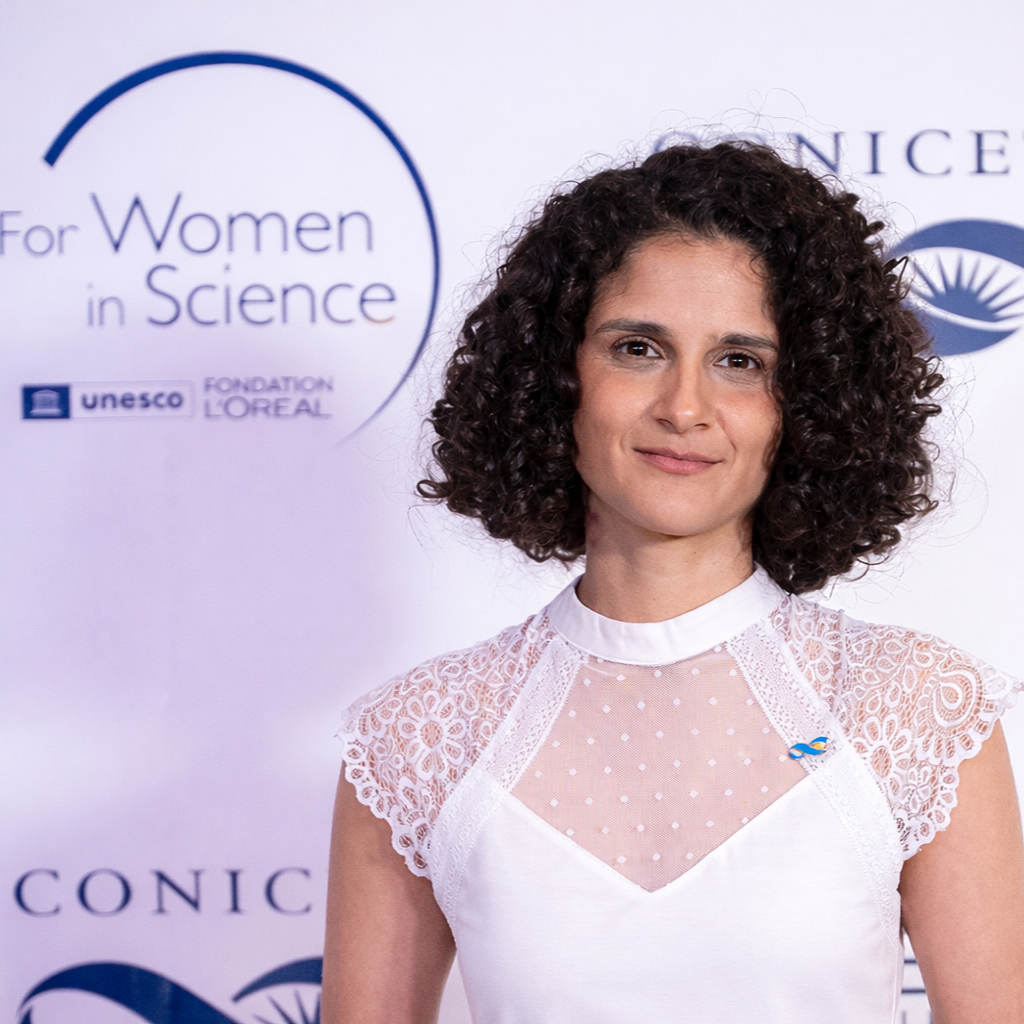
 Dr Mehrnoosh Arrar is an assistant researcher at the National Scientific and Technical Research Council (CONICET) at the Institute of Calculus at the University of Buenos Aires (UBA). She was born in the United States, where she completed her education, which includes a bachelor’s degree in chemistry from the University of Florida and a PhD in chemistry from the University of California, San Diego. She is currently working in Argentina, developing her line of research focused on molecular modelling of the NS3 helicase of dengue for the design of antivirals, which earned her the L’Oréal-UNESCO for Women in Science Award (Argentina, 2025).
What initially motivated you to pursue science, and how did that interest evolve into the study of the dengue virus?
Since I was a child, I have wanted to be a paediatrician. I began studying chemistry in the pre-medical track at the University of Florida in the United States, and I attended a seminar in which Professor Adrian Roitberg talked about his computational research group and its biomedical projects. I was captivated by his enthusiasm and interdisciplinary methodology. I approached him to ask if I could join his group. From that experience, I began to learn about the world of academic research and to identify more as a future scientist than a future doctor. I continued to deepen my knowledge of computational chemistry during my PhD, always with a particular interest in applications with biomedical relevance. I began researching the molecular mechanisms of the dengue virus during my postdoctoral studies in Argentina and decided to apply for the CONICET Research Career in this line of research because I find it very enriching to be able to collaborate with local leaders in the field.
You were born and spent part of your career in the United States, and you are currently conducting research in Argentina. What differences and challenges did you encounter when you joined the Latin American scientific system, and what aspects of this context do you find most enriching?
The main challenge and difference I encountered when I joined the Latin American scientific system was clearly the funding available for research projects. As a postdoctoral fellow at the National Science Foundation, I was able to access a grant of US$30,000. Later, as a research assistant at CONICET, I was able to receive a grant of approximately $1,000. Doing science from Argentina, therefore, requires international collaborations and grants. While this implies a highly competitive system, I also believe that it has resulted in a great deal of creativity and solidarity among research groups. I find this creative and collaborative way of working very enriching.
Your team is researching the replication mechanisms of the dengue virus. What are your current objectives in this line of work?
We are currently seeking to interpret allosteric phenomena of the dengue virus helicase in terms of its dynamics in order to innovate new antiviral strategies.
In your laboratory, you decided to focus on the NS3 helicase as a possible therapeutic target. What makes it such an important protein?
Non-structural protein 3 (NS3) is one of two viral enzymes encoded in the viral genome. It is an indispensable protein for viral replication and therefore represents an attractive molecular target for the development of molecules with antiviral potential. The helicase domain of NS3 in particular acts as a molecular motor, coupling the hydrolysis of nucleoside triphosphates with unidirectional locomotion on the viral genome, making it available as a template for the viral polymerase, which synthesizes the complementary strand in the process of viral genome replication.
What do you consider to be the main challenges in developing effective antivirals or vaccines against the four serotypes of the dengue virus?
From the molecular-atomic point of view of NS3, it is a major challenge to take into account the sequence differences between the four serotypes. Our hypothesis is that there are conserved mechanisms, beyond the differences in sequences, that we could seek to disrupt with the binding of a molecule and thus slow down viral replication.
What future lines of research do you plan to develop based on the current results?
The current results indicate that the viral genome—a single strand of RNA—plays an active role in modulating helicase dynamics. It will be interesting to investigate the role of the viral genome, not only as the information that enables viral protein synthesis, but also as another viral biomolecule that actively contributes to viral replication.
Based on your experience, why is it important for the region to promote its own research on dengue rather than relying on international developments?
Although dengue is a serious global public health problem, it is referred to as a neglected disease. This is because it is not a priority issue in the central countries, which are the ones that invest the most in scientific research. It is therefore essential that the region promotes its own research on this and other endemic diseases.
A key part of your work is based on computer simulations. How did you incorporate this tool into your training, and what advantages does it offer over other experimental approaches?
All my group’s work is based on computer simulations, particularly molecular dynamics simulations. I incorporated this tool into my training through my participation as an undergraduate student in a research group, through internships with other computer groups, and during my PhD. It is an interdisciplinary approach that requires some knowledge of physics, chemistry, mathematics, and statistics, which allows for the investigation of biological and physicochemical phenomena. It is complemented by various experimental techniques, and this synergy is a great advantage in my research work.
What message or advice would you like to convey to young female researchers starting their scientific careers?
Be encouraged; join a research group; establish collaborations; apply for grants/awards.
You were recently recognised with the L’Oréal-UNESCO for Women in Science Award. What did this recognition mean to you, and how did it influence your vision of the future, both personally and professionally?
In the current context of paralysis in the Argentine scientific system, this recognition gave me hope. It is a sign, a reminder that there is still interest in supporting science and recognising women scientists. And, of course, the funding provided allows us to continue and promote the research project.
Interview by Distel Matias Nicolas (Universidad Nacional de San Luis) – Immunopaedia Ambassador