


Neutrophils are best known as frontline immune cells that attack pathogens. But during early pregnancy, some maternal neutrophils appear to take on a very different role: supporting placental development.
Researchers found large numbers of neutrophils at the maternal–fetal interface, where placental cells migrate into the uterine lining and remodel maternal blood vessels (Figure 1).
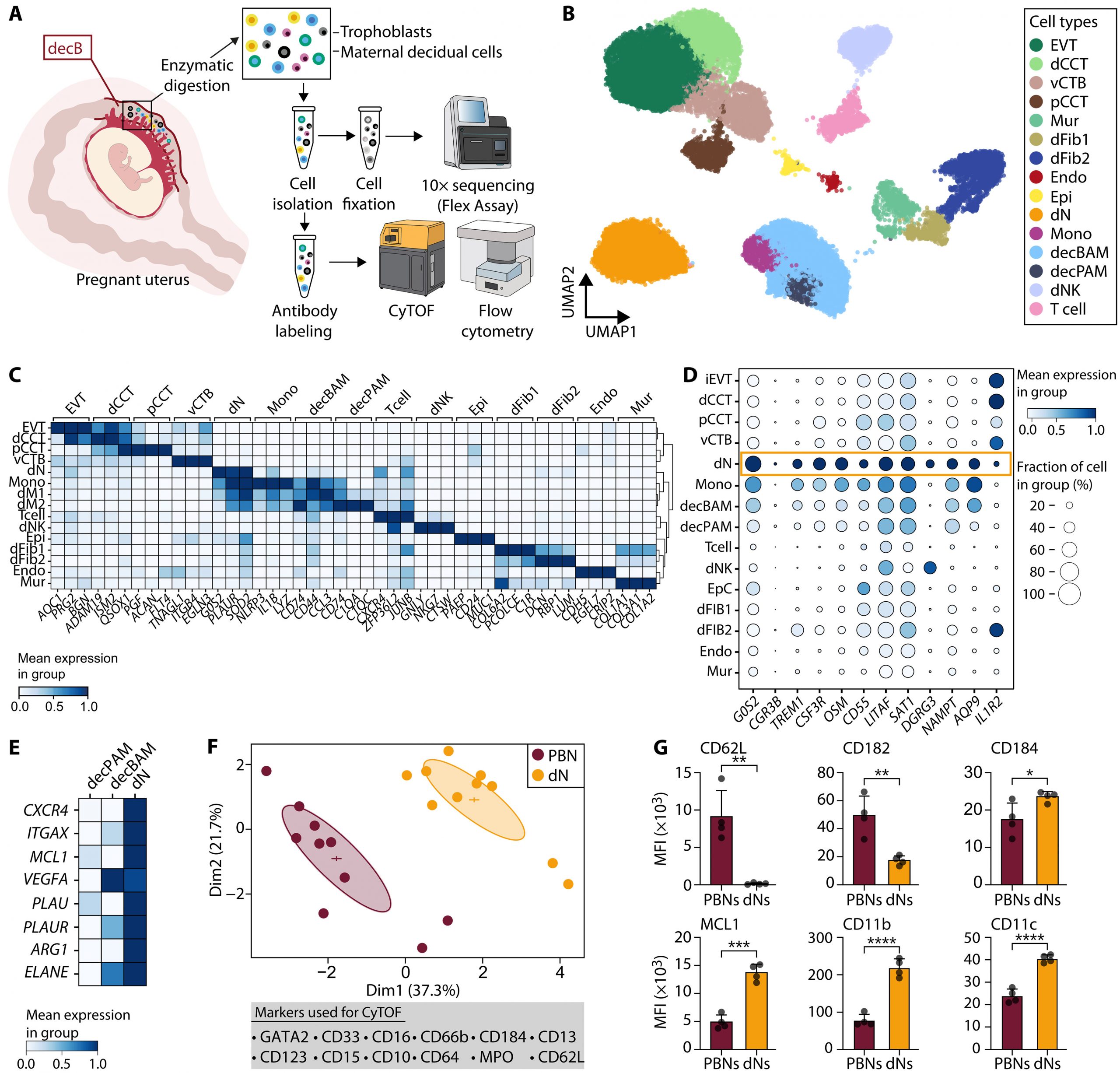
Figure 1: Neutrophils at the maternal-fetal interface display a compartment-associated phenotypic shift. (A) Workflow for scRNA-seq, CyTOF, and flow cytometry of enzymatically isolated decB cells. (B) UMAP of scRNA-seq clusters. (C) Heatmap of top marker genes per cluster. (D) Dot plot of selected neutrophil-associated marker expression across clusters. (E) Differential-expression heatmap comparing decPAMs, decBAMs, and dNs. (F) PCA of CyTOF profiles from donor-matched PBNs and dNs, with two density-separated fractions analyzed per donor (n = 5 donors; 10 observations per compartment); markers used for CyTOF are indicated below the plot. (G) Flow cytometric MFI of indicated markers in PBNs and dNs (n = 4 donors). Data are represented as means ± SD. Data were analyzed by unpaired two-tailed t test. Only statistically significant comparisons are indicated. *P ≤ 0.05, **P ≤ 0.01, ***P ≤ 0.001, and ****P ≤ 0.0001. dCCT/pCCT, distal/proximal cell column trophoblast; vCTB, villous cytotrophoblast; Mur, mural cell; dFib, decidual fibroblast; Endo, endothelial cell; Epi, epithelial cell; Mono, monocyte; dN, decidual neutrophil; PBN, peripheral blood neutrophil; dNK, decidual natural killer cell; MFI, median fluorescence intensity; UMAP, uniform manifold approximation and projection.
Rather than causing inflammation, these tissue neutrophils helped placental cells move into maternal tissue.
Neutrophils from maternal blood initially damaged placental cells in laboratory experiments. However, signals from the placental environment changed their behaviour, turning them into cells that supported placental migration instead.
One key mechanism involved MMP-9, released by tissue neutrophils, which increased placental cell motility and activated placental TGF-β. TGF-β then helped reprogram incoming neutrophils.
This reveals a fascinating two-way communication system: the placenta shapes maternal immune cells, while those immune cells help shape the developing placenta.
Neutrophils are remarkably adaptable. Their function depends on their environment, they can drive inflammation and tissue damage, or support normal tissue development and pregnancy.
Whether this neutrophil–placenta interaction is altered in pregnancy complications remains an important question for future research.
Journal article: Höbler, AL, et al. 2026. Fibrinoid-associated neutrophils promote invasive placentation and neutrophil reprogramming at the maternal-fetal interface. Science Immunology.
Summary by Stefan Botha