


CD8+ T cells are among the immune system’s most important weapons against cancer. However, within the tumour microenvironment, prolonged exposure to cancer cells can drive T-cell exhaustion, gradually reducing their ability to proliferate and kill tumour cells.
A new study published in Nature Communications identifies dual-specificity phosphatase 4 (DUSP4) as a protein that helps preserve the anti-tumour activity of CD8+ T cells, with potential implications for improving CAR-T cell therapy against solid tumours (Figure 1).
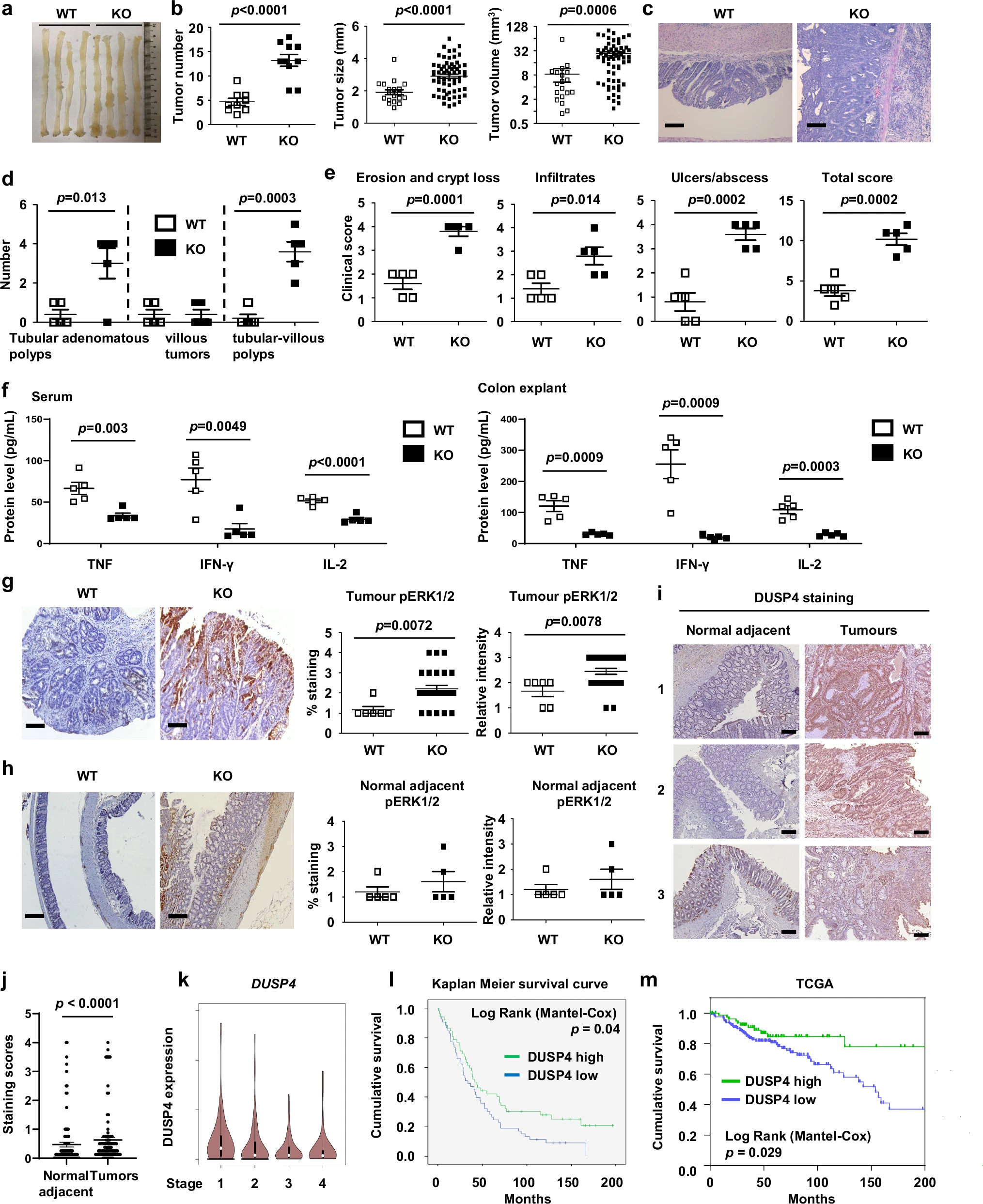
Figure 1: Deficiency of DUSP4 in mice resulted in increased colonic tumor development in AOM/DSS-induced colorectal cancer, and high DUSP4 expression in tumors was associated with better overall survival in CRC patients. a Representative photographs of the colonic tumors in wild-type (WT) and DUSP4 knockout (KO) mice upon AOM/DSS treatment for colorectal cancer (CRC) induction. b Quantification of colonic tumor number (WT n = 9 mice, KO n = 10 mice), size, and volume (WT n = 42 tumors, KO n = 132 tumors) in AOM/DSS-treated WT and DUSP4 KO mice. c Representative H&E-stained sections of colonic tissues from WT and DUSP4 KO mice. Scale bar, 100 μm. d Classification and quantification of different types of colonic tumors based on H&E staining (n = 5 mice per group). e The scatter graphs showed the clinical histological scores of crypt loss, inflammatory infiltrates, and ulceration (n = 5 mice per group). f The protein levels of TNF, IFN-γ, and IL-2 in the serum and colon explant culture supernatant from WT and DUSP4 KO mice were determined by ELISA (n = 5 mice per group). Representative micrographs showing the immunohistochemistry staining of pERK1/2 in tumor sections (g) and adjacent normal sections (h) from WT and DUSP4 KO mice (WT n = 6 tumors, KO n = 29 tumors). Scale bar, 100 μm. Representative immunohistochemistry (IHC) micrographs (i) and quantification (j) of DUSP4 expression in adjacent normal tissue and tumor sections from CRC patients (Normal adjacent samples n = 105; tumor samples n = 105). Scale bar, 200 μm. k Violin plots show comparisons of DUSP4 level in tumors from patients across different CRC stages. The embedded box plot showing the median and interquartile range was performed using GEPIA2. l Kaplan-Meier survival rate and log-rank (Mantel-Cox) test showing the overall survival of CRC patients stratified by low or high DUSP4 expression in tumor cells. (Normal adjacent samples n = 105; tumor samples n = 105). m Survival analysis over 200 months was performed on CRC patients with high or low expression of DUSP4 using data from the TCGA database. Data are presented as mean ± SEM. Two-tailed unpaired Student’s t-test was used in the comparisons. A p-value < 0.05 was considered to be statistically significant. Source data are provided as a Source data file.
Researchers found that loss of DUSP4 was associated with:
- Weaker CD8+ T-cell responses and reduced production of cancer-killing molecules.
- Increased markers of T-cell exhaustion.
- Greater colorectal tumour burden in preclinical models.
Analysis of tumour samples from 105 colorectal cancer patients also showed that lower DUSP4 levels were associated with poorer overall survival.
The researchers identified a signalling mechanism involving the ERK2–KLF2 pathway. Without sufficient DUSP4, increased ERK2 activity raises KLF2 levels, suppressing gene programmes that support CD8+ T-cell anti-tumour activity. DUSP4 therefore appears to help maintain the functional state of these cancer-fighting cells.
The team used CRISPR activation (CRISPRa) to increase DUSP4 expression in human CAR-T cells. In experimental models, DUSP4-enhanced CAR-T cells showed improved proliferation and tumour-killing activity, resulting in smaller tumours than those treated with standard CAR-T cells.
T-cell exhaustion remains a major barrier to effective immunotherapy, particularly in solid tumours. Identifying mechanisms that preserve T-cell function could offer new strategies for engineering more effective cell therapies.
However, an important caveat: these CAR-T findings remain preclinical. The experimental colorectal cancer cells were engineered to express CD19, the target recognised by the CAR-T cells, so further work is needed to establish whether this strategy can improve tumour-specific CAR-T therapy in patients.
Journal article: Li, H., et al. 2026. DUSP4 promotes anti-tumor CD8+ T cell function and boosts CAR-T cell efficacy in mouse colorectal cancer. Nature Communications.
Summary by Stefan Botha