

Researchers have demonstrated that a specialised type of humanised mouse can mount human-like immune responses against therapeutic proteins, potentially providing a more useful model for predicting drug immunogenicity during the development of biologics and biosimilars (Figure 1).
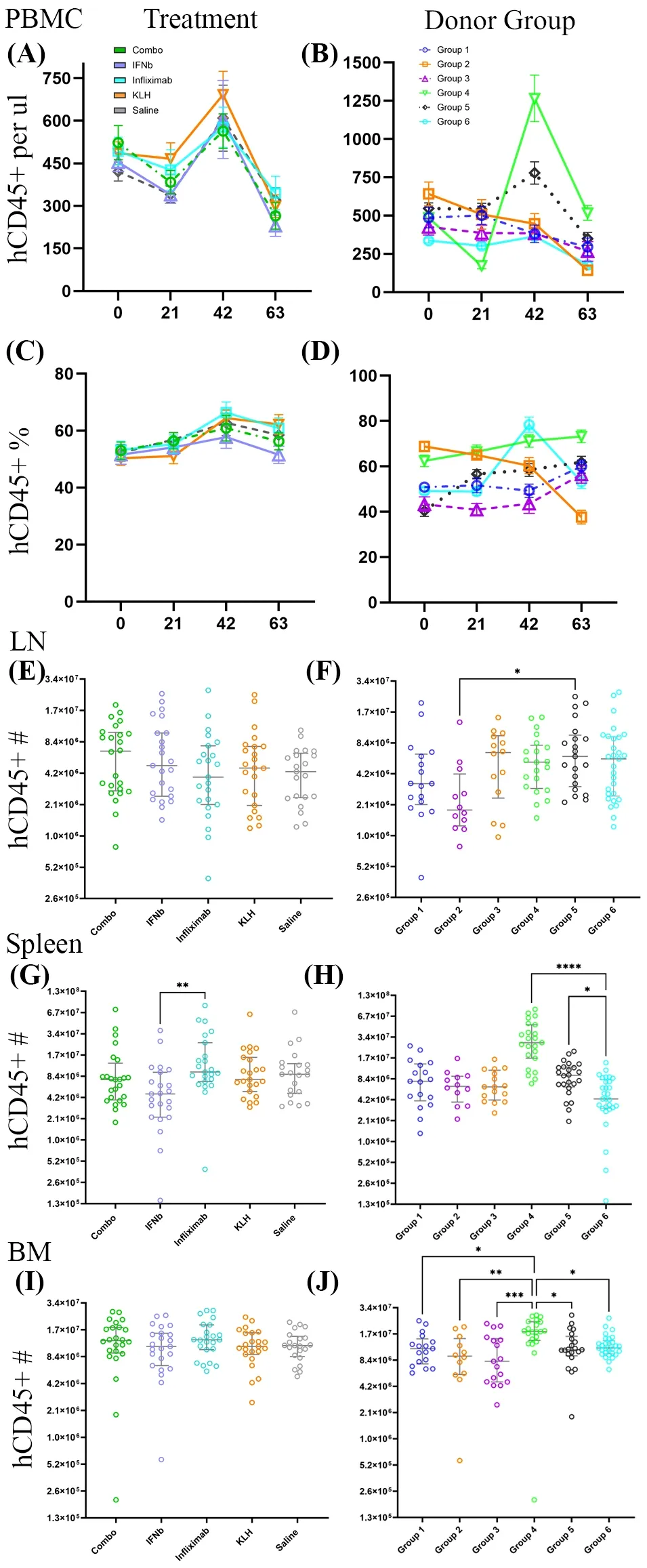
Figure 1: Quantification of human CD45+ leukocyte reconstitution in NeoThy immune-humanized mice. PBMCs are shown by treatment (A, C) and donor (B, D) based on cells per μL blood (A, B) and percentage (C, D) of human CD45+ cells. Absolute cell yields of human CD45+ cells in lymph nodes (E, F), spleen (G, H), and bone marrow (I, J) at necropsy are presented by treatment group and donor, respectively. Treatment groups (left column) are noted as green (combo), purple (IFN-β), light blue (infliximab), orange (KLH), and gray (saline). Donor groups (right column) are noted as blue (donor 1), orange (donor 2), purple (donor 3), green (donor 4), black (donor 5), and light blue (donor 6). Data points represent individual group means for PBMC and individual mice for LN, SP, and BM. Total n for treatment groups at necropsy (combo, infliximab, IFNβ, KLH, and saline were 24, 23, 23, 21, and 21, respectively). Total n for donor groups 1–6 at necropsy were 17, 12, 14, 21, 21, and 27. Statistics were calculated using a two-way ANOVA with Tukey’s multiple comparisons post-test for PBMC and Kruskal–Wallis ANOVA with Dunn’s multiple comparisons post-test for tissues. Mean values ± SEM are shown for PBMC, with box and whisker plots showing the median and interquartile range for tissues. Statistical differences are shown with an asterisk if p < 0.05. PBMC, peripheral blood mononuclear cell; LN, lymph node; SP, spleen; BM, bone marrow; KLH, keyhole limpet hemocyanin.
The proof-of-concept study, published in Frontiers in Immunology, used NeoThy™ immune-humanized mice to test two biological drugs known to trigger anti-drug antibodies (ADAs) in some patients: infliximab, an anti-TNF monoclonal antibody, and interferon-β-1b, used to treat multiple sclerosis.
Biological medicines, including monoclonal antibodies and therapeutic proteins, can be recognised as foreign by the immune system. This can lead to the production of anti-drug antibodies, which may bind to the drug, alter its clearance or, in some cases, interfere with its therapeutic activity.
Predicting these responses before a drug reaches patients remains challenging. Conventional animal models are often poorly suited to the task because human therapeutic proteins can themselves appear foreign to the animals, producing immune responses that do not accurately reflect what happens in humans.
Even non-human primates have not consistently provided reliable predictions of clinical immunogenicity.
To address this problem, the researchers used NeoThy immune-humanized mice, which are generated using human thymic tissue together with human haematopoietic stem cells.
The human thymus is particularly important because it provides the environment required for appropriate T-cell development and selection. This allows the mice to develop a more complete human immune system capable of distinguishing human proteins from foreign antigens.
The researchers generated humanized mice using tissue from different donors and treated them with infliximab, interferon-β-1b, or both drugs together. Blood samples were collected
The mice developed substantial human immune-cell populations, although the extent of immune reconstitution varied between donors.
Importantly, the researchers observed activation of adaptive immunity, including B-cell proliferation and antibody class switching. Many animals produced different IgG subclasses, indicating that their B cells were capable of undergoing the maturation processes normally required for effective antibody responses.
In several mice, human immunoglobulin concentrations approached or even exceeded those measured in normal human serum.
The researchers also detected anti-drug antibodies. Antibodies targeting interferon-β were detected in several animals, while some mice produced neutralizing antibodies against infliximab. The responses varied according to both the human donor used to generate the mice and the treatment they received.
The ability to generate antigen-specific, class-switched antibody responses is an important advance because this has been a limitation of several previous humanized mouse models.
The findings suggest that NeoThy mice could potentially be used to identify immunogenicity risks earlier in biological drug development, helping researchers compare candidate therapies, investigate biosimilars and assess potential immune safety concerns before clinical testing.
However, the study is an early proof of concept. The donor-dependent differences observed in the mice highlight the complexity of modelling human immune responses, and larger studies will be needed to determine how closely the responses predict those seen in patients.
If validated, humanized models such as NeoThy could complement, not necessarily replace, clinical immunogenicity assessments and provide researchers with a more biologically relevant platform for studying how patients may respond to therapeutic proteins.
Journal article: Gharaie, S, et al., 2026. Study evaluating NeoThy™ immune-humanized mice as a model for assessing immunogenicity and anti-drug antibody responses to biological therapeutics. Frontiers in Immunology.
Summary by Stefan Botha