


Type 1 diabetes (T1D) has been associated with a reduced risk of certain cancers, including melanoma, breast and colorectal cancer. But what could explain this connection?
New research suggests that hyperglycaemia can metabolically reprogramme CD8⁺ T cells, enhancing their ability to control tumour growth in preclinical models (Figure 1). Researchers compared tumour growth in hyperglycaemic mice, insulin-treated diabetic mice and mice with normal blood glucose levels.
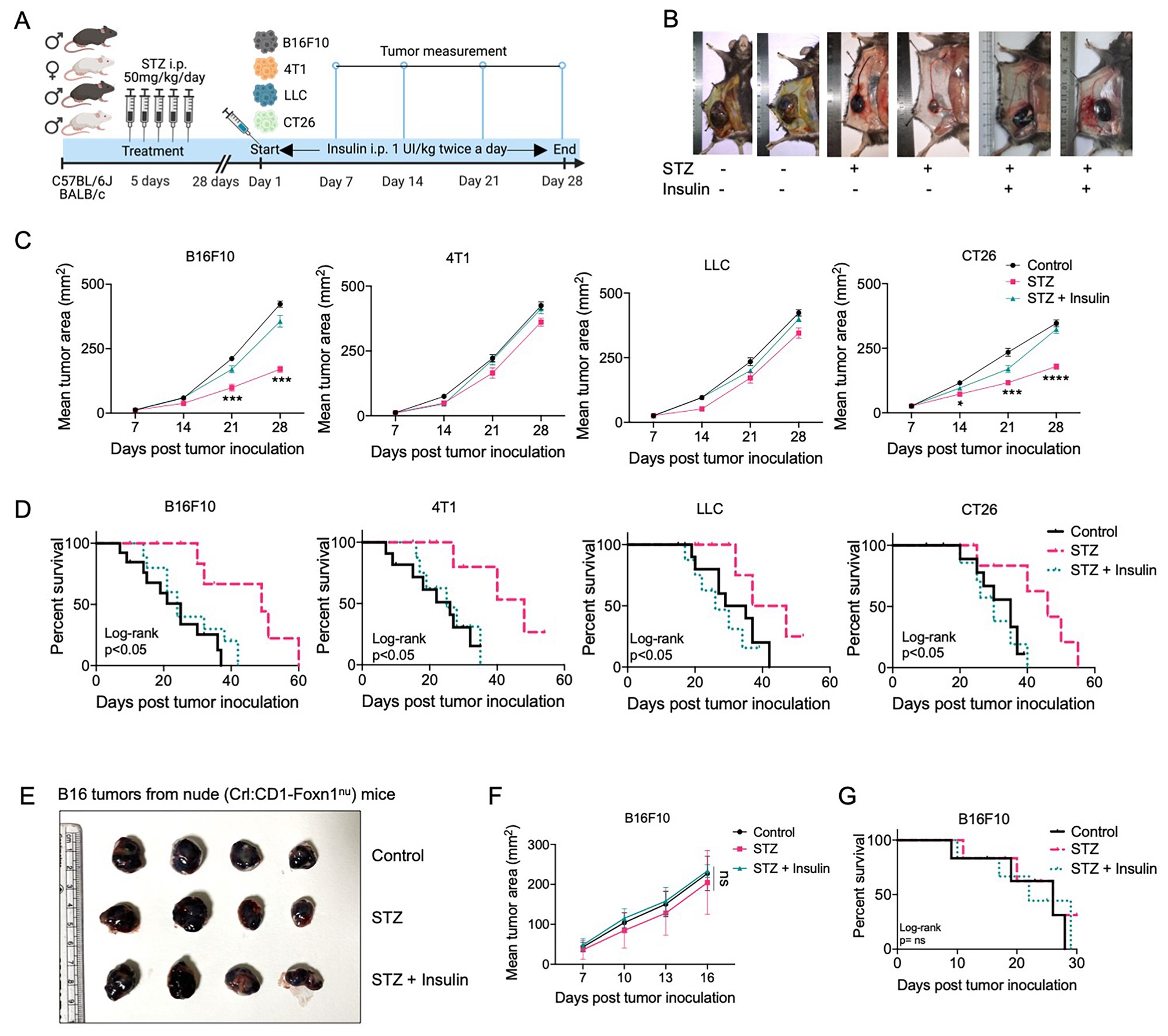
Figure 1: High blood glucose is associated with reduced growth of transplantable tumors, resulting in extended overall survival. (A) Schematic representation of experimental design. Three hosts were investigated: untreated or control, STZ treated, and STZ+insulin treated (n = 6, 4- to 6-wk-old male or female C57BL/6J or BALB/c mice/cohort). STZ was administered intraperitoneally for 5 consecutive days, and animals then were left untreated for 28 d to allow for hyperglycemia to develop. On day 1, each of the 3 host groups were injected with tumors (subcutaneous B16F10 melanoma cells or LLC lung carcinoma cells in male C57BL/6 mice, or 4T1 breast carcinoma cells into the mammary fat pad in female BALB/c mice or subcutaneous CT-26 colon carcinoma cells in female BALB/c mice). Insulin was then administered intraperitoneally to the STZ+insulin host groups twice a day throughout the course of the experiments. (B) Representative photographs of B16F10 tumor-bearing C57BL/6J mice with scale rulers collected at the end of the experiment (day 28). (C) Mean tumor area (mm2) of B16F10, 4T1, LLC, and CT26 tumor-bearing mice with control, STZ-treated, and STZ+insulin-treated (n = 6) groups. Tumor areas were determined in each model on days 7, 14, 21, and 28. (D) Kaplan-Meier survival curve of B16F10, 4T1, LLC, and CT26 tumor-bearing mice (n = 10) in control, STZ-induced hyperglycemia, and STZ+insulin-treated hosts. Survival curves were plotted and intergroup differences analyzed using a log-rank test. (E) Representative photographs (with scale rulers) of B16F10 tumors harvested from untreated, STZ-treated and STZ+insulin-treated (n = 6, 4–6 wk old, male) nude (Crl:CD1-Foxn1nu) mice (day 16). The nude mice are deficient for T cell numbers and function due to genetic modifications on Cd-1 Foxn-1 genes, respectively. (F) Mean B16F10 tumor area (mm2) in nude mice (n = 6) on days 7, 10, 13, and 16. (G) Kaplan-Meier survival curve of B16F10 melanoma-bearing nude mice with intergroup differences analyzed using a log rank test. Kruskal-Wallis test followed by Dunn’s multiple comparisons test was performed for panel C and F. ***P ≤ 0.001, ****P ≤ 0.0001. i.p., intraperitoneal; ns, not significant.
Tumours grew more slowly in hyperglycaemic mice. These animals also had more T cells, with enhanced tumour-fighting activity. Interestingly, insulin-mediated glucose control was associated with a loss of this heightened antitumour activity, suggesting that glucose availability may influence T-cell function.
The researchers identified increased activity of the IGF1–IGF1R signalling axis in CD8⁺ T cells from hyperglycaemic mice.
This pathway was implicated in the metabolic reprogramming associated with improved tumour control, pointing towards a potential mechanism through which glucose dysregulation alters antitumour immunity.
Importantly, the team also observed increased activity of the same signalling pathway in immune cells from blood samples of people with hyperglycaemia, providing a potential translational link.
Rather than reproducing hyperglycaemia itself, researchers hope to understand whether the beneficial T-cell signalling changes can be selectively mimicked to enhance antitumour immunity. This could offer new avenues for developing T-cell-based cancer immunotherapies.
These findings primarily come from mouse models. The human observations support the relevance of the signalling pathway but do not establish improved cancer outcomes in people with hyperglycaemia or T1D. Hyperglycaemia is associated with serious health complications and is not a cancer prevention or treatment strategy.
This research highlights the complex relationship between metabolism and immune function. Understanding how metabolic signals shape CD8⁺ T-cell activity could reveal new therapeutic opportunities, without reproducing the harmful effects of uncontrolled blood glucose.
Journal article: Sarkar A, et al. 2026. Experimental high blood glucose metabolically rejuvenates CD8+ T cells for improved control of tumor growth through an IGF1-IGF1R axis. The Journal of Immunology.
Summary by Stefan Botha