


Immune checkpoint inhibitors (ICIs) have transformed cancer treatment, but treatment-associated complications, including wasting-related conditions such as sarcopenia, cachexia and malnutrition, remain important clinical challenges.
New research suggests that GLP-1 receptor agonists (GLP-1 RAs), commonly used for weight management, may be associated with improved outcomes in patients with overweight or obesity starting ICI therapy.
Using US TriNetX health records, researchers conducted a target-trial emulation involving adults with cancer and overweight or obesity who initiated ICI treatment, excluding patients with recent diabetes (Figure 1).
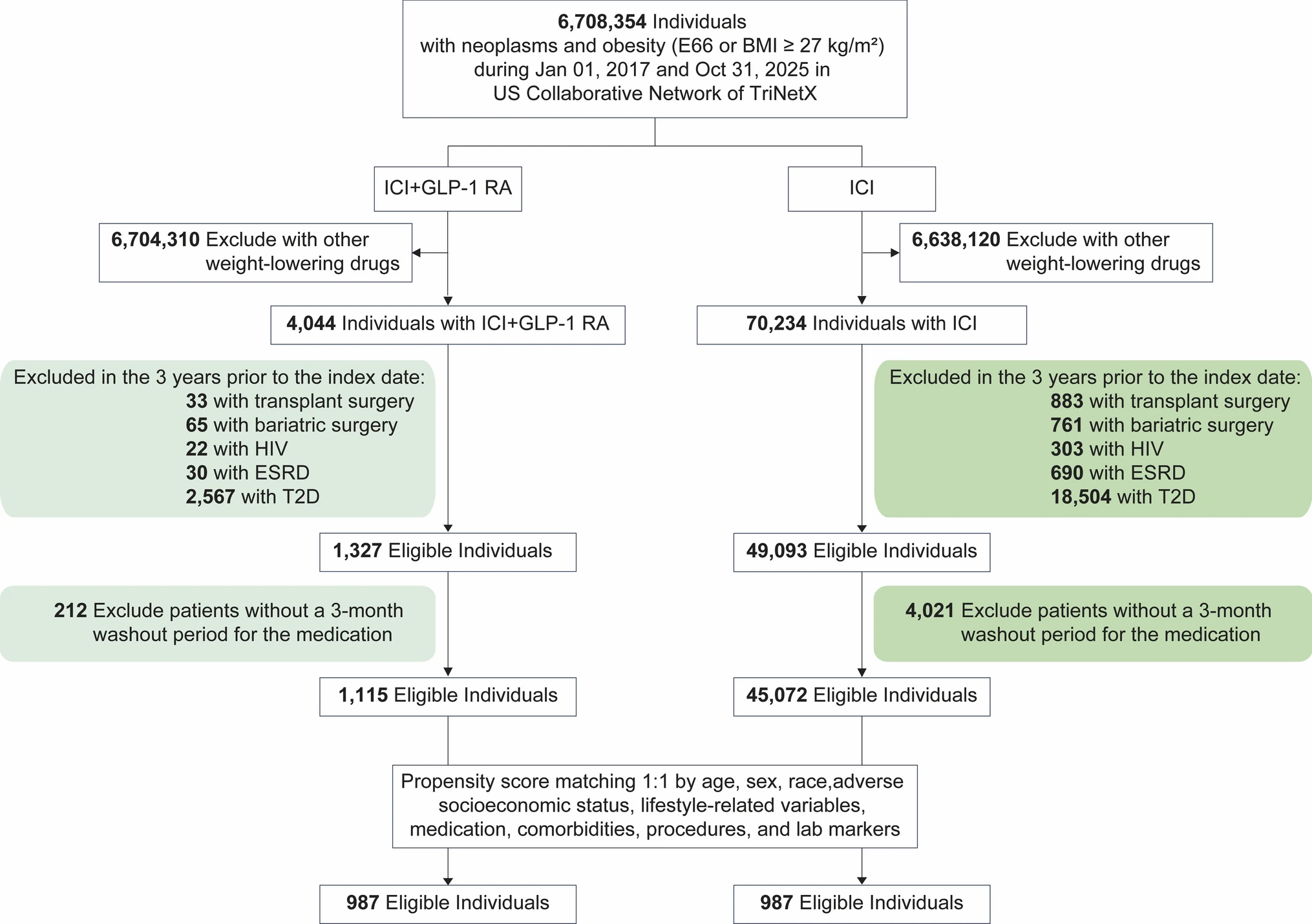
Figure 1: Flowchart and target-trial emulation design. Exposure was defined as a GLP-1 RA prescription or administration within a prespecified 30-day peri-initiation window before or after ICI initiation.
Following propensity score matching, 1,974 patients were analysed, comparing those with GLP-1 RA exposure around ICI initiation with those without.
Over 36 months, GLP-1 RA exposure was associated with:
- 37% lower relative hazard of recorded wasting-related diagnoses and immune-related adverse events (HR 0.63, 95% CI 0.50–0.79).
- 33% lower hazard of hospitalisation (HR 0.67).
- 31% lower hazard of ICU admission (HR 0.69).
- 32% lower hazard of emergency department visits (HR 0.68).
These findings raise the possibility that metabolic interventions could have a role in supportive care for patients receiving cancer immunotherapy.
However, GLP-1 RAs are also associated with weight loss, making their potential use particularly complex in patients already vulnerable to malnutrition, sarcopenia or cancer-associated cachexia.
This was an observational study using target-trial emulation, not a randomised clinical trial. The findings demonstrate associations, not causation. The reported outcomes also depend on recorded clinical diagnoses, and the results do not establish that GLP-1 RAs directly prevent muscle wasting or improve antitumour immunity.
The authors also caution that the exploratory association with reduced all-cause mortality may reflect channelling bias rather than a treatment effect.
As immunotherapy becomes increasingly central to cancer care, understanding how metabolic health influences treatment tolerance and clinical outcomes is an important research priority.
Prospective studies are needed to establish whether GLP-1 RAs offer meaningful supportive-care benefits, and for which patients their potential benefits outweigh the risks.
Journal article: Lin, YJ, et al. 2026. GLP-1 receptor agonists at immune checkpoint inhibitor initiation with immune-related and supportive-care outcomes in patients with cancer and overweight or obesity without diabetes: a target trial emulation. Cancer, Immunology, Immunotherapy.
Summary by Stefan Botha