


What if we could turn a patient’s own immune cells into therapeutic agents – without first removing them, engineering them in the laboratory, and reinfusing them?
In vivo cell engineering aims to do exactly that. By delivering genetic instructions directly to selected immune cells using platforms such as lipid nanoparticles or viral vectors, researchers are exploring a potentially faster and more scalable alternative to conventional ex vivo cell therapies (Figure 1).
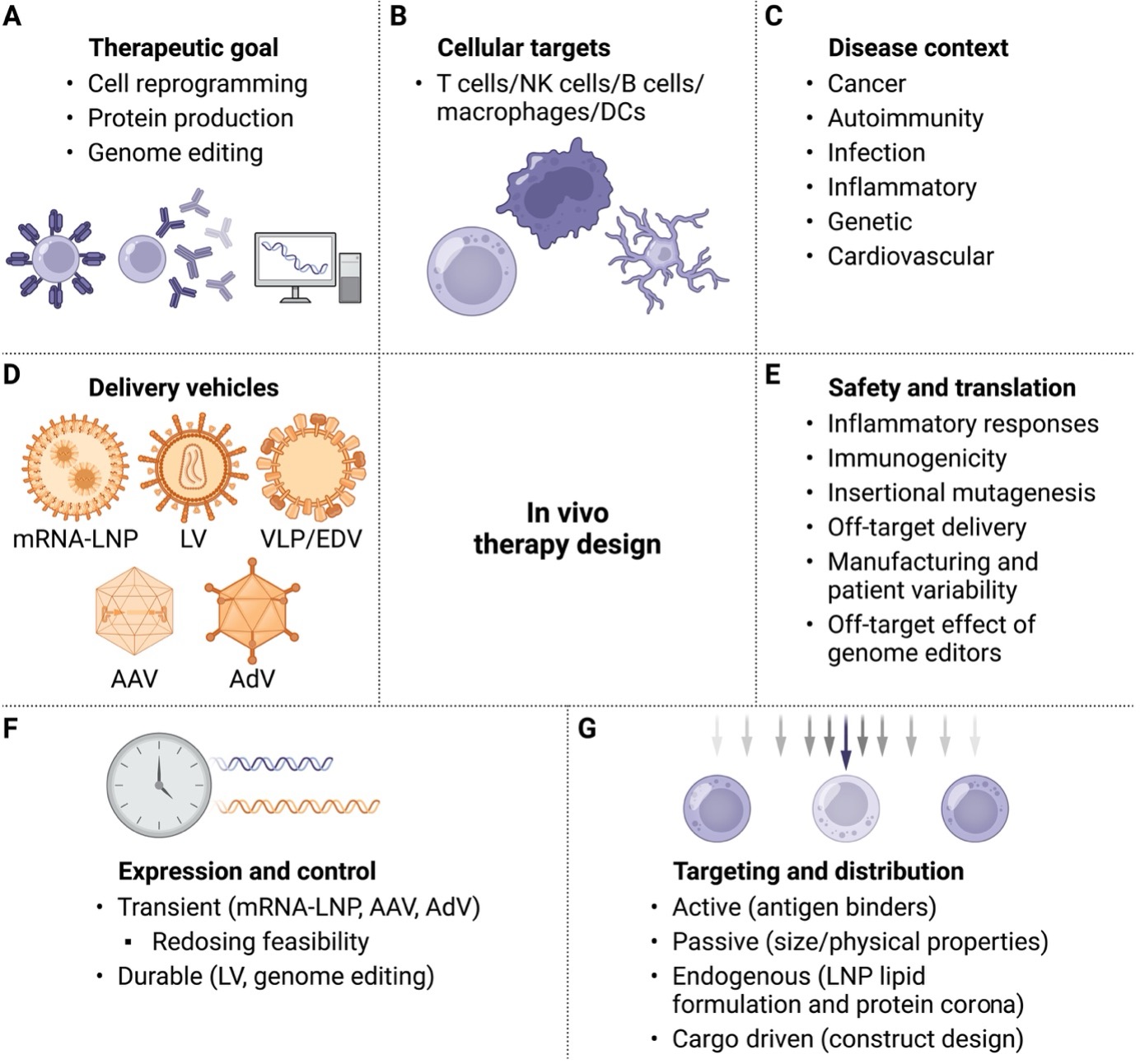
Figure 1: Navigating the new frontier of in vivo cell engineering. Schematic overview of the major parameters that must be integrated when designing an in vivo therapy. (A) Therapeutic goal: the intended molecular outcome of engineering. (B) Cellular targets: the immune cell types addressable in vivo. (C) Disease context: the clinical indications motivating vehicle and construct choice. (D) Delivery vehicles: the panel of vector platforms available for in vivo administration, including mRNA-LNPs, VLP/EDVs, LVs, AAVs, and AdVs. (E) Safety and translation: key risk factors that must be assessed during preclinical and clinical development. (F) Expression and control: the durability of transgene expression, ranging from transient expression (achieved with mRNA-LNP, AAV, or AdV platforms, with redosing feasibility as a key consideration) to durable/permanent modification (achieved with LV or genome editing). (G) Targeting and distribution: mechanisms governing vehicle biodistribution and cell selectivity. [(A) to (G)] Together, these interconnected considerations define the design space for engineering therapeutic cells directly in the patient.
CAR T-cell therapies have transformed treatment for certain blood cancers and are showing promise in autoimmune diseases. However, conventional approaches involve complex, expensive manufacturing, specialised facilities, and weeks of cell processing.
In vivo engineering could potentially simplify this process by programming immune cells directly within the patient.
The key is precision. Delivery systems must reach the intended cell type and tissue, deliver the correct genetic payload, and generate the desired duration of activity. Researchers are investigating targeting ligands, improved vector design, biodistribution control, and genome-editing technologies to address these barriers.
Safety remains equally important, particularly the risks of immunogenicity, inflammatory toxicity, off-target genetic modification, and uncontrolled persistence of engineered cells.
Early clinical studies in oncology and autoimmune disease are encouraging, but substantial challenges remain before this approach can become widely available.
In vivo cell engineering could expand the reach of cell-based therapies by transforming endogenous immune cells into therapeutic tools directly inside the body. The challenge now is to make that process precise, controllable, and safe.
Journal article: Mietz, J., et al. 2026. Programming immunity in situ: A new frontier of in vivo cell engineering. Science Immunology.
Summary by Stefan Botha