


Antiretroviral therapy (ART) effectively suppresses HIV replication, but it cannot eliminate viral DNA integrated into the genomes of infected cells. New research reveals how even defective HIV proviruses may actively reshape immune cell biology, potentially helping infected cells survive and persist for years (Figure 1).
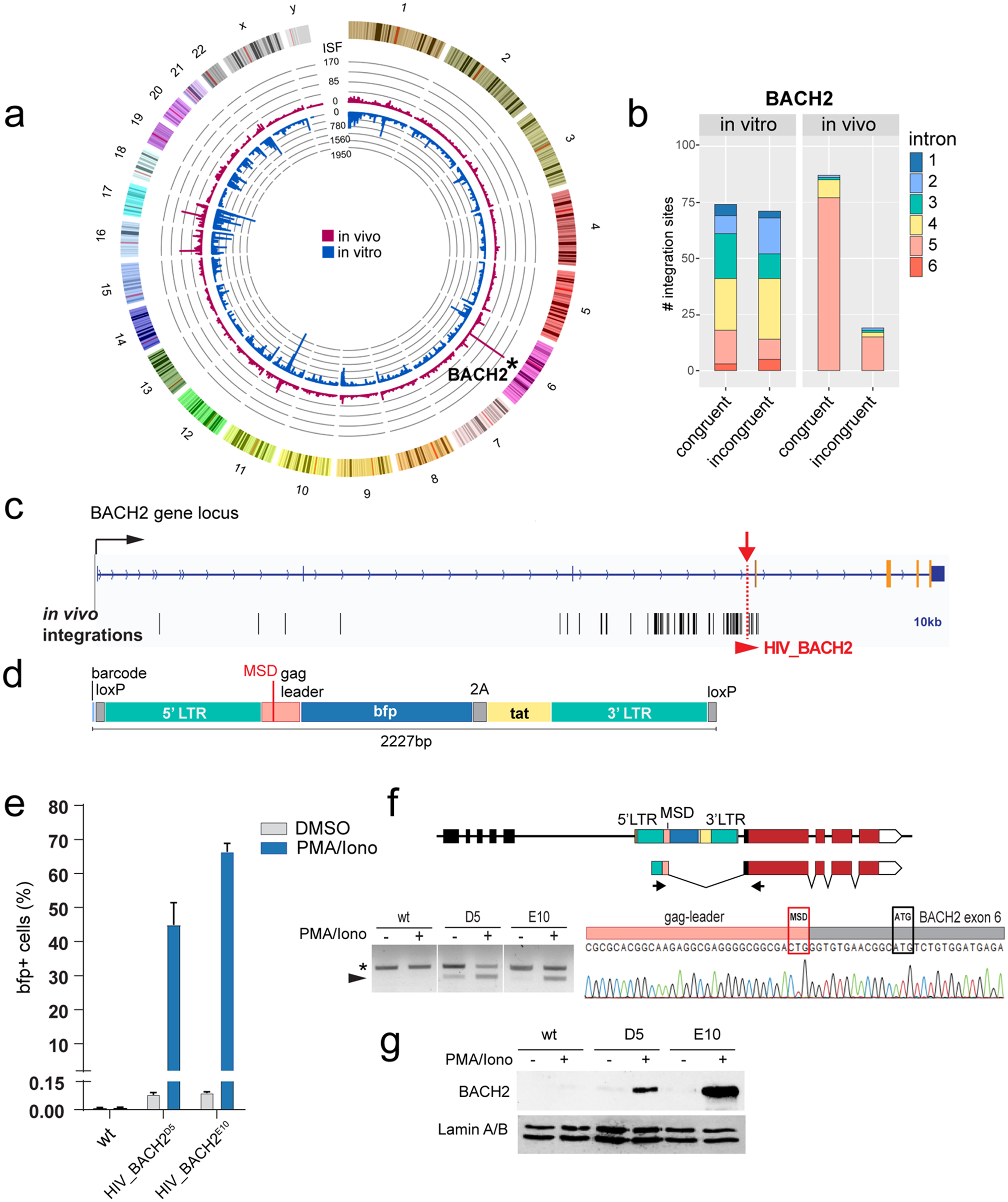
Figure 1: HIV_BACH2 cells model LTR-driven insertional activation of the BACH2 RdIG. (a) Circos plot depicting the genome-wide frequency of proviral integrations per gene locus in PLWH on ART (in vivo) vs HIV-1 infection of CD4 + T cells in vitro. Data on proviral integration sites was extracted from the Retrovirus Integration Database 45. Asterisk marks the BACH2 gene locus. ISF: integration site frequency. (b) Frequency of in vivo and in vitro provirus integration sites in the BACH2 gene locus stratified by intron and transcriptional orientation of the provirus in context of the BACH2 gene (congruent, incongruent). (c) Schematic of the BACH2 gene locus. Black bars indicate mapped provirus integrations in PBMCs of PLWH on ART. The site of targeted integration of the HIV-1 reporter (LTRbfp2Atat) 3710 bp upstream of BACH2 ATG within intron 5 is marked (red arrow). (d) Schematic of the LTRbfp2Atat reporter that was targeted into the BACH2 locus to generate HIV_BACH2 cell line models (E10 and D5 clones). (e) Percentage of bfp positive HIV_BACH2 cells (E10 and D5 clonal lines) upon exposure to PMA/Ionomycin or DMSO control. Untargeted wild-type parental cells (wt) were used as controls. (f) Detection of LTR/BACH2 chimeric transcripts in HIV_BACH2 cell models (E10 and D5 clonal lines) and untargeted wt cells by non-quantitative RT-PCR. Schematic indicates aberrant splicing from reporter-inherent HIV-1 major splice donor (MSD) site to acceptor site of BACH2 exon 6. Protein-coding sequence of BACH2 is indicated in red. Arrows indicate position of primers used for PCR amplification of chimeric transcripts (arrowhead). Asterisk denotes unspecific PCR product. (g) Western blot analysis of HIV_BACH2D5/E10 cells for expression of BACH2 protein. Anti-Lamin A/B antibody was used for blotting and loading control.
https://doi.org/10.1371/journal.ppat.1014618.g001
The team investigated HIV integration into BACH2, a key regulator of immune cell development and function and a recognised integration hotspot in people living with HIV.
Using CRISPR-Cas9, researchers recreated an HIV integration site within BACH2 in CD4 T-like cells and examined its effects.
They found that transcriptional activity from the integrated HIV sequence disrupted normal BACH2 regulation, maintaining elevated BACH2 protein levels and triggering widespread changes in gene expression.
In affected cells, researchers observed:
- Reduced immune activation and inflammatory gene expression, suggesting altered immune responsiveness.
- Increased expression of genes associated with T cell survival and longevity.
- Enhanced cellular proliferation, potentially favouring the expansion of HIV-infected cell clones.
- An altered immune profile resembling that previously observed in expanded HIV-infected cell clones.
The researchers also identified signs that these cells may suppress innate mechanisms involved in controlling the HIV reservoir.
Together, these findings suggest that defective, transcriptionally active proviruses can do more than persist passively: they may actively promote the survival and expansion of the cells carrying them.
Reducing transcriptional activity of the integrated HIV sequence diminished the associated cellular changes.
This supports further investigation of “block and lock” approaches, which aim to durably silence HIV proviruses and potentially limit their immunomodulatory effects.
However, these findings do not yet demonstrate that silencing defective proviruses can eliminate the HIV reservoir or achieve a cure.
HIV persistence is not simply a consequence of viral latency. The interaction between proviral integration, host gene regulation and immune cell survival may also shape the long-term reservoir.
Understanding these mechanisms could reveal new vulnerabilities in the infected cell populations that sustain HIV despite effective ART.
Journal article: Hamann, M.V., et al. 2026. Selective persistence of HIV-1-infected T cell clones can occur through immune reprogramming driven by defective, transcriptionally active proviruses. Plos Pathogens.
Summary by Stefan Botha