


Preterm birth remains the leading cause of death in children under five, yet its causes are poorly understood. A new study in Nature Immunology profiled antibodies in more than 2,000 pregnancies and found a distinct autoreactive signature months before early delivery. Within it, antibodies against an anti-inflammatory protein caused placental damage in mice.
Pregnancy rewrites the antibody repertoire
The team used PhIP-seq, a phage display method that screens serum against the entire human proteome at once. They analysed 3,101 serum samples from 2,195 pregnancies across eight cohorts in three countries.
First, they compared pregnant women with never-pregnant controls. A classifier built on 3,096 peptides separated the two groups with an AUC of 0.93. Pregnancy itself, therefore, elicits a broad and shared programme of autoreactivity. Reassuringly, the signature recovered reactivities already known in pregnancy, including those against histocompatibility molecules and sperm antigens. A broader signature before preterm delivery
A broader signature before preterm delivery
Next, the researchers compared preterm and term pregnancies. Preterm sera carried far more reactivities, and this held a cross all eight cohorts (Figure 1).
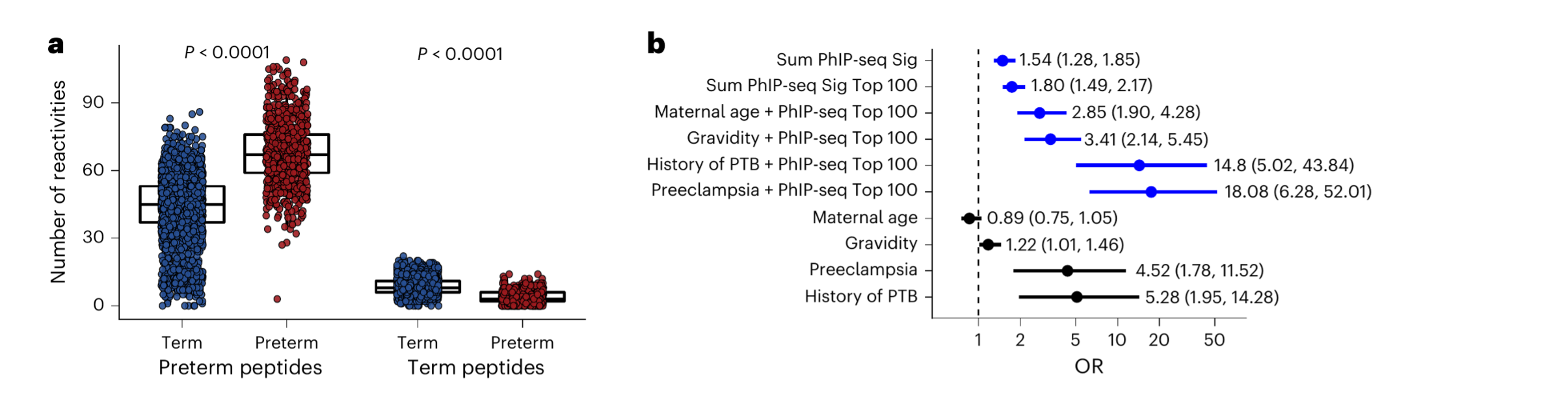
Figure 1: The preterm autoantibody signature. a, Number of preterm- and term-specific autoantibody reactivities per individual in term (blue) and preterm (red) pregnancies across all cohorts. Each point represents one individual. b, Odds ratios for preterm birth from the antibody signature, from established clinical risk factors, and from both combined. The vertical dashed line marks no effect (OR 1). Reproduced from Rackaityte et al., 2026, Nature Immunology (CC BY 4.0).
Importantly, these antibodies appeared on average 12 weeks before delivery, suggesting that they precede labour rather than result from it. The signature also scaled with severity: the earlier the delivery, the stronger the signal.
A model trained on these features and tested on 466 held-out samples forecast preterm delivery with an AUC of 0.76, and still worked on first-trimester samples.
One antibody with a plausible mechanism
IL-1β is a well-established driver of labour, while IL1RA is its natural brake. Among the targets, the authors found antibodies against IL1RA.
Crucially, sera from anti-IL1RA-positive women neutralised IL1RA in a reporter assay, releasing the brake on IL-1β signalling. In pregnant mice, anti-IL1RA antibodies raised maternal IL-1β, increased fetal resorption and caused placental malperfusion, vessel constriction and immune infiltration. In human placenta, IL1RA localised to endothelial cell junctions, and patient sera blocked it there.
The fine print
Prevalence varied widely by assay, from 0.4% to 16%, so anti-IL1RA explains only a fraction of preterm births. The mouse work used a commercial antibody rather than patient sera, and measured placental injury rather than early delivery. Finally, the predictive model was validated within the same cohorts, not in an external one.
Looking ahead
Nevertheless, this work reframes preterm birth as a condition with measurable immunological antecedents. Because recombinant IL1RA (anakinra) is already in clinical use, the authors suggest it merits evaluation in pregnancies stratified by antibody status.
Future studies should also clarify whether these reactivities reflect failed tolerance to self or alloimmune responses to paternal antigens.
Journal article: Rackaityte, E., et al., 2026. Evidence for maternal autoantibodies in the pathogenesis of preterm birth. Nature Immunology.
Summary by Ignacio Mazzitelli