


Successfully treating tuberculosis (TB) does not always mean the infection is gone for good. Preventing relapse remains a major global health challenge, and new research suggests that targeting B cells could help strengthen long-term immune control.
A recent preclinical study found that combining the BCG vaccine with A proliferation-inducing ligand (APRIL) immunotherapy substantially reduced TB relapse in mice (Figure 1).
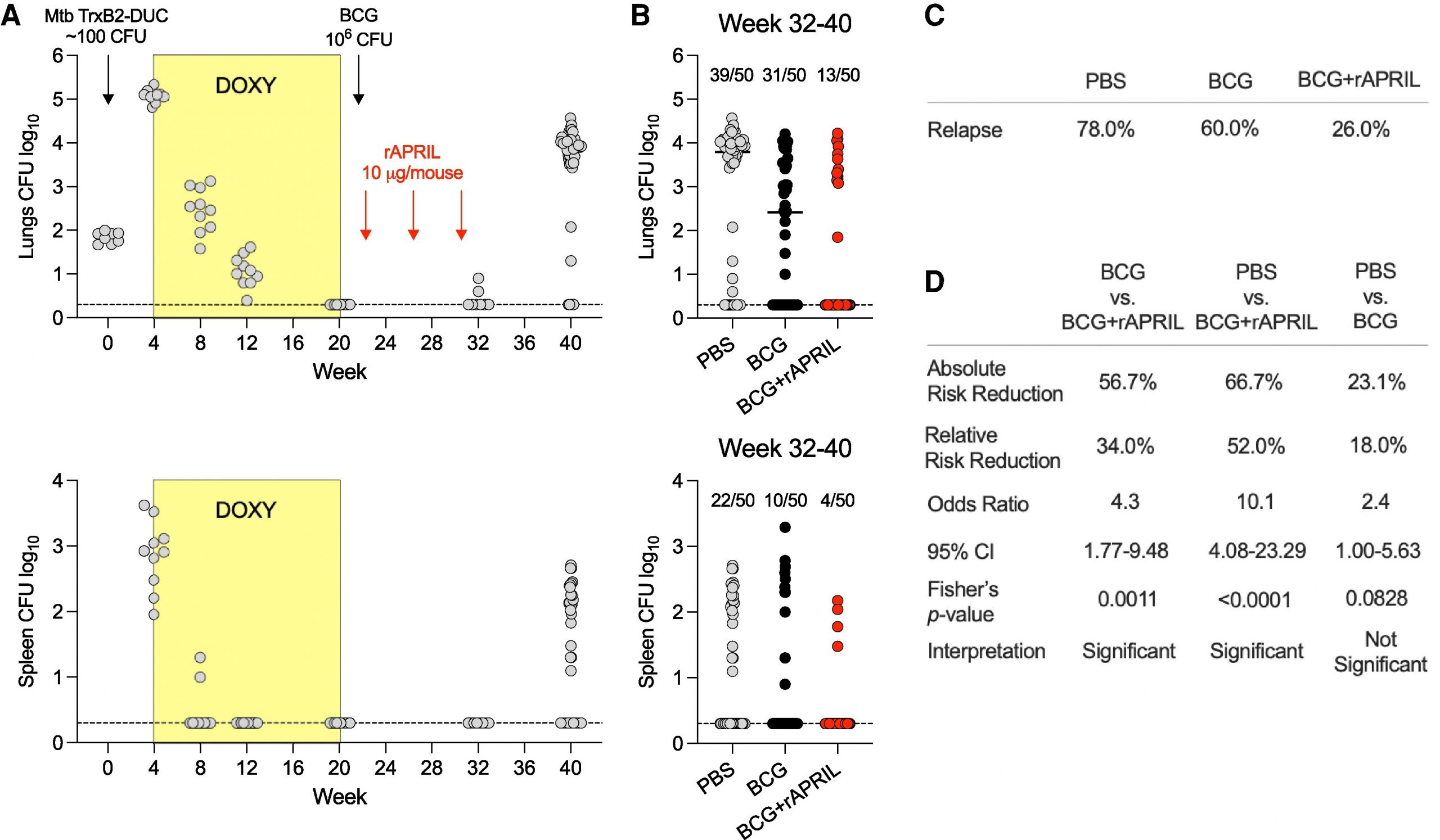
Figure 1: Bacille Calmette–Guérin (BCG) with adjunct recombinant A proliferation–inducing ligand (rAPRIL) immunotherapy reduces tuberculosis (TB) relapse in mice. A, Mice were infected with ∼100 colony forming units (CFUs) of aerosolized Mycobacterium tuberculosis (Mtb) TrxB2-DUC. At designated times, the bacterial loads in lungs and spleen were determined by plating organ homogenates an agar. Paucibacillary TB infection in mice was established by TrxB2 depletion induced by doxycycline (DOXY) treatment from 4 to 20 wk. Study cohorts: phosphate buffered saline (PBS), BCG, and BCG with adjunct rAPRIL immunotherapy (BCG + rAPRIL). Phosphate buffered saline and BCG were administered subcutaneously at 22 wk, and 10 μg rAPRIL per mouse was provided intraperitoneal at 22, 26, and 30 wk. B, Mtb burden in lungs and spleen at 32 and 40 wk. The number of mice with detectible Mtb and the total number of animals are shown. C, Relapse frequency in study cohorts. D, Statistical analysis of relapse data in study cohorts using a 2-sided Fisher’s exact test. The primary, prespecified comparison tested whether rAPRIL improved BCG. Secondary pairwise comparisons (PBS vs BCG, PBS vs BCG + rAPRIL) were considered exploratory and were adjusted for multiple testing using the Bonferroni method. Combined data of 2 independent studies are shown. Dashed lines in A and B depict the limit of detection.
Building on evidence that specialised splenic B cells help restrict TB infection, researchers investigated whether recombinant APRIL (rAPRIL), a cytokine involved in B-cell survival and differentiation, could enhance BCG-mediated protection.
Using a mouse model of latent TB and spontaneous relapse, the team compared three groups:
- BCG + rAPRIL: 26% relapse
- BCG alone: 60% relapse
- Saline control: 78% relapse
The combination therapy was associated with a substantial reduction in relapse compared with either control group.
Flow cytometry revealed that adjunctive rAPRIL selectively remodelled and activated marginal zone B (MZB) cell compartments in the lungs and spleen.
Treated animals showed increased expression of:
- CD69, associated with immune cell activation and tissue retention.
- CD86, a co-stimulatory molecule involved in immune responses.
In contrast, T-cell populations were only modestly affected across treatment groups, pointing towards B-cell modulation as a potential contributor to the enhanced protection.
BCG remains an important TB vaccine, but protection against pulmonary TB in adults and post-treatment relapse remains challenging.
These findings highlight B cells as potential targets for immunomodulation, suggesting that strengthening specific B-cell compartments could complement existing TB prevention strategies.
These results are from preclinical mouse models. The findings do not establish efficacy in humans, and further research is needed to determine the mechanisms, durability, safety and clinical potential of APRIL-based immunotherapy.
Beyond conventional vaccine strategies, manipulating immune cell survival and differentiation may offer new opportunities to improve durable protection against TB recurrence.
Journal article: Tsai, CY., et al. 2026. Bacille Calmette–Guérin Vaccination With Adjunctive A Proliferation–Inducing Ligand Immunotherapy Reduces Tuberculosis Relapse in Mice. The Journal of Infectious Diseases.
Summary by Stefan Botha