


The autoimmune regulator (Aire) is best known for promoting T cell tolerance in the thymus, where it helps prevent immune responses against the body’s own tissues. New research reveals an unexpected role for Aire in antibody-secreting cells, where it helps regulate the production of natural IgM antibodies (Figure 1).
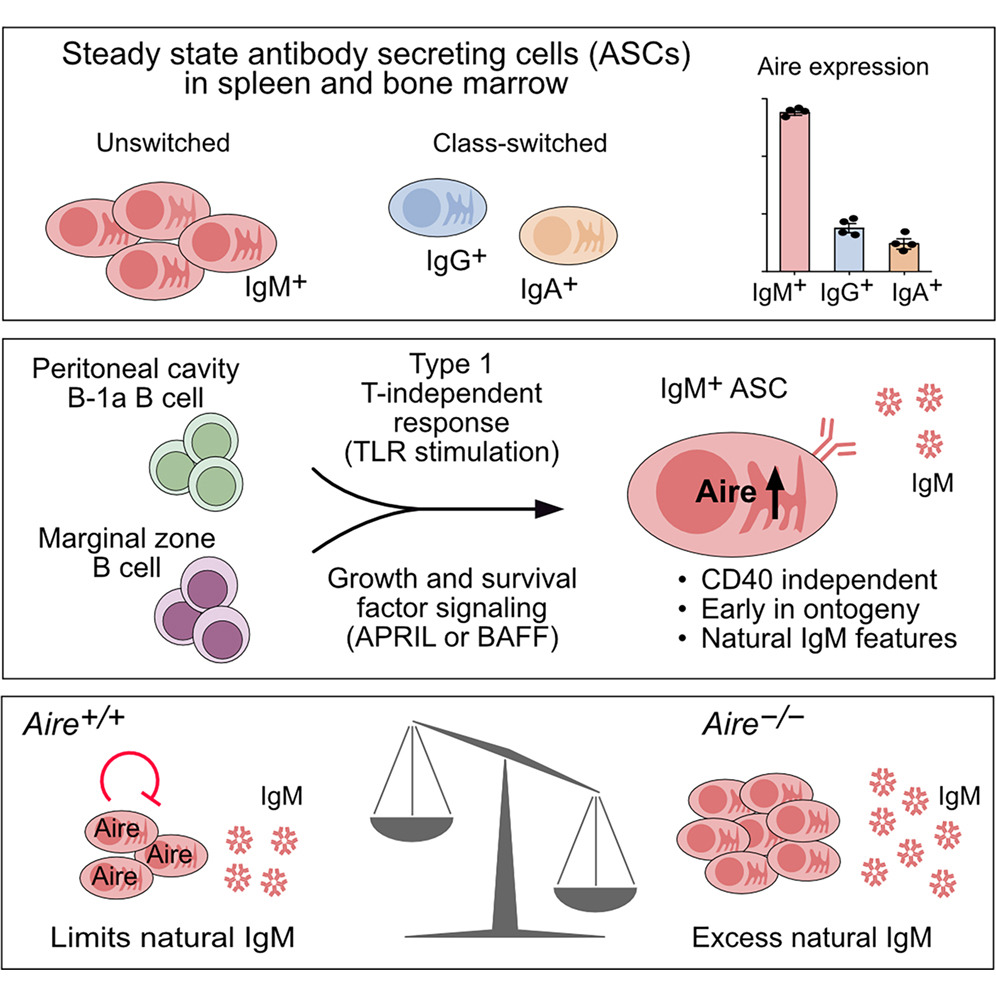
Figure 1: Graphical abstract.
Researchers identified Aire-expressing antibody-secreting cells (ASCs) in the spleen and bone marrow, with the highest Aire expression found in IgM⁺ ASCs.
These cells shared features of natural antibody-producing cells:
- They developed independently of T cell help.
- They displayed distinctive antibody repertoire characteristics.
- They arose primarily from B-1a and marginal zone B cells.
Natural IgM antibodies can recognise multiple targets and contribute to early immune defence.
The study found that innate immune signals could drive B cell differentiation into antibody-secreting cells in vitro. However, robust Aire induction required additional survival and growth signals through BAFF or APRIL, members of the tumour necrosis factor (TNF) superfamily.
This identifies a previously unrecognised signalling pathway involved in regulating Aire expression outside the thymus.
Unlike its established role in thymic epithelial cells, Aire did not promote promiscuous gene expression in these antibody-secreting cells.
Instead, it acted within the cells themselves to limit the size of the IgM⁺ ASC population and regulate natural IgM levels under steady-state conditions.
These findings expand our understanding of Aire beyond T cell tolerance, revealing a role in maintaining antibody-producing cell homeostasis. They also highlight how innate immune signals and B cell survival pathways can intersect to regulate natural antibody production.
The results raise new questions about how Aire balances natural antibody responses, although its implications for autoimmune disease and infection require further investigation.
Journal article: Sayed, A., et al. 2026. Aire is a cell-intrinsic regulator of natural IgM-secreting cells. Immunity.
Summary by Stefan Botha