


Researchers have identified why some individuals develop life-threatening COVID-19 while others experience only mild illness, revealing that a pre-existing autoimmune response can disable one of the body’s most important antiviral defence systems (Figure 1). The study shows that certain people carry memory B cells that produce antibodies capable of neutralising type I interferons, key signalling proteins responsible for mounting the body’s early antiviral response.
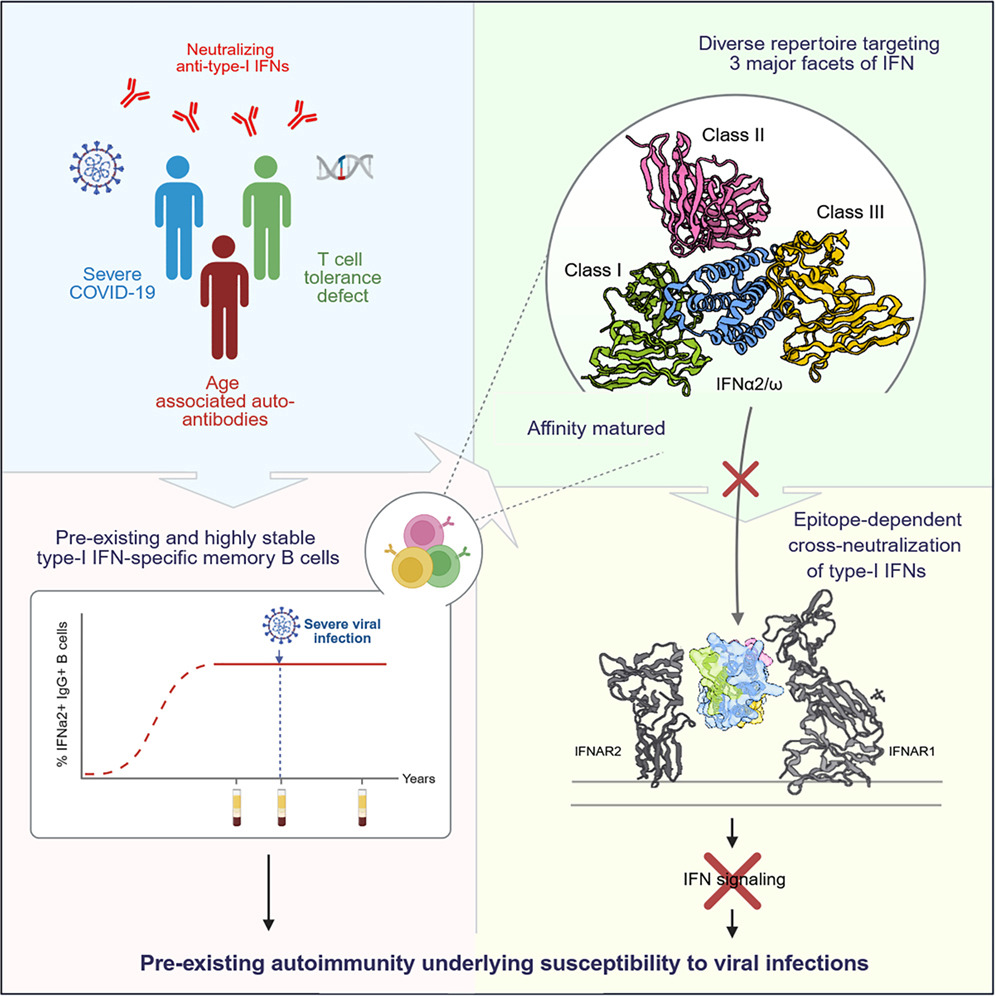
Figure 1: Graphical abstract.
The findings suggest that this hidden immune defect exists before infection occurs and may help explain susceptibility not only to severe COVID-19, but also to other serious viral diseases.
Type I interferons are among the immune system’s first responders to viral infection. Produced shortly after a virus enters the body, they alert neighbouring cells, activate antiviral genes and help prevent viruses from spreading during the earliest stages of infection.
Previous studies had shown that some patients with severe COVID-19 produce autoantibodies that neutralise type I interferons. However, it remained unclear how these harmful antibodies developed or whether they arose because of severe disease.
To answer this question, an international team of researchers analysed immune cells and antibodies from patients with severe COVID-19 using patient-derived monoclonal antibodies, X-ray crystallography and AlphaFold3-based structural modelling.
The researchers discovered that patients with interferon-neutralising autoantibodies possessed a large and diverse population of memory B cells specifically programmed to recognise type I interferons.
Rather than representing a temporary immune abnormality triggered by infection, these B cells had undergone affinity maturation, the normal process by which antibody-producing cells evolve to generate increasingly high-affinity antibodies during immune responses.
In this case, however, affinity maturation had strengthened antibodies directed against the body’s own antiviral proteins instead of a pathogen, creating a stable autoimmune response that existed before SARS-CoV-2 infection.
Structural analyses showed that these antibodies recognised three major regions on type I interferons, allowing them to neutralise multiple interferon subtypes, including interferon-α and interferon-ω.
By disabling type I interferons at the earliest stage of infection, these autoantibodies effectively silence the immune system’s antiviral alarm. Without this critical first line of defence, viruses can replicate rapidly before adaptive immune responses can be established, substantially increasing the risk of severe disease.
The findings support growing evidence that defects in immune tolerance can predispose certain individuals to severe viral infections. Importantly, the autoimmune response appears to remain clinically silent until the individual encounters a virus that depends heavily on early interferon signalling for control.
The researchers suggest that screening for interferon-targeting autoantibodies could eventually help identify individuals at increased risk of severe viral infections before exposure occurs, particularly older adults and people with underlying immune tolerance defects.
Beyond COVID-19, these autoantibodies may also influence susceptibility to seasonal influenza, emerging coronaviruses and other viral pathogens that rely on intact type I interferon responses for early immune control.
The study provides new insight into the mechanisms linking autoimmunity and antiviral immunity and identifies affinity-matured autoreactive B cells as a key driver of severe viral disease. Future work may focus on developing diagnostic tests to identify at-risk individuals and therapies that restore interferon activity in patients carrying these pathogenic autoantibodies.
Journal article: Fournier, M, et al. 2026. Affinity-matured B cell responses neutralizing type-I interferons underlie severe viral infections. Cell.
Summary by Stefan Botha