


Researchers have identified a previously unrecognised role for the stress-response protein arachidonate lipoxygenase-15 (ALOX15) in protecting cells against viral infections (Figure 1). The study reveals that ALOX15 is a critical regulator of the innate antiviral response, helping infected cells mount robust type I interferon responses against respiratory RNA viruses, including influenza.
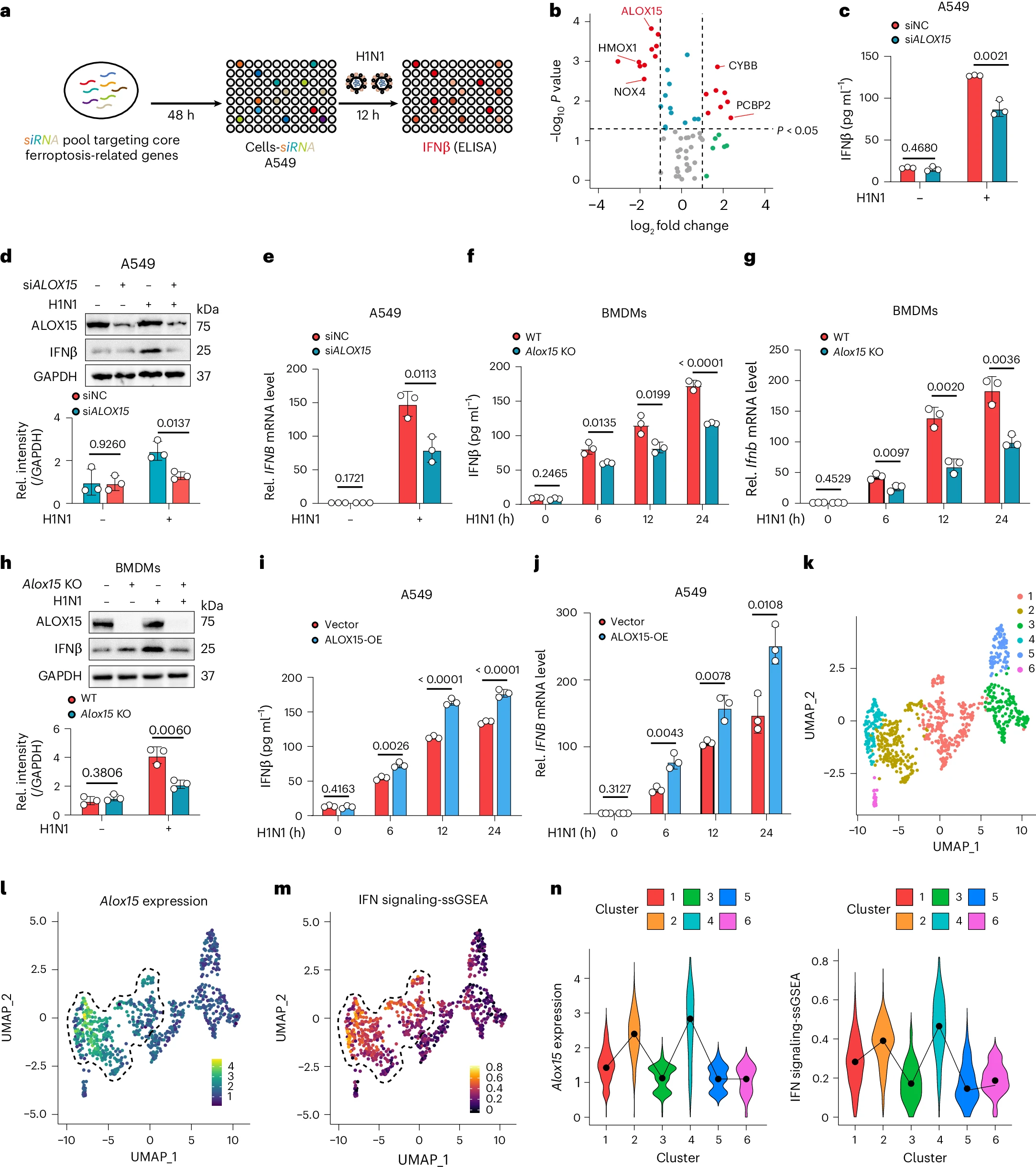
Figure 1: Identification of ALOX15 as a regulator of IFNβ signaling. a, Screening of ferroptosis-related genes in regulating type I IFN production using an siRNA library. A549 cells were transfected with siRNAs targeting ferroptosis-related genes (identified from KEGG and GeneCard databases) before infection with H1N1 virus. IFNβ levels in the cell culture supernatant were measured by enzyme-linked immunosorbent assay (ELISA) at 12 h after infection. b, Volcano plot illustrating the ratio of IFNβ production (log2(fold change), x axis) versus statistical significance (−log10(Pvalue), y axis) in cells treated with ferroptosis gene-targeting siRNAs compared to small interfering negative control (siNC)-treated cells. c–e, IFNβ level determined by ELISA, western blotting and quantitative PCR (qPCR) in siALOX15-transfected A549 cells infected with H1N1 virus for 12 h. f,g, IFNβ production and relative Ifnb mRNA expression levels in WT and Alox15−/− BMDMs infected with H1N1 virus at various time points. h, Immunoblot analysis of ALOX15 and IFNβ protein levels in cell lysates from WT and Alox15−/− BMDMs infected with H1N1 virus for 12 h. i,j, IFNβ production and IFNB relative mRNA expression levels in A549 cells transfected with either vector or Flag-ALOX15 expression plasmid, and then infected with H1N1 virus at the indicated time points. k–n, Analysis of Alox15 expression and IFN signaling in fibroblasts from African green monkey lung tissues following SARS-CoV-2 infection, based on publicly available scRNA-seq datasets. UMAP analysis reveals six fibroblast subclusters. Differential expression patterns across the six subclusters (l). Differential IFN signaling in the six subclusters. Correlation analysis of Alox15 expression and IFN signaling across the six subclusters. Data in b–j are presented as the mean ± s.d. from three biologically independent replicates (n = 3). Statistical significance was determined by two-tailed unpaired Student’s t-test (b–j). Exact P values are indicated in the figures. Immunoblots in d and h are representative of three independent experiments with similar results.
The findings also demonstrate that targeting ALOX15 could form the basis of a new host-directed antiviral strategy, potentially offering protection against multiple viral pathogens.
When viruses infect cells, they trigger a series of stress responses that activate the innate immune system. One of the most important antiviral pathways centres on mitochondrial antiviral signalling protein (MAVS), which detects viral RNA and initiates production of type I interferons, potent antiviral cytokines that limit viral replication and alert neighbouring cells to infection.
The researchers discovered that ALOX15, previously recognised mainly for its role in lipid metabolism and inflammatory responses, is also an essential component of this pathway.
Using mouse models, they found that loss of Alox15 impaired MAVS signalling and significantly reduced type I interferon production following influenza infection. As a result, animals lacking ALOX15 were more susceptible to viral disease. Restoring ALOX15 expression in the lungs using an adeno-associated viral vector reversed this increased susceptibility, confirming its protective role.
The study showed that ALOX15 rapidly relocates to mitochondria following infection with several RNA viruses, including H1N1 influenza, H3N2 influenza, and human coronavirus-229E. Notably, this antiviral function occurred independently of the enzyme’s lipid-modifying activity, indicating that ALOX15 performs a previously unknown structural role during infection.
The researchers also observed mitochondrial localisation of ALOX15 in peripheral blood mononuclear cells collected from individuals with influenza, suggesting that the mechanism operates during natural human infection.
Mechanistic studies revealed that activated MAVS recruits ALOX15 to mitochondria, where it helps stabilise the antiviral signalling complex.
ALOX15 achieves this by displacing USP19, a deubiquitinating enzyme that normally limits MAVS activation. This preserves K63-linked ubiquitination of MAVS, allowing the signalling complex to remain assembled for longer and sustain production of antiviral interferons.
By reinforcing this central innate immune pathway, ALOX15 enables cells to generate a stronger and more durable antiviral response.
Building on these findings, the researchers developed a proof-of-concept therapeutic strategy that targets the host rather than the virus itself. They combined songorine, a compound that increases ALOX15 expression, with PD146176, an inhibitor of ALOX15’s enzymatic activity.
This combination enhanced antiviral protection against influenza, demonstrating that selectively promoting ALOX15’s immune-regulatory function while limiting its enzymatic activity may provide an effective treatment strategy.
Because host-directed therapies are less likely to be undermined by viral mutations, targeting ALOX15 could offer a promising new approach for combating influenza and potentially other RNA virus infections.
The study identifies ALOX15 as an unexpected component of mitochondrial antiviral immunity and expands our understanding of how cellular stress responses contribute to antiviral defence.
Journal article: Weng, JY, et al. 2026. ALOX15 orchestrates mitochondrial antiviral immunity and serves as a host target for anti-influenza therapy. Nature Immunology.
Summary by Stefan Botha