


Researchers have identified a previously unknown mechanism that regulates B cell activity, revealing that the liver-derived protein fibrinogen-like protein 1 (FGL1) suppresses immune responses by binding to the B-cell receptor TACI (Figure 1). Published in Immunity, the study uncovers a new immune checkpoint that helps control antibody-producing cells and demonstrates its therapeutic potential in a mouse model of systemic lupus erythematosus (SLE).
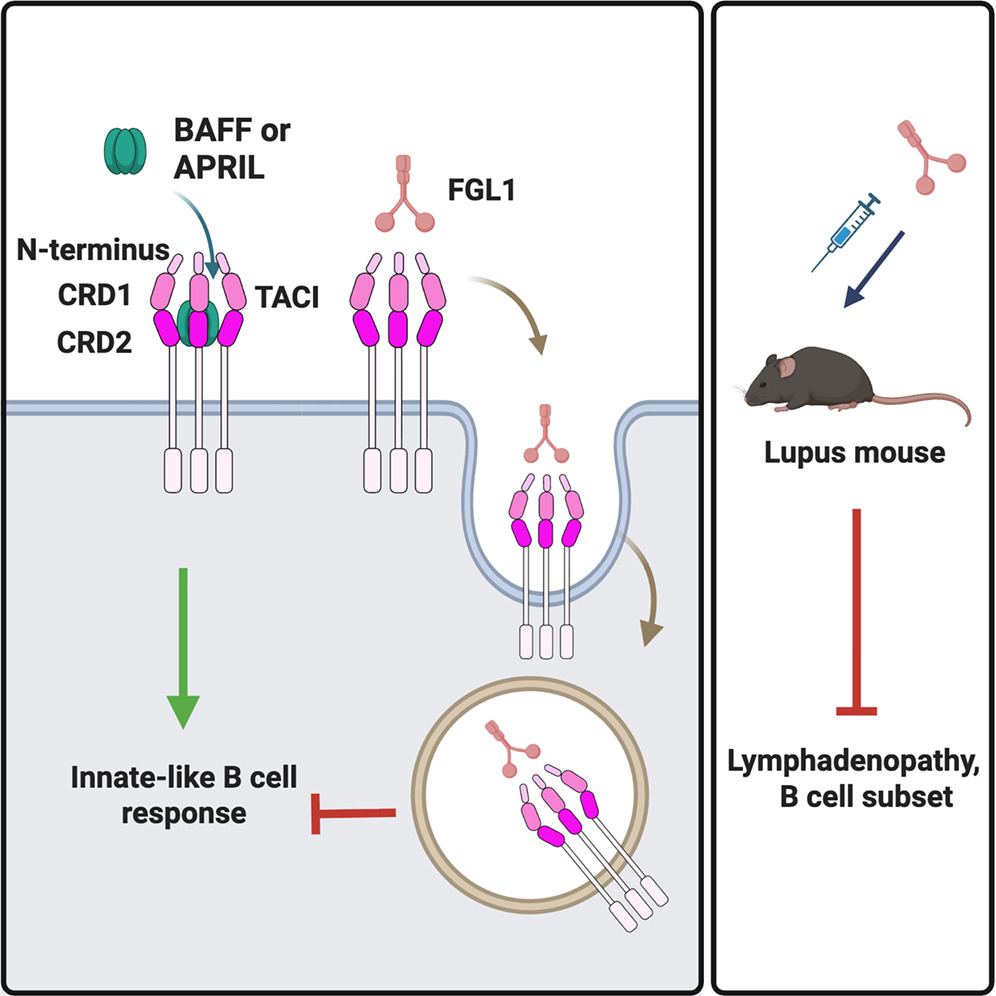
Figure 1: Graphical abstract.
The findings expand the known functions of FGL1 beyond T cells and suggest that targeting the FGL1–TACI pathway could provide a novel strategy for treating autoimmune diseases.
FGL1 is best known as a ligand for the inhibitory receptor LAG3 on T cells, where it helps dampen immune responses. However, mice lacking FGL1 develop autoimmune features that differ from those seen in mice lacking LAG3, suggesting that FGL1 may have additional immune-regulatory roles.
To investigate this possibility, the researchers administered recombinant FGL1 to B6/lpr mice, a well-established model of lupus-like autoimmune disease. Treatment significantly reduced autoimmune manifestations, accompanied by fewer B cells and diminished antigen-specific IgM antibody responses.
These observations pointed to a direct role for FGL1 in regulating B-cell function.
Using a genome-wide screen of cell surface proteins, the researchers identified transmembrane activator and calcium modulator and cyclophilin ligand interactor (TACI) as a previously unrecognised receptor for FGL1.
TACI is a member of the tumour necrosis factor receptor (TNFR) family and plays a central role in B-cell activation and survival through interactions with the cytokines BAFF and APRIL.
Interestingly, FGL1 binds to a different region of TACI than BAFF and APRIL. Rather than competing directly with these activating ligands, FGL1 attaches to an N-terminal binding site, allowing it to regulate receptor function through a distinct mechanism.
Further experiments showed that FGL1 promotes internalisation of TACI, reducing the amount of receptor available on the B-cell surface to respond to activating signals from BAFF and APRIL.
By limiting receptor availability, FGL1 selectively suppresses the activation of a subset of innate-like B cells without broadly shutting down all B-cell responses.
Importantly, the protective effects of FGL1 were completely lost in mice lacking TACI, confirming that this receptor is essential for mediating FGL1’s immunosuppressive activity.
Excessive B-cell activation and autoantibody production are hallmarks of many autoimmune diseases, including lupus. Current therapies often rely on broad immunosuppression or depletion of B cells, approaches that can increase susceptibility to infection.
The discovery of the FGL1–TACI pathway offers an alternative strategy by selectively dampening B-cell activation through modulation of receptor availability rather than eliminating immune cells altogether.
These findings establish FGL1 as a previously unrecognised inhibitory ligand for B cells and identify TACI as a novel immune checkpoint regulating humoral immunity. Further research will determine whether therapies targeting this pathway can be translated into new treatments for lupus and other autoimmune disorders characterised by excessive B-cell activity.
Journal article: Su, T.T., et al. 2026. The liver-secreted protein FGL1 restrains a subset of innate-like B cell responses via the receptor TACI. Immunity.
Summary by Stefan Botha