


UV radiation can introduce a substantial number of mutations into melanocytes, the pigment-producing cells of the skin. Yet despite carrying this mutational burden, melanocytes can persist without being eliminated by the immune system.
A new study reveals a fascinating mechanism behind this immune tolerance: melanocytes can switch on their own immune checkpoint protection through the transcription factor MITF (Figure 1).
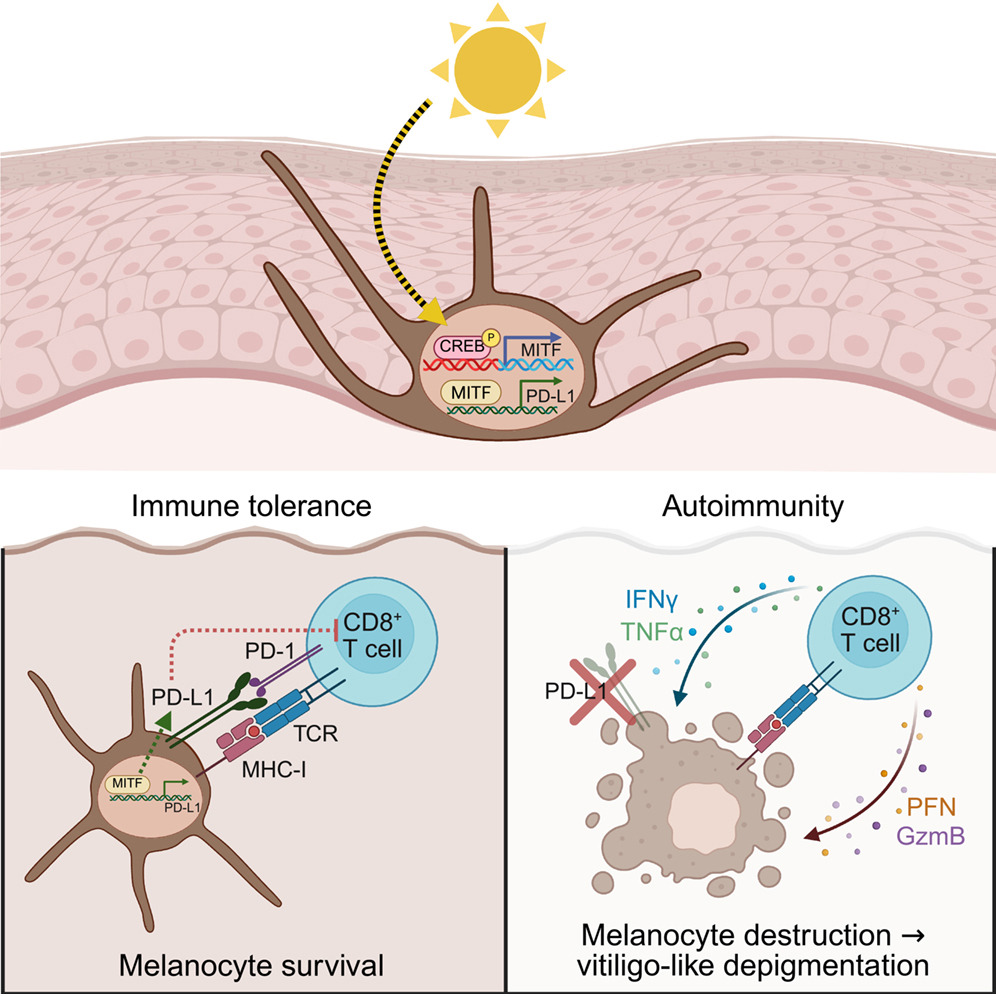
Figure 1: Graphical abstract.
Microphthalmia-associated transcription factor (MITF) is a master regulator of melanocyte biology. It is essential for melanocyte development, pigmentation, and the cellular response to UV exposure.
The study found that MITF also directly controls expression of PD-L1 (CD274), a major immune checkpoint molecule.
Mechanistically, MITF binds to a conserved enhancer upstream of the PD-L1 gene containing functional E-box elements, directly activating PD-L1 transcription.
Importantly, this pathway was independent of interferon-γ signalling, which is one of the canonical mechanisms known to induce PD-L1 in many tissues.
The researchers found that MITF controlled both the baseline expression of PD-L1 in healthy melanocytes and its increase following UV radiation. This suggests that melanocytes aren’t simply passive targets of immune regulation.
Instead, they possess an intrinsic transcriptional programme that allows them to anticipate the immune consequences of UV-induced cellular damage and increase their resistance to immune-mediated destruction.
The consequences became clear when PD-L1 was selectively deleted from melanocytes in mice.
Following long-term UVB exposure, these animals developed:
- Increased CD8⁺ T-cell infiltration
- Increased melanocyte destruction
- Depigmentation resembling features of vitiligo
The human cell experiments told a similar story.
PD-L1-deficient melanocytes generated from human iPSCs underwent more apoptosis and were substantially more vulnerable to killing by gp100-specific CD8⁺ T cells. So, melanocyte PD-L1 appears to function as a critical immune-protective brake, limiting cytotoxic T-cell-mediated destruction.
This finding provides an interesting mechanistic link between immune checkpoint biology and depigmentation disorders. If melanocytes lose their ability to maintain PD-L1 expression, CD8⁺ T cells may gain greater access to these cells and eliminate them.
That raises the possibility that dysregulation of the MITF–PD-L1 axis could contribute to the failure of melanocyte immune tolerance observed in vitiligo.
It also highlights an important principle: immune checkpoints aren’t exclusively mechanisms that protect tumours. They are part of normal tissue-level immune regulation. The same mechanism that protects healthy melanocytes could potentially become advantageous during melanoma development.
UV-induced mutations can generate abnormal cells that would ordinarily be candidates for immune surveillance. If MITF-driven PD-L1 expression allows mutated melanocytes to avoid CD8⁺ T-cell clearance, this intrinsic tolerance programme could provide an early form of immune evasion during melanoma development.
But there is an important twist. Once melanoma has developed, this same PD-L1-mediated immune suppression can become a therapeutic vulnerability. PD-1/PD-L1 checkpoint inhibitors work, in part, by releasing the brakes that prevent T cells from attacking tumour cells.
MITF is traditionally viewed through the lens of pigmentation and melanocyte differentiation, but these findings expand its role into immune regulation, showing that a melanocyte-intrinsic transcriptional programme can directly control susceptibility to cytotoxic T-cell attack.
It also helps connect two seemingly different conditions: vitiligo and melanoma.
Too little melanocyte immune protection can contribute to autoimmune depigmentation, while too much checkpoint protection may allow damaged or transformed melanocytes to escape immune surveillance.
Melanocytes don’t simply endure UV-induced damage, they actively regulate how visible that damage is to the immune system. Understanding this balance between tissue protection, autoimmunity and tumour immune evasion could provide new insight into both vitiligo and melanoma biology.
Journal article: Lo, J.A., et al. 2026. UV irradiation drives lineage-specific MITF-mediated transcription of PD-L1 to confer immune tolerance to UV-mutated melanocytes. Cell Immunity.
Summary by Stefan Botha