


Researchers have identified a previously unrecognised link between inflammation and skin pigmentation, showing that the inflammatory chemokine CXCL1 can directly suppress melanin production by inhibiting a key signalling pathway involved in melanocyte function (Figure 1). The findings provide new insight into how inflammatory skin conditions influence pigmentation and may inform future treatments for disorders characterised by abnormal skin colour.
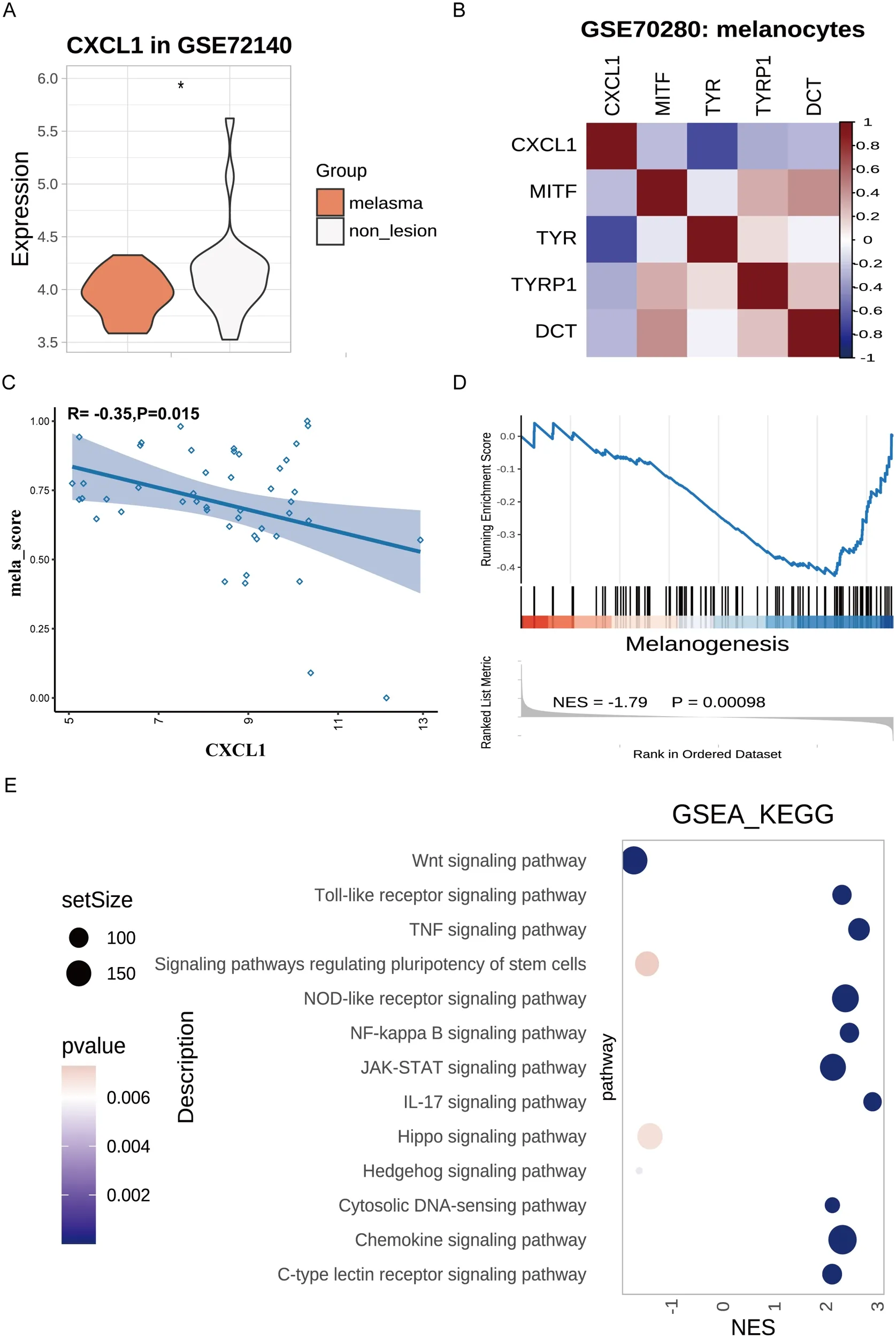
Figure 1: CXCL1 is negatively correlated with melanogenesis. (A) Violin plot showing the expression levels of CXCL1 in the melasma skin tissue transcriptomic dataset (GSE72140). (B) Correlation analysis between CXCL1 and key melanogenesis-related genes (MITF, TYR, TYRP1, DCT) in the UVB-irradiated human primary melanocyte transcriptomic dataset (GSE70280). (C) Correlation analysis between CXCL1 and the melanogenesis score (mela-score) in the ultraviolet-irradiated human skin tissue transcriptomic dataset (GSE45493). (D, E) GSEA results based on KEGG pathways in the GSE45493 dataset.
The study demonstrates that the CXCL1–CXCR2 signalling axis reduces melanin production by suppressing the WNT/β-catenin pathway, a central regulator of melanogenesis.
Abnormal skin pigmentation is a common feature of many inflammatory skin diseases, including melasma, psoriasis, acne and atopic dermatitis. While inflammation is known to influence pigment production, the molecular mechanisms linking immune signalling to melanocyte activity have remained poorly understood.
To identify potential regulators, the researchers analysed transcriptomic datasets from several inflammatory skin conditions, as well as ultraviolet-irradiated skin. Among the inflammatory mediators identified, CXCL1 emerged as a strong candidate capable of negatively regulating melanogenesis.
The team tested the effects of CXCL1 in primary human melanocytes, MNT1 melanoma-derived pigment cells, and human skin tissue explants.
Across all experimental models, exposure to CXCL1 significantly reduced melanin content and tyrosinase activity, the enzyme responsible for the rate-limiting step of melanin synthesis.
CXCL1 also decreased the expression of several key genes required for pigment production, including MITF, the master regulator of melanocyte development and function, as well as the melanogenic enzymes TYR, TYRP1 and DCT.
These findings demonstrate that CXCL1 directly suppresses the molecular machinery responsible for melanin synthesis.
Mechanistic studies showed that CXCL1 exerts its effects through its receptor, CXCR2. Activation of this pathway reduced both the expression and nuclear localisation of β-catenin, a critical signalling molecule within the WNT/β-catenin pathway, which normally promotes melanocyte differentiation and melanin production.
Importantly, treatment with the selective CXCR2 inhibitor SB225002 reversed these effects, restoring β-catenin signalling and supporting the conclusion that the CXCL1–CXCR2 axis suppresses melanogenesis by inhibiting WNT signalling.
The findings provide a mechanistic explanation for how inflammatory environments may contribute to changes in skin pigmentation observed in many dermatological conditions.
By linking inflammatory chemokine signalling to one of the major pathways controlling melanocyte biology, the study highlights the CXCL1–CXCR2 pathway as a potential therapeutic target for disorders involving abnormal pigmentation.
Future treatments that simultaneously reduce inflammation while modulating melanogenesis could offer a more targeted approach for conditions such as melasma and post-inflammatory pigmentary disorders.
Journal article: Zhang, Y, et al. 2026. CXCL1-CXCR2 axis inhibits melanogenesis through the suppression of the WNT/β-catenin pathway. Frontiers in Immunology.
Summary by Stefan Botha