


Two experimental mRNA-based tuberculosis (TB) vaccines have demonstrated promising immune responses and protection against Mycobacterium tuberculosis in preclinical studies, supporting their progression into early-stage human clinical trials (Figure 1). The research highlights the potential of mRNA vaccine technology to address one of the world’s deadliest infectious diseases.
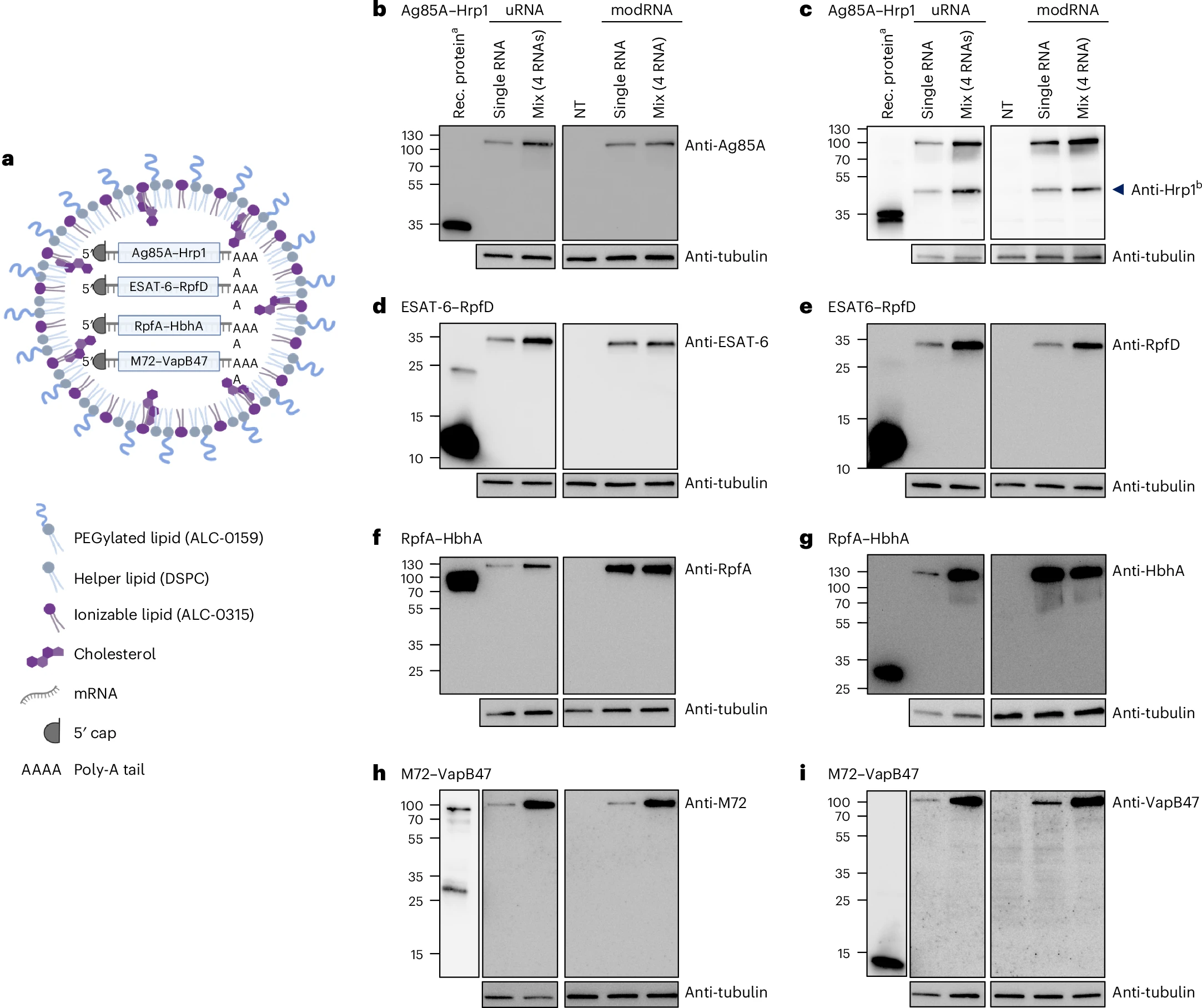
Figure1 : mRNAs encoding fusion Mtb antigens are successfully translated into corresponding proteins in vitro. a, Schematic illustration of BNT164 vaccine candidates. Four mRNAs, each encoding a fusion of two Mtb antigens, were formulated as lipid nanoparticles. b–i, HEK293T cells were transfected with BNT164 mRNAs either as a single mRNA (0.25 µg ml−1) or a manually generated mixture of the four mRNAs (1 µg ml−1) using a RiboJuice transfection kit. Nontransfected cells were used as a negative control, and respective recombinant proteins were used as positive controls. Protein expression was assessed by western blot using antigen-specific antibodies: anti-Ag85A (b), anti-Hrp1 (c), anti-ESAT-6 (d), anti-RpfD (e), anti-RpfA (f), anti-HbhA (g), anti-M72 (h) or anti-VapB47 (i). The western blots shown are representative of three individual experiments. The expected molecular weights were as follows: Ag85A–Hrp1, 50 kDa (b,c); ESAT-6–RpfD, 28 kDa (d,e); RpfA–HbhA, 120 kDa (f,g); and M72–VapB47, 86 kDa (h,i). The black arrow indicates the Ag85A–Hrp1 monomer. The loading control was tubulin. In h and i, brightness and contrast were adjusted independently for lanes containing recombinant protein controls to improve visualization of the bands. Uncropped blot images are provided in the source data. aAsterisk indicates that the recombinant protein tested in each individual blot was matched to the detection antibody. bDouble asterisk indicates that the anti-Hrp1 antibody detected both monomeric and dimeric Ag85A–Hrp1 fusion protein. NT, nontransfected; rec., recombinant. Panel a created in BioRender; Vukovic, N. https://biorender.com/zg085sb (2026).
The vaccine candidates, BNT164a1 and BNT164b1, were designed to generate broad immunity by targeting multiple stages of the TB bacterium’s life cycle rather than focusing on a single antigen.
Despite the widespread use of the BCG vaccine, tuberculosis remains a leading cause of death from infectious disease worldwide, causing more than a million deaths each year. One of the major challenges in developing improved vaccines is the complex biology of M. tuberculosis, which expresses different proteins during active infection, dormancy and reactivation.
To overcome this, researchers developed two mRNA-lipid nanoparticle vaccine candidates encoding eight distinct TB antigens expressed throughout different stages of infection: Ag85A, Hrp1, ESAT-6, RpfD, RpfA, HbhA, M72 and VapB47.
The two vaccines contain identical antigen targets but differ in their mRNA design. BNT164a1 uses unmodified mRNA, while BNT164b1 incorporates N1-methylpseudouridine, a modified nucleoside commonly used in several licensed mRNA vaccines to improve mRNA stability and protein production.
Prime-boost vaccination induced robust immune responses against all eight antigens in three different mouse models, including standard laboratory strains and humanised HLA-A2.1/DR1 mice, which more closely mimic human immune responses.
Both vaccine candidates stimulated broad T-cell immunity, alongside antibody responses, suggesting they can activate multiple arms of the adaptive immune system.
Importantly, the vaccines significantly reduced bacterial burdens following aerosol infection with two different strains of M. tuberculosis, demonstrating protection against pulmonary tuberculosis in preclinical challenge models.
Further analysis revealed that vaccine-induced protection was associated with increased infiltration of CD8⁺ T cells into granulomas, the organised immune structures that form around TB bacteria in infected lungs.
Many of these CD8⁺ T cells displayed characteristics of memory precursor cells, indicating that the vaccines may generate durable immune responses capable of providing long-term protection against future infection.
Both vaccine candidates were also well tolerated in preclinical safety studies conducted in rats, with no major safety concerns identified.
Based on these encouraging results, BNT164a1 and BNT164b1 have advanced into Phase 1/2 clinical trials, where researchers will evaluate their safety, tolerability and immunogenicity in humans.
While further clinical testing will determine whether these vaccines provide protection against tuberculosis in people, the study demonstrates the versatility of mRNA vaccine technology beyond COVID-19. By targeting multiple antigens expressed across different stages of bacterial infection, this approach may overcome limitations that have hindered previous TB vaccine candidates and represents an important step towards developing more effective vaccines against one of the world’s most persistent infectious diseases.
Journal article: Agrawal, N., et al. 2026. mRNA-based tuberculosis vaccines BNT164a1 and BNT164b1 are immunogenic, well tolerated and efficacious in rodent models. Nature Immunology.
Summary by Stefan Botha