


The immune system undergoes critical developmental changes before and during early childhood. New research suggests that exposure to a high-fat diet during pregnancy and early life may have lasting consequences for how the immune system responds to infection and vaccination.
A new study has identified a mechanism through which maternal and early-life obesity may reprogramme developing CD4+ T cells, impairing the formation of key immune cells needed for effective antibody responses (Figure 1).
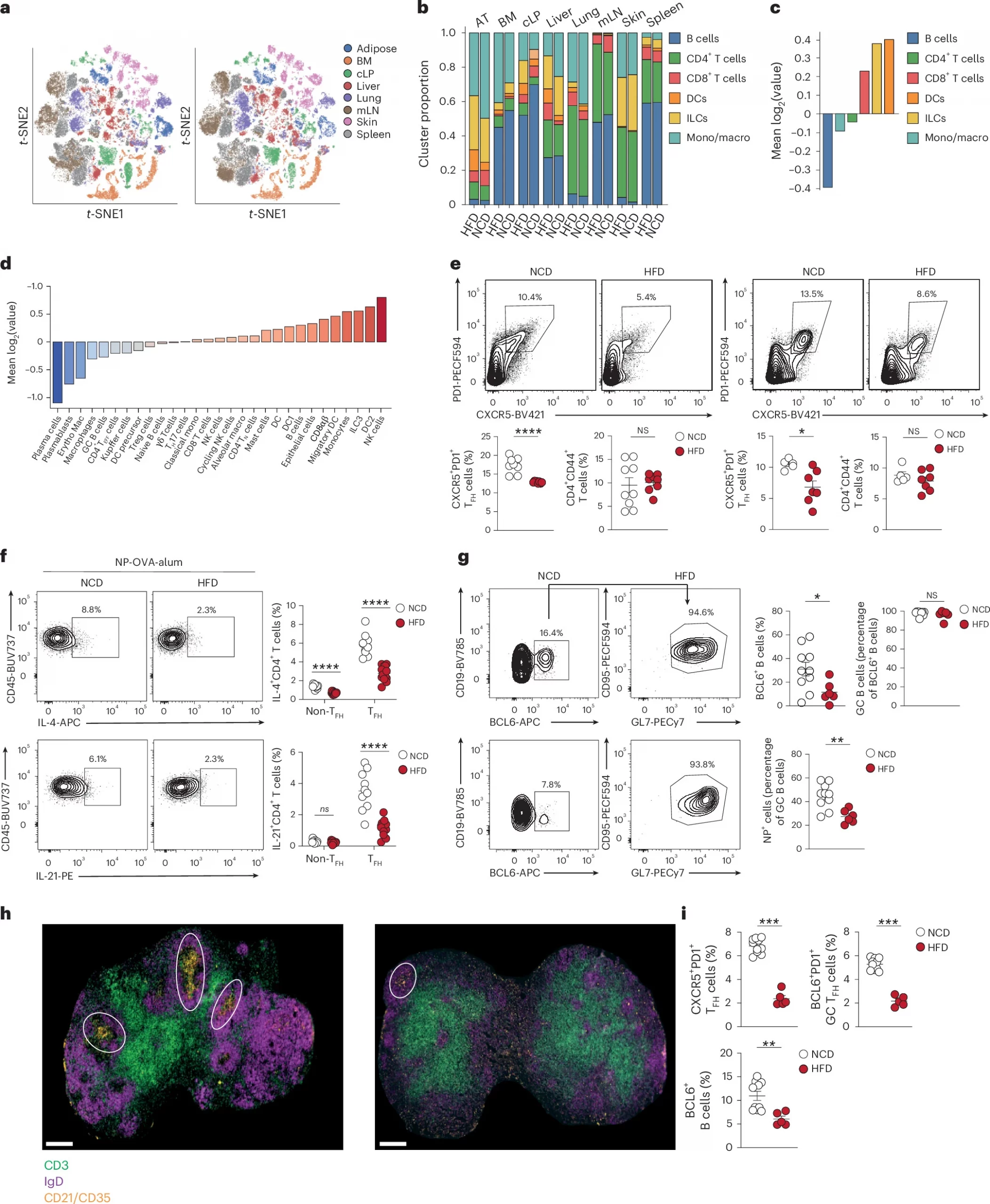
Figure 1: Early life diet-induced obesity impairs TFH cell and GC responses. , The t-distributed stochastic neighbor (t-SNE) embedding visualization of scRNA-seq data from juvenile lean (NCD; 62,683 cells; left) and obese (HFD; 65,550 cells; right) mice, colored by tissue of origin. b, Proportions of B cells, CD8+ T cells, CD4+ T cells, DCs, ILCs and monocytes or macrophages (mono/macro) in NCD and HFD mice, colored by cell type. c, The mean log2(fold-change) for cell types in b, pooled at the organism level. Negative and positive values indicate enrichment in NCD and HFD mice, respectively. d, The mean log2(fold-change) at the organism level for erythroid macrophages (erytho macs), GC B cells, DCs, regulatory T (Treg) cells, type 17 CD4+ T helper (TH17) cells, monos, natural killer (NK) cells and ILCs. Negative and positive values indicate enrichment in NCD and HFD mice, respectively. e, Representative flow cytometry plots of viable CD4+TCRβ+FOXP3−CD44+CD62L−CXCR5+PD-1+ TFH cells (top) and frequencies of activated CD4+TCRβ+FOXP3−CD44+ T cells and TFH cells (bottom) in inguinal dLNs at day 7 post-intramuscular (i.m.) immunization with mRNA–PR8-HA (left; NCD, n = 5; HFD, n = 5) or NP-OVA + alum (right; NCD, n = 5; HFD, n = 7). Data represent three independent experiments. f, Representative flow cytometry plots (left) and frequencies (right) of IL-4+ and IL-21+ TFH cells and CXCR5−PD-1− non-TFH cells in inguinal dLNs 7 d after NP-OVA + alum i.m. immunization (NCD, n = 10; HFD, n = 14). Data represent three independent experiments. g, Representative flow cytometry plots (left) and frequencies (right) of CD19+IgD−BCL6+ B cells, CD19+IgD−BCL6+CD95+GL7+ GC B cells and antigen-specific NP+ GC B cells in inguinal dLNs 7 d after NP-OVA + alum i.m. immunization (NCD, n = 10; HFD, n = 6). Data represent two independent experiments. h, Representative immunofluorescence images of inguinal dLNs stained for CD3 (FITC, green), IgD (APC, purple) and CD21 or CD35 (PE-CF594, yellow) at day 9 after NP-OVA + alum i.m. immunization in NCD (left) and HFD (right) mice. Images represent eight dLNs (NCD, n = 4; HFD, n = 4); outlines indicate GCs. scale bar, 300 μm. i, Frequencies of TFH cells, CD4+TCRβ+FOXP3−CD44+CD62L−CXCR5+BCL6+ GC TFH cells and CD19+IgD−BCL6+ GC B cells in inguinal dLNs at day 7 after secondary NP-OVA + alum i.m. immunization (NCD, n = 10; HFD, n = 5). Data represent two independent experiments. Data are presented as mean ± s.e.m. in e, f, g and i. Statistical significance was determined by a two-tailed Mann–Whitney U test in e, g and i or by multiple Mann–Whitney U tests with Holm–Šídák correction in f. *P < 0.05; **P < 0.01; ***P < 0.001; ****P < 0.0001. NS, not significant.
Using a mouse model of juvenile obesity, researchers found:
- Reduced numbers of T follicular helper (TFH) cells, which are essential for supporting B-cell activation, antibody production and long-term humoral immunity.
- An increased proportion of more inflammatory T-cell subsets.
- Weaker responses to vaccination, suggesting impaired development of protective antibody immunity.
The underlying mechanism involved reduced expression of A20, a key regulatory enzyme. High-fat diet exposure appeared to reprogramme immature T cells, suppressing A20 and limiting their ability to mature into TFH cells.
To explore the relevance of these findings, the researchers examined immune cells from five patients with a rare genetic condition involving the loss of one copy of the A20 gene. These individuals also showed reduced circulating TFH cells, resembling the immune phenotype observed in obese mice.
This provides a link between A20 expression and TFH-cell development in humans, although it does not establish that maternal obesity causes the same immune changes in children.
The findings highlight a potentially critical window during early immune development when nutritional and metabolic environments can influence long-term immune function.
They also identify A20 as a possible molecular target for future interventions aimed at restoring impaired T-cell development and vaccine responses.
Importantly, the dietary findings are primarily based on mouse models, and further research is needed to establish the extent and persistence of these effects in humans.
Journal article: Michieletto, M.F., et al. 2026. Maternal and early life obesity programs CD4+ T cell fate to impair vaccine immunity. Nature Immunology.
Summary by Stefan Botha