


Neuroinflammation and immune dysregulation have both been implicated in Alzheimer’s disease (AD). However, it remains unclear whether changes in circulating immune cells are already detectable before dementia develops.
A new study investigated peripheral B-cell and T-cell populations in people with normal cognition or mild cognitive impairment, using cerebrospinal fluid and blood biomarkers to distinguish early AD from other dementias and non-degenerative cognitive complaints (Figure 1).
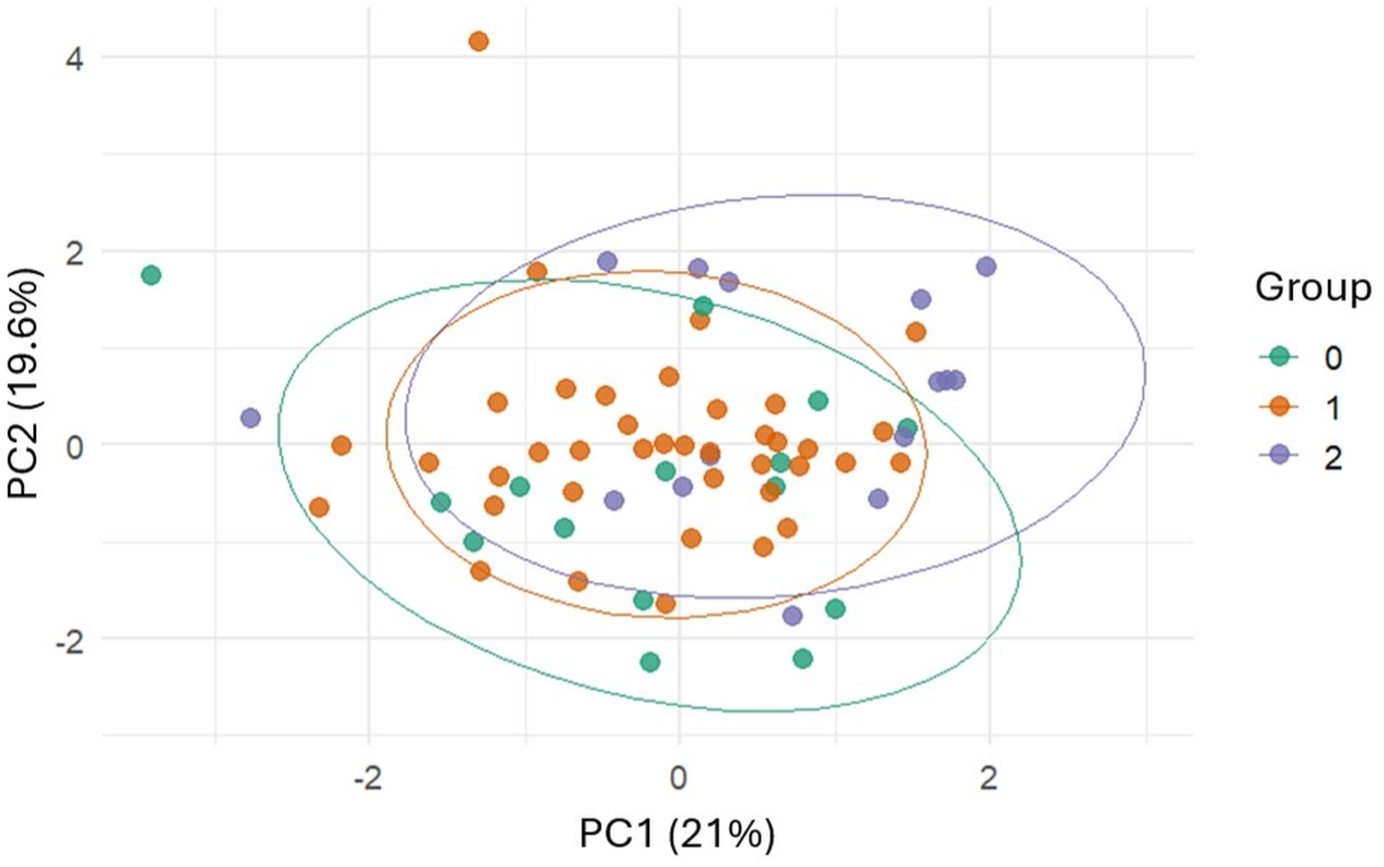
Figure 1: Principal component analysis of selected peripheral immune-cell subsets across diagnostic groups. Each point represents one participant, coloured according to diagnostic group: NDC, non-degenerative cognitive complaints; AD, biomarker-defined Alzheimer’s disease; and OD, other dementias. Ellipses indicate group-level dispersion in the PCA space. PC1 and PC2 explained 21.0% and 19.6% of the total variance, respectively. The plot shows substantial overlap between diagnostic groups, without complete separation, although OD participants tended to extend towards higher PC1 and PC2 values.
The study included 79 participants: 43 with biomarker-defined AD, 18 with other dementias, and 18 with non-degenerative cognitive complaints.
Interestingly, researchers found no significant differences in peripheral lymphocyte populations between early AD and the non-degenerative cognitive complaint group after correction for multiple testing.
Some modest differences emerged when comparing AD with other dementias. These included:
- Higher frequencies of Th17-like regulatory T cells in the other dementia group.
- A similar trend for Th9-like cells, although this did not remain significant after multiple-testing correction.
- A relationship between Th17-like regulatory T cells and CSF neurofilament light chain, a marker associated with neuronal injury.
An exploratory model incorporating double-negative T-cell subsets showed moderate discrimination between AD and non-degenerative cognitive complaints (AUC 0.743), but this finding has not been externally validated.
These findings suggest that prominent changes in peripheral adaptive immune cell populations may not yet be established during the earliest biomarker-defined stages of AD. They also highlight the importance of distinguishing immune alterations associated with AD from those that may accompany neurodegeneration more broadly.
The study is relatively small and single-centre, and its exploratory immune signatures require functional and independent validation. Importantly, the findings do not support using peripheral lymphocyte profiles as biomarkers for early AD detection at this stage.
Journal article: Cabanero-Navalon, M.D., et al. 2026. Peripheral T- and B-cell immune signatures in early Alzheimer’s disease. Frontiers in Immunology.
Summary by Stefan Botha