

Vulvovaginal candidiasis, commonly known as a vaginal yeast infection, affects up to three-quarters of women at least once in their lifetime. While Candida albicans is the fungal pathogen responsible, much of the itching, burning and discomfort is driven by the host inflammatory response.
A new study reveals how albumin, the most abundant protein in human blood, may contribute to this excessive inflammation while simultaneously helping the fungus evade immune attack (Figure 1).
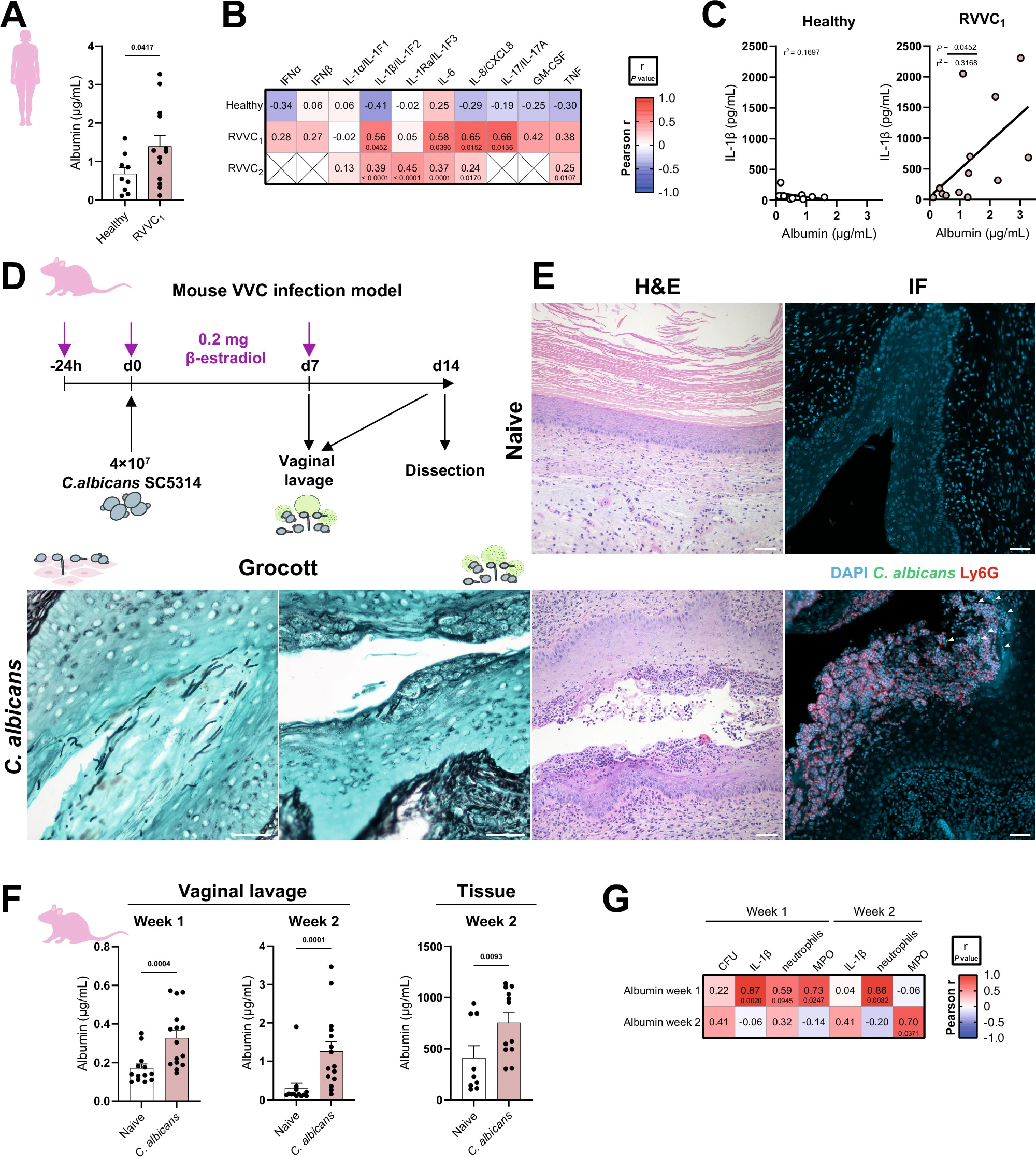
Figure 1: Albumin concentrations correlate with VVC-associated cytokines in vivo. A Albumin concentrations in vaginal lavages of healthy women (n = 9) and RVVC1 patients (n = 13). Significance was tested using a two-tailed Welch’s t-test. B Heatmap showing two-tailed Pearson correlation coefficient (r) of cytokine and albumin concentrations in vaginal lavages from healthy women (n = 9) and two independent cohorts of RVVC patients (n = 13 and n = 102, respectively). C Example of two-tailed Pearson correlations shown in (B) for IL-1β and albumin in the RVVC1 cohort and healthy women. D Mouse VVC infection model scheme. E Representative images of vaginal histology sections of naïve or C. albicans infected mice, 2 weeks after infection. Sections were stained with hematoxylin/eosin to visualize tissue pathology (H&E, scale = 100 µm), Grocott’s (Scale = 50 µm) to visualize fungal presence and immunofluorescence (scale = 50 µm) showing nuclei (DAPI, blue), C. albicans (anti-Candida antibody, green, indicated by white arrowheads) and neutrophils (anti-Ly6G, red). Images are representative of 4 mice per group. F Albumin levels in vaginal lavages (n = 13 uninfected and n = 15 infected) or organ homogenate (n = 9 uninfected and n = 12 infected) from β-estradiol-treated, and β-estradiol-treated C. albicans-infected mice. Significances were calculated using two-tailed Mann–Whitney U-test. G two-tailed Pearson correlations between albumin concentrations and colony forming units (CFUs, week 1), IL-1β concentrations, MPO concentrations, or neutrophil count (n = 9 mice) in vaginal lavages one week after infection of β-estradiol-treated mice with C. albicans. Data in (F and G) are pooled data from three and two independently conducted experiments, respectively. Bars represent the mean + SEM with dots as individual biological replicates.
In samples from patients with recurrent vulvovaginal candidiasis, higher albumin concentrations were associated with increased levels of inflammatory mediators. The researchers identified two mechanisms that may explain this relationship:
Amplifying the inflammatory alarm: Albumin stimulates C. albicans to produce the fungal enzyme Sap1. In macrophages, Sap1 activates the NLRP3 inflammasome, promoting the release of interleukin-1β (IL-1β). This inflammatory signal can recruit and activate additional immune cells, further intensifying inflammation.
Protecting the fungus from immune attack: Albumin can scavenge reactive oxygen species (ROS), important antimicrobial molecules used by macrophages and neutrophils. It also appears to help Candida strengthen its resistance to oxidative stress, allowing more fungal cells to survive immune attack.
The findings suggest a potential vicious cycle: fungal infection increases inflammation and blood vessel permeability, allowing more albumin to enter the vaginal tissue. Albumin then promotes further inflammasome activation while helping Candida withstand immune killing. The result is a stronger inflammatory response without necessarily improving fungal clearance.
The study highlights an important distinction in mucosal immunity: a stronger immune response does not always translate into more effective pathogen elimination. Understanding how host proteins such as albumin influence the balance between inflammation and antimicrobial defence could help explain recurrent or particularly inflammatory infections.
The therapeutic challenge will be to reduce damaging inflammation without compromising the immune system’s ability to control the fungus.
Journal article: Austermeier, S., et al. 2026. Local albumin excess exacerbates Candida albicans-induced inflammasome activation linked with hyperinflammation during vulvovaginal candidiasis. Nature Communications.
Summary by Stefan Botha