


The small intestine does more than absorb nutrients, it is also a frontline barrier against pathogens, coordinating complex interactions between epithelial cells and the immune system. Yet, how different infections reshape this cellular landscape remains poorly understood.
Researchers have developed GutPath, a single-cell atlas containing more than 500,000 cells, profiling gene and protein expression across the ileum and its draining lymph nodes during diverse infections and microbial colonisation (Figure 1).
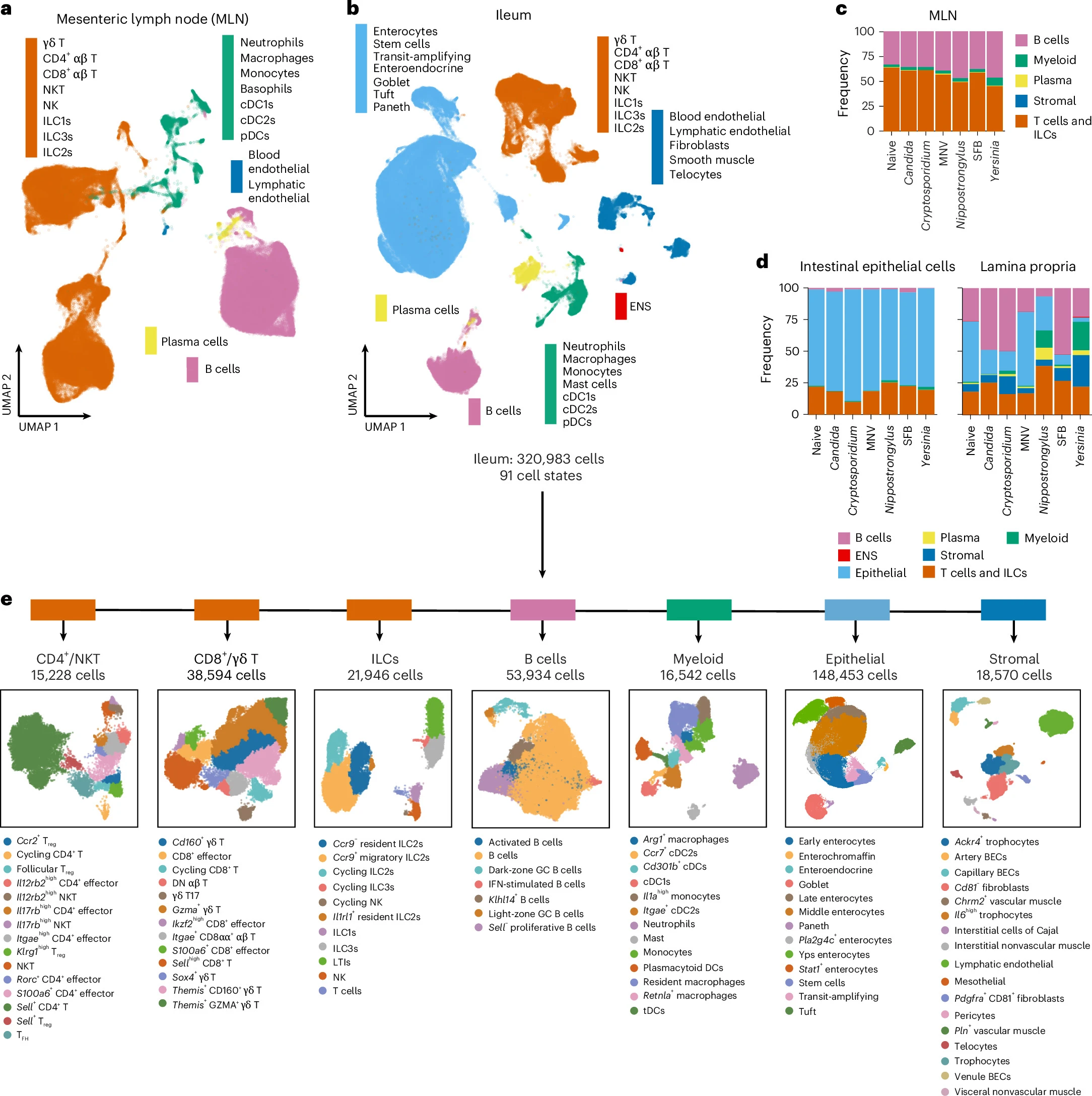
Figure 1: GutPath as a resource for mining mucosal responses to infection. a,b, Uniform Manifold Approximation and Projection (UMAP) dimensionality reduction of CITE-seq data, depicting major cell lineages (indicated by color) and annotated cell types in the MLN (a) and ileum (b) across all infections or colonizations. c,d, Frequencies of major cell lineages (indicated by color) in the MLN (c) for each condition and in the IECs (d, left) and LP (d, right) across infections or colonizations. e, UMAP plots and cell numbers of ileal cell subsets after reclustering and high-resolution cell annotation. Major cell lineages to which each subset belongs are indicated on the top edge by the same colors as in b. Plasma cells and enteric nervous system lineages are not shown. Number of replicate mice for each condition: naive, n = 2; Candida, n = 2; Cryptosporidium, n = 3; MNV, n = 2; Nippostrongylus, n = 2; SFB, n = 2; Yersinia, n = 3. Treg, regulatory T cells; TFH, T follicular helper cells; T17, T cells characterized by their production of IL-17 and/or Rorc expression; DN, double negative; LTIs, lymphoid tissue inducer cells; GC, germinal center; DCs, dendritic cells; cDCs, conventional dendritic cells; pDCs, plasmacytoid dendritic cells; tDCs, transitional dendritic cells; BECs, blood endothelial cells; ENS, enteric nervous system.
The atlas identifies 91 cell states in the ileum and captures immune responses across six infectious model systems, spanning different pathogen types.
GutPath reveals that intestinal responses are not uniform. Different pathogens trigger distinct cellular and molecular programmes, including pathogen-specific responses in enterocytes, the epithelial cells responsible for nutrient absorption and barrier function.
Researchers also identified a previously uncharacterised enterocyte state during Yersinia pseudotuberculosis infection. This state was spatially associated with bacterial burden and tissue pathology, linking cellular changes to the local infection environment.
By combining single-cell transcriptomics, protein profiling and spatial analysis, GutPath provides a resource for investigating how intestinal cells communicate and coordinate pathogen-specific responses.
The atlas could help researchers better understand intestinal infections and inflammatory conditions such as Crohn’s disease, where the ileum is frequently affected.
Understanding infection requires more than identifying which immune cells are present, it means uncovering which cell states emerge, how they interact, and where these responses occur within the tissue.
🔗 Explore the atlas: https://gutpath.org
Journal article: Hart, A., et al. 2026. Diverse infections transcriptionally reprogram the intestinal epithelium and epithelial–immune cell interactions. Nature Immunology.
Summary by Stefan Botha