


Researchers have uncovered how cytokine signals can physically reorganise DNA inside CD4+ T cells to activate genes that are essential for immune cell function (Figure 1).
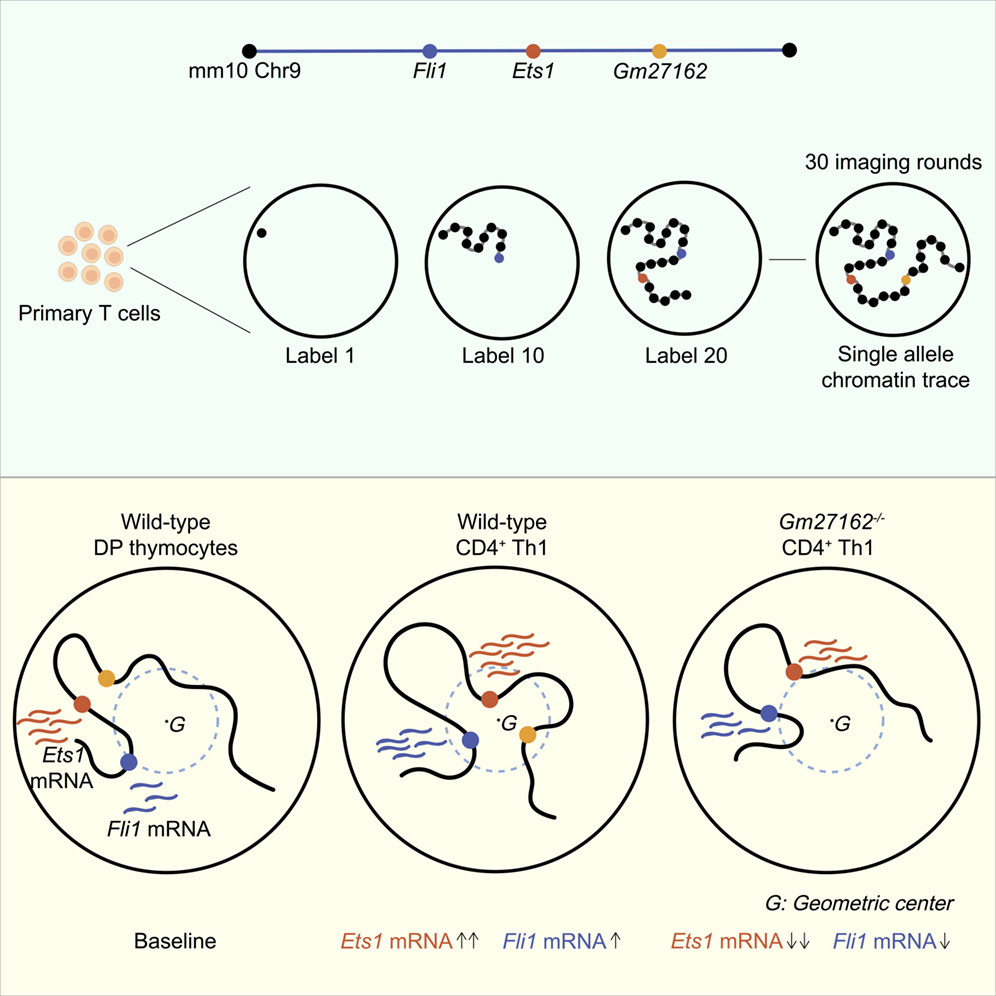
Figure 1: Graphical abstract.
The study focused on the Ets1-Fli1 genomic locus, which contains two related transcription factors that are important for T-cell development and effector responses. The researchers investigated how the three-dimensional organisation of this region changes as naïve CD4+ T cells respond to cytokines and develop into specialised T-helper cells.
Using epigenomic profiling and single-allele chromatin tracing, the team found that Ets1, Fli1 and a regulatory region called the Gm27162 super-enhancer can form simultaneous, multi-way interactions within the same genomic region. These physical contacts were associated with coordinated gene activity.
One of the most striking findings was that cytokine signals did not simply switch genes on, they reorganised the physical architecture of the locus.
In Th1 cells, cytokine stimulation increased interactions between Ets1, Fli1 and Gm27162. The super-enhancer moved toward the geometric centre of the genomic region, bringing it into a configuration associated with increased expression of both transcription factors.
When the researchers deleted the super-enhancer, this cytokine-driven reorganisation was lost. The cells also reverted toward a chromatin and gene-expression state resembling immature double-positive thymocytes.
The team also investigated a CTCF-bound boundary within the locus. Removing this boundary caused the genomic region to become less compact but surprisingly did not substantially alter Ets1 expression or T-cell development. In contrast, removing the super-enhancer altered the spatial relationship between Ets1 and Fli1, with closer promoter proximity associated with greater coordinated expression.
These results suggest that different elements of the locus have distinct structural functions: some help organise the overall genomic architecture, while the super-enhancer plays a more direct role in coordinating cytokine-responsive gene activation.
Why it matters: The study provides a mechanism for how extracellular immune signals can be translated into changes in 3D genome organisation and T-cell gene expression. It also offers a potential explanation for how non-coding genetic variants within the Ets1-Fli1 region could disrupt T-cell regulation and contribute to immune-mediated diseases.
In other words, cytokines may not simply tell a T cell which genes to activate, they can help physically rearrange the genome so that the right regulatory elements are brought together.
Journal article: Jay, A., et al. 2026. Single-allele chromatin tracing reveals cytokine-dependent super-enhancer repositioning in CD4+ T cells. Immunity.
Summary by Stefan Botha