


Tumours do more than compete with immune cells for nutrients, they can actively reshape how nutrients are used within the tumour microenvironment to simultaneously support their own growth and suppress immune responses.
In a new study, researchers found that tumours dynamically alter the metabolism of the amino acids arginine and lysine as they progress (Figure 1). The findings reveal a previously underappreciated metabolic trade-off that allows cancer cells to optimise their growth while limiting the ability of immune cells to attack them.
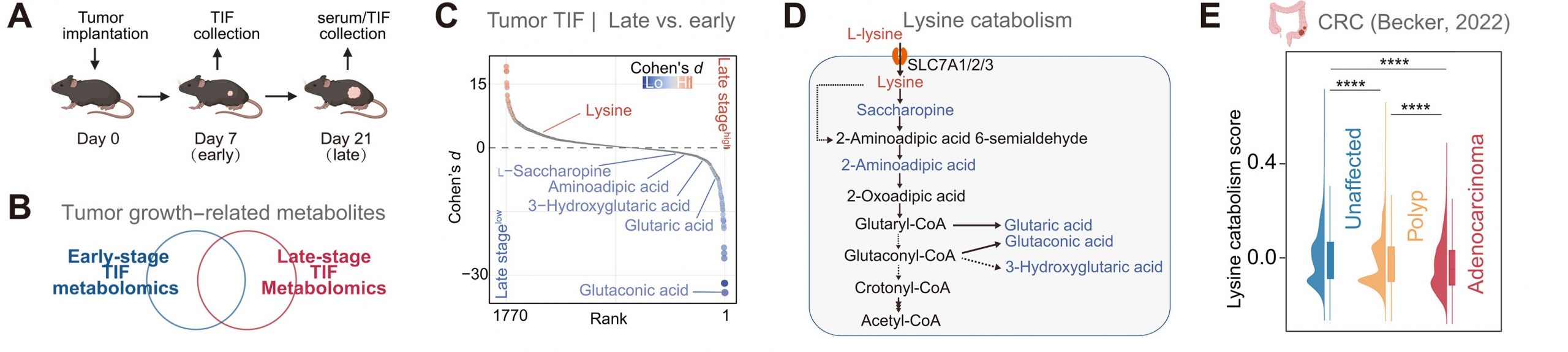
Figure 1: Progressive suppression of lysine catabolism during tumor progression. (A) Sample collection from MC38 tumor–bearing mice. (B) Venn diagram of metabolites detected in TIF. (C) Dot plot showing expression of lysine and its catabolites in TIF. (D) l-lysine catabolic pathway. (E) Half-violin and box plots of lysine catabolism in epithelial cells during CRC progression (24). Shortened from publication.
The researchers found that increased expression of SLC7A1, a transporter involved in amino acid uptake, enhanced the uptake and utilisation of arginine by tumour cells. This metabolic shift supported tumour growth.
At the same time, tumours reduced lysine breakdown through decreased expression of SLC7A2. While this appeared beneficial to the tumour, it also had an important consequence for the immune response: reduced lysine catabolism lowered production of glutaconic acid (GC), a metabolic product that can enhance the activity of anti-tumour CD8+ T cells.
The study revealed that GC can modify pyruvate kinase M2 (PKM2) through a post-translational modification called glutaconylation, specifically at lysine residues K336 and K337.
This modification stabilised PKM2 in its dimeric form and altered metabolic gene expression in a way that helped reinvigorate CD8+ T-cell function.
Consequently, by suppressing the metabolic pathway that generates GC, tumour cells can effectively reduce a metabolite that would otherwise support anti-tumour immunity.
The researchers therefore describe an amino acid trade-off within the tumour microenvironment: cancer cells increase the use of arginine to fuel their own growth while restricting lysine catabolism and the production of an immunostimulatory metabolite. This allows the tumour to simultaneously promote proliferation and create conditions that are less favourable for effective T-cell responses.
The findings were observed across multiple mouse tumour models and supported by analyses of patient datasets, suggesting that these metabolic changes are relevant beyond a single experimental cancer model.
Why it matters: Tumour metabolism is often viewed simply as a competition for nutrients, but this study suggests a more sophisticated mechanism in which cancer cells selectively rewire individual amino acid pathways to balance their own metabolic needs with immune evasion. Targeting these metabolic adaptations, or restoring metabolites such as GC that enhance CD8+ T-cell function, could provide new strategies for improving anti-tumour immunity and potentially the effectiveness of cancer immunotherapy.
Journal article: Yu, W., et al. 2026. Dynamic regulation of lysine and arginine metabolism promotes immune evasion by limiting T cell function in cancer. Science Immunology.
Summary by Stefan Botha