


A recent study showed that a single episode of malaria may cause long-lasting changes to the immune architecture of the spleen (Figure 1). The study found that malaria permanently reduces a specialised population of spleen-resident macrophages that help filter the blood, recycle iron and coordinate immune responses.
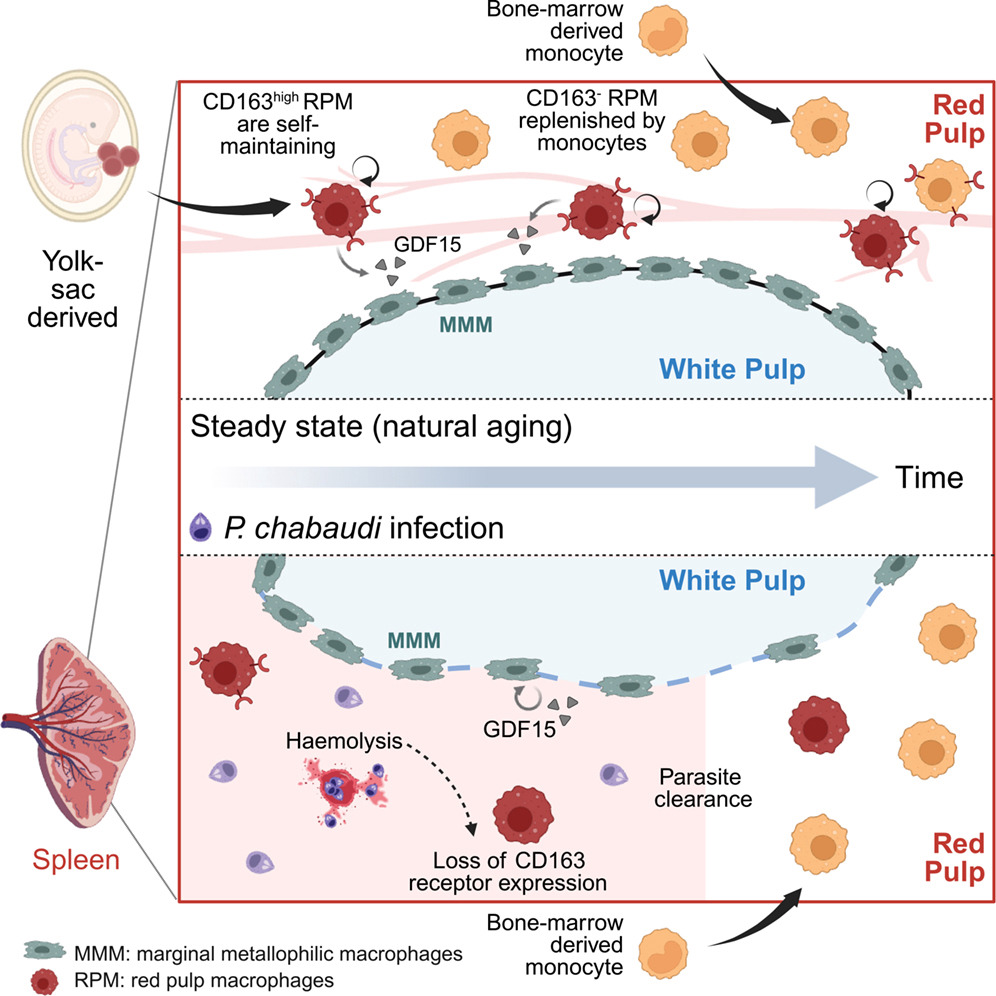
Figure 1: Graphical abstract.
The findings, published in Immunity, suggest that the effects of malaria may persist long after parasites have been cleared and could influence how the body responds to future infections and vaccines.
Macrophages are immune cells that engulf pathogens, damaged cells and other unwanted material. The spleen contains specialised populations of macrophages that continuously remove damaged red blood cells and recycle their iron.
Some of these cells are tissue-resident macrophages, established during embryonic development and maintained locally throughout life. Others are recruited from circulating blood cells and can enter tissues when additional immune cells are needed.
Researchers have traditionally assumed that recruited macrophages could largely replace resident macrophages following severe infection or tissue damage. The new study suggests that this replacement is not equivalent: newly recruited cells may occupy the same location but do not necessarily acquire all of the specialised characteristics and functions of the original population.
The researchers focused on CD163-positive macrophages in the spleen, which are particularly important for clearing damaged red blood cells and recycling iron.
Using genetically modified mice, they found that blood-stage malaria caused a substantial loss of these resident macrophages. Although the infection eventually cleared, the CD163 macrophage population remained depleted for months after infection.
The vacant niches were instead occupied by macrophages derived from bone marrow cells. However, these replacement cells did not fully reproduce the characteristics of the original resident macrophages.
The consequences were not limited to the disappearance of one macrophage population. CD163-positive macrophages normally communicate with another specialised macrophage population in the marginal zone of the spleen. This cellular network helps maintain the organisation of the spleen and supports communication between immune cells responding to blood-borne pathogens. Following malaria infection, this macrophage communication network was persistently disrupted.
Further experiments showed that depletion of CD163 macrophages was associated with more severe malaria in mice, including higher parasite levels in the blood and prolonged anaemia. Importantly, the altered splenic environment also worsened the response to subsequent malaria infections.
The researchers suggest that these findings could have important implications for people living in regions where malaria transmission is frequent.
Because CD163-positive macrophages are also found in the human spleen, malaria may similarly alter the organisation and function of the human splenic immune system. A previous infection could therefore leave behind a lasting change in immune surveillance, blood-cell clearance and iron metabolism, even after the parasite has disappeared.
This may also be relevant to malaria vaccine responses, particularly in populations repeatedly exposed to infection, although the study’s findings in mice will need to be confirmed in humans.
The study also challenges the assumption that recruited macrophages can simply replace tissue-resident populations after infection. Understanding the differences between these macrophage populations could help researchers develop strategies to restore tissue-specific immune functions after severe infections.
The findings may therefore have implications beyond malaria, potentially informing research into how other infections cause long-term changes to tissue-resident immune cells and how these changes might be reversed.
Journal article: Mauel, K., et al. 2026. CD163+ red pulp macrophages interact with marginal metallophilic macrophages during blood-stage malaria to maintain splenic architecture. Immunity.
Summary by Stefan Botha