


Researchers have developed a precision approach to treating inflammatory bowel disease (IBD) by using bacteriophages, viruses that selectively infect bacteria, to disarm harmful gut microbes without disrupting the wider microbiome (Figure 1). The findings demonstrate that targeting disease-causing bacteria can reduce intestinal inflammation while enhancing the effectiveness of existing therapies.
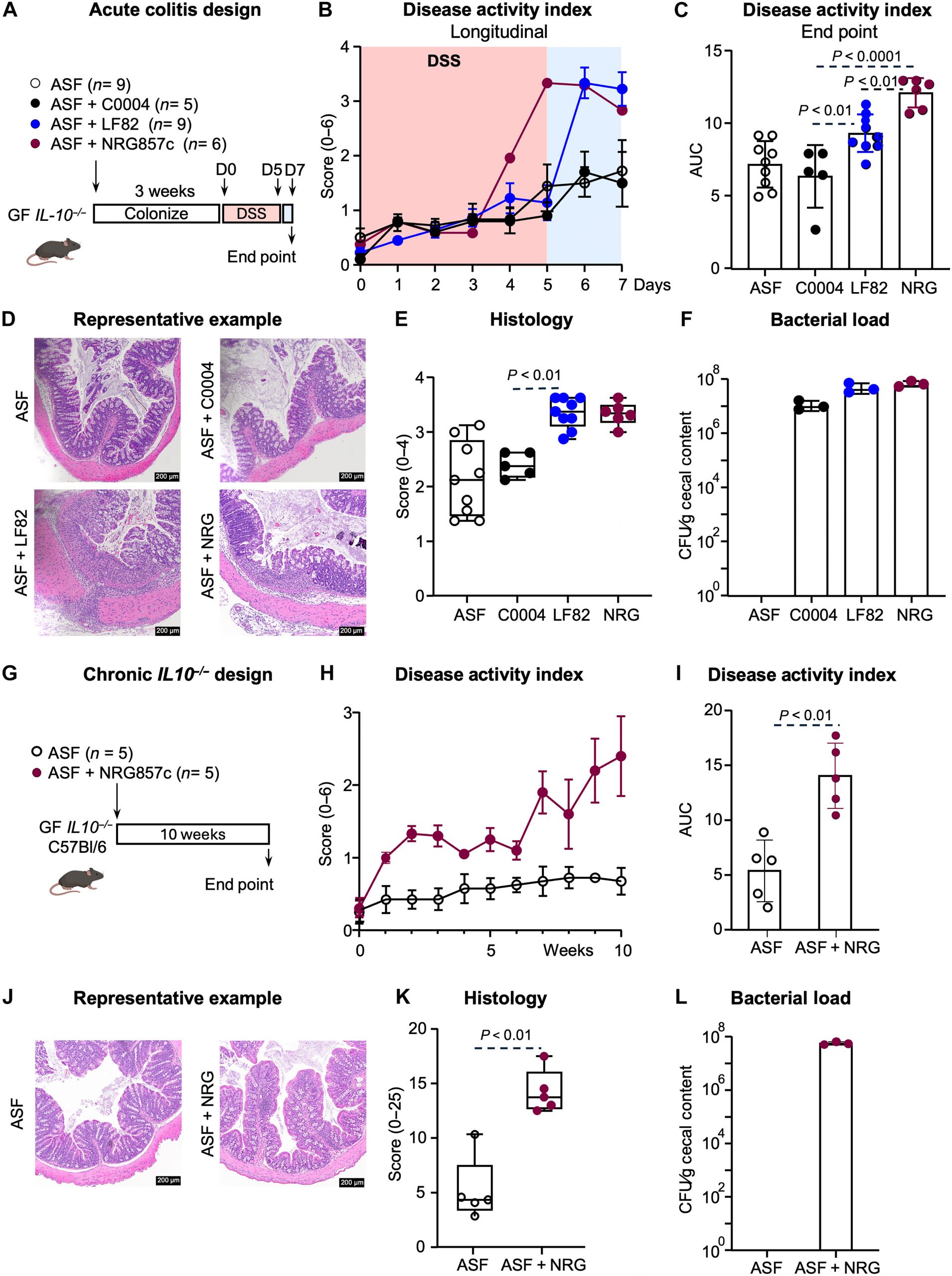
Figure 1: CD-associated AIEC exacerbates colitis in gnotobiotic mouse models. (A) GF C57BL/6 mice were co-colonized with ASF and 108 CFU of E. coli NRG857c for 3 weeks. Mice were treated with low-grade DSS (2%, w/v) for 5 days, followed by 2 days of water. D0, day 0. (B) DAI scores (stool consistency plus occult blood) analyzed longitudinally (dots represent daily mean DAI score of each group ± SD). (C) AUCs for DAI scores at end point (each dot represents longitudinal AUC for one mouse; bar plots represent means ± SD). Statistical significance was determined by a one-way ANOVA with Tukey post hoc test. (D) Representative histology examples of cross-sectional proximal colon. Scale bars, 200 μm. (E) Histology scores (Cooper score method; each dot represents one mouse; box-and-whisker plot represents median values, interquartile range, minimum values, and maximum values) (45). Statistical significance was determined by a one-way ANOVA with Tukey post hoc test. (F) Cecal bacterial loads at end point. (G) GF C57BL/6 IL-10−/− mice were co-colonized with ASF and 108 CFU of E. coli NRG857c and monitored weekly for 10 weeks. (H) DAI scores (stool consistency plus occult blood) analyzed longitudinally (dots represent daily mean DAI score ± SD). (I) AUCs for DAI scores at end point (each dot represents longitudinal AUC for one mouse per group; bar plots represent means ± SD). Statistical significance was determined Mann-Whitney U test. (J) Representative histology examples of cross-sectional proximal colon. Scale bars, 200 μm. (K) Histology scores, using a modified grading system (each dot represents one mouse; box-and-whisker plot represents median values, interquartile range, minimum values, and maximum values) (44). Statistical significance was determined by Mann-Whitney U test. (L) Cecal bacterial loads at end point (bar plots represent means ± SD).
The study offers a promising step towards personalised microbiome-based treatments for Crohn’s disease, one of the major forms of IBD.
IBD affects hundreds of thousands of people worldwide and results from complex interactions between genetics, the immune system and the gut microbiome. Current treatments can control inflammation but often lose effectiveness over time or require increasing doses, which may lead to significant side effects.
The researchers focused on adherent-invasive Escherichia coli (AIEC), a group of bacteria that has been linked to intestinal inflammation in a subset of patients with Crohn’s disease. Unlike many bacterial pathogens, AIEC are defined by their behaviour, specifically their ability to attach to and invade intestinal cells and survive within immune cells, making them difficult to identify and selectively eliminate.
Rather than using broad-spectrum antibiotics, the team employed bacteriophages, naturally occurring viruses that infect only specific bacterial strains. This highly targeted approach allows harmful bacteria to be controlled while preserving beneficial members of the gut microbiome.
The researchers isolated bacteriophages capable of specifically infecting AIEC strains obtained from patients with Crohn’s disease. In experimental models, phage treatment significantly reduced intestinal inflammation.
Importantly, the phages did not eradicate the bacteria. Instead, they suppressed the expression of a key bacterial virulence factor—a molecular structure that enables AIEC to adhere to the intestinal lining and trigger inflammatory immune responses. By disabling this mechanism, the bacteria remained present but were no longer able to drive disease.
This strategy represents a shift from killing bacteria outright to reducing their disease-causing potential, an approach that may place less selective pressure on microbes and better preserve the balance of the intestinal ecosystem.
The study also found that phage therapy enhanced the effects of corticosteroids, one of the most commonly prescribed treatments for IBD. When used in combination with bacteriophages, lower doses of steroids achieved anti-inflammatory effects comparable to those seen with higher steroid doses alone.
While bacteriophages have previously been shown to improve antibiotic activity, this is the first report demonstrating that phage therapy can also enhance the efficacy of a non-antibiotic medication, highlighting its potential as an adjunct treatment for chronic inflammatory disease.
The bacterial virulence mechanism targeted by the phages can be detected in stool samples and was found to be elevated in a subset of patients with Crohn’s disease. This raises the possibility of identifying patients who are most likely to benefit from this precision therapy, bringing microbiome-guided personalised medicine closer to clinical practice.
The researchers are now expanding their work to evaluate larger collections of patient-derived bacterial strains and develop combinations of bacteriophages with broader therapeutic activity before progressing towards clinical trials.
Together, the findings demonstrate how precisely targeting disease-associated bacterial functions, rather than broadly eliminating microbes, could provide a safer and more effective approach to managing inflammatory bowel disease.
Journal article: Jackson K, et al. 2026. Phage intervention improves colitis and response to corticosteroids by attenuating virulence of Crohn’s disease-associated bacteria. Science Translational Medicine.
Summary by Stefan Botha