


A new study has revealed how a specialised population of CD8⁺ T cells contribute to kidney damage in lupus nephritis, identifying a pathway that links immune cell development in lymph nodes to destructive inflammation within the kidney (Figure 1).
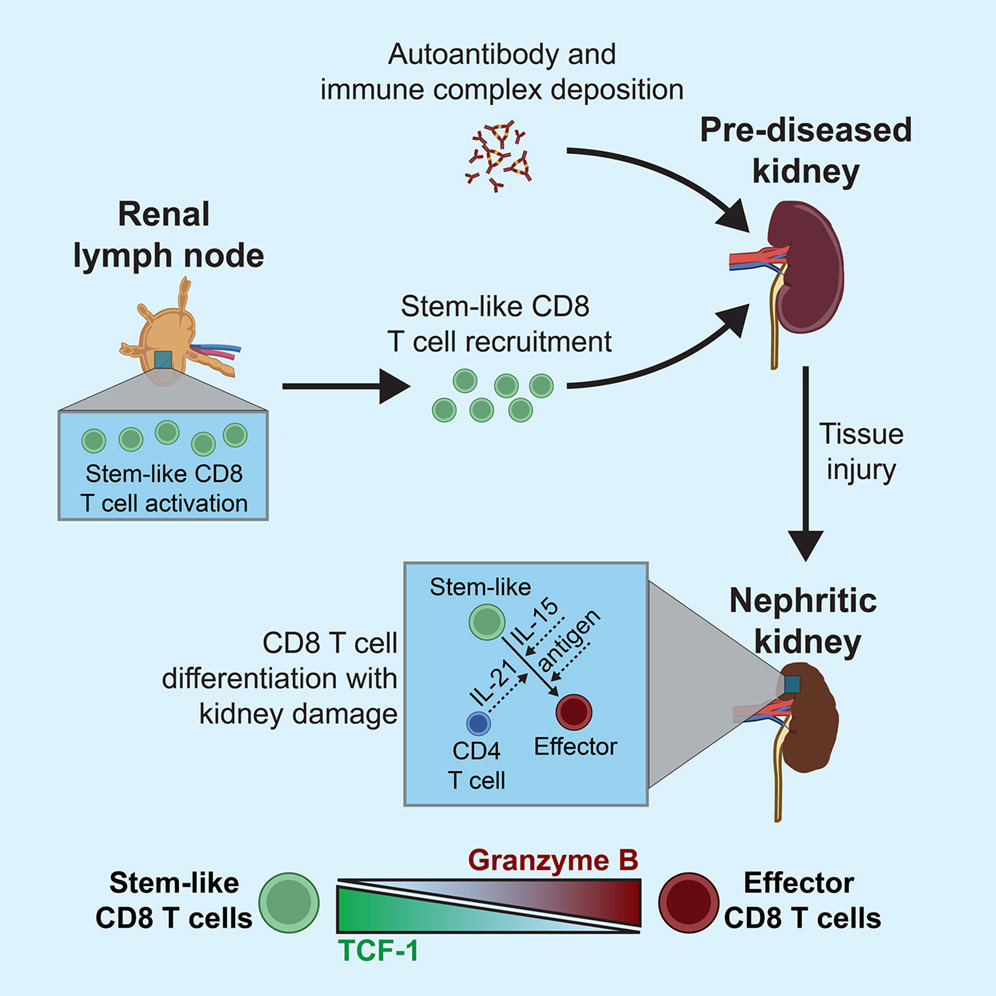
Figure 1: Graphical abstract.
Systemic lupus erythematosus (SLE) is an autoimmune disease characterised by the loss of immune tolerance, production of autoantibodies, and formation of immune complexes that accumulate in tissues. While these antibody-mediated processes are central features of disease, the presence of CD8⁺ T cells within the kidney have emerged as one of the strongest predictors of poor outcomes in lupus nephritis, a severe and potentially life-threatening complication of SLE.
Until now, however, it has remained unclear where these kidney-infiltrating CD8⁺ T cells originate, how they acquire their damaging properties, and what signals drive their activation.
Researchers studying lupus-prone mouse models have now identified a population of TCF-1⁺ stem-like CD8⁺ T cells within kidney-draining lymph nodes that act as a reservoir for pathogenic immune responses. These cells undergo antigen-specific expansion following recognition of their target signals through the T cell receptor (TCR), before migrating into the kidney and differentiating into highly inflammatory cytotoxic cells.
Once inside the kidney, these antigen-experienced CD8⁺ T cells undergo clonal expansion and acquire strong effector functions, including the ability to directly damage tissue. Importantly, their pathogenic activity depends on support from CD4⁺ T cells and signalling through the cytokines interleukin-21 (IL-21) and interleukin-15 (IL-15), which promote their differentiation and cytotoxic capacity.
The researchers found that this differentiation process resembles immune responses observed in chronic viral infections and cancer, where stem-like T cells continuously generate more differentiated effector populations. However, unlike exhausted T cells commonly observed in chronic infection and tumours, CD8⁺ T cells in lupus nephritis retain their ability to attack tissues despite expressing immune checkpoint molecules associated with terminal differentiation.
This finding highlights an important distinction between autoimmune and cancer-associated T cell states: in lupus, these cells do not simply become dysfunctional. Instead, they maintain a persistent capacity for tissue destruction.
The study also identified a similar CD8⁺ T cell differentiation program in kidney samples from patients with lupus nephritis, suggesting that this mechanism is conserved between experimental models and human disease.
Together, these findings redefine how CD8⁺ T cells contribute to lupus nephritis. Rather than being recruited randomly during inflammation, pathogenic kidney-infiltrating CD8⁺ T cells appear to develop through an organised developmental pathway beginning in renal-draining lymph nodes, where stem-like populations are activated before generating destructive effector cells in the kidney.
By identifying the IL-15 and IL-21 signalling pathways that regulate this process, the study highlights potential therapeutic opportunities to selectively target pathogenic T cell differentiation while preserving broader immune function.
These insights expand our understanding of lupus nephritis beyond antibody-mediated disease and reveal a critical role for adaptive T cell programming in driving autoimmune organ damage.
Journal article: Souz, J.A., et al. 2026. Organ injury in systemic autoimmunity is mediated by stem-like CD8+ T cells arising from tissue-draining lymph nodes. Cell Immunity.
Summary by Stefan Botha