


A pioneering gene therapy could offer a new treatment approach for patients living with CTLA-4 insufficiency, a rare and potentially life-threatening immune disorder caused by defects in immune regulation (Figure 1).
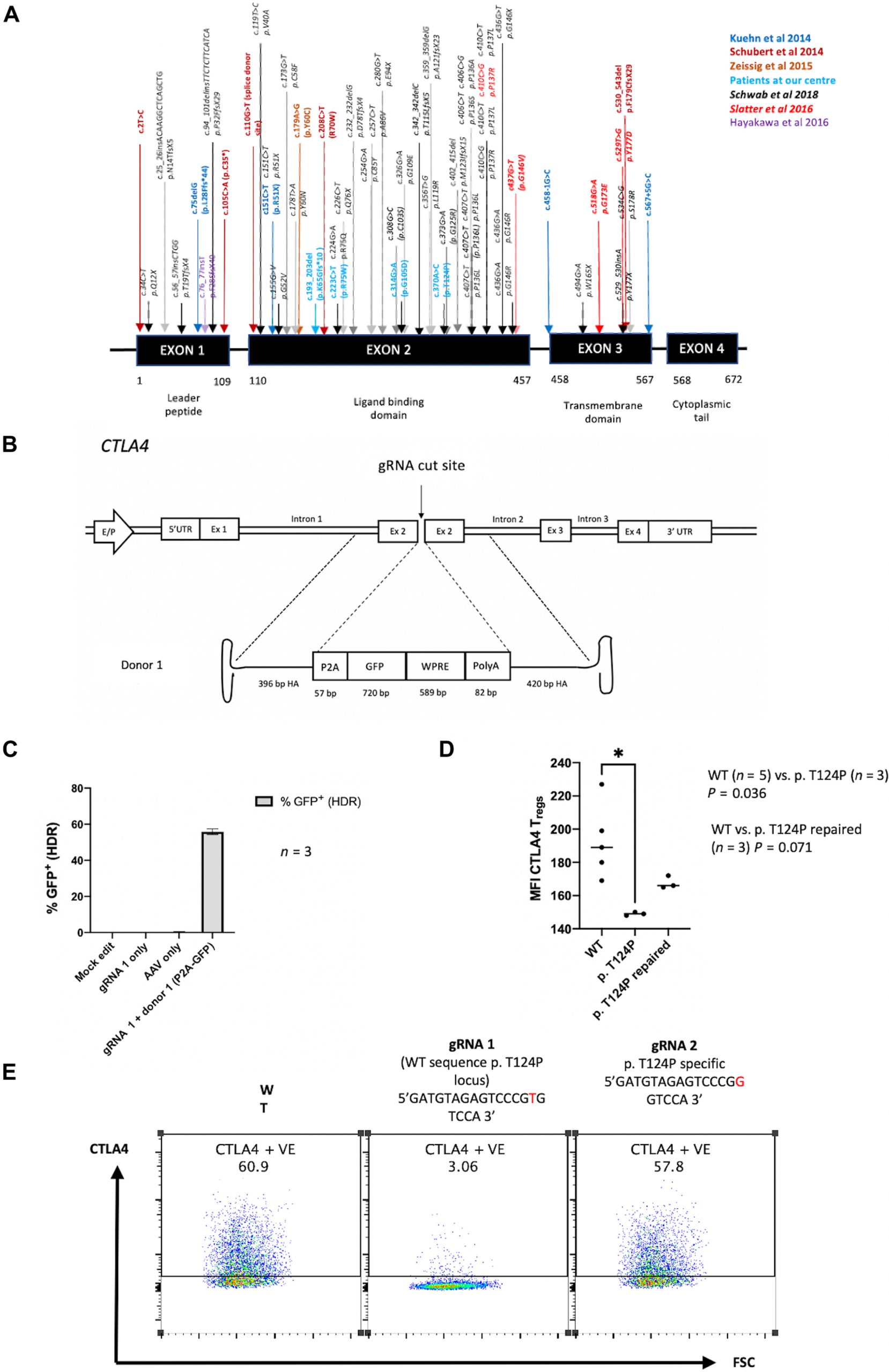
Figure 1: Targeting the CTLA-4 locus with CRISPR-Cas9 and repair of a point mutation. (A) Schematic representation of the mutational landscape of CTLA-4 insufficiency. Mutations are color coded by citation (key, bottom right). (B) Schematic representation of HDR donor 1 (P2A-GFP-WPRE-PolyA). (C) Average HDR rate (n = 3, percentage GFP+ in cells from six separate healthy donors; mean, 55.83; SD, 1.626). (D) Median fluorescent intensity (MFI) of CTLA-4 from five separate healthy controls and three separate samples from a single patient with p.T124P c.370A>C, unedited or edited. A significant difference was seen in CTLA-4 MFI between WT and p. T124P heterozygous mutant cells (P = 0.036, Mann-Whitney test). After editing, the difference in MFI was no longer significant (P = 0.071). (E) Flow cytometry plot demonstrating surface CTLA-4 expression in cells from a healthy individual in an unedited control (left), edited with a gRNA specific for the WT CTLA-4 sequence (gRNA 1) with resulting knockdown of CTLA-4 protein (center), and a population edited with a gRNA specific for the p.T124P c.371A>C (gRNA 2; right) demonstrating minimal activity on the WT sequence.
Early pre-clinical studies suggest that correcting the underlying genetic defect in a patient’s own immune cells can restore more balanced immune function, paving the way for a first-in-human clinical trial planned for 2028.
CTLA-4 insufficiency is caused by mutations affecting the CTLA4 gene, which encodes the immune checkpoint protein CTLA-4 (cytotoxic T-lymphocyte-associated protein 4). This protein acts as a critical brake on immune activation, particularly by controlling the activity of regulatory T cells (Tregs) that prevent excessive immune responses.
Individuals with CTLA-4 insufficiency typically have only one functional copy of the gene, resulting in insufficient CTLA-4 protein production. Without adequate regulation, the immune system can become chronically activated, leading to autoimmune complications, inflammation, recurrent infections, and increased risk of immune-related disease.
Current treatment options often rely on bone marrow transplantation, which replaces the stem cells responsible for generating immune cells. While effective in some cases, transplantation carries significant risks and may not be suitable for older or medically fragile patients.
The team is developing an alternative strategy: instead of replacing the entire immune system, they aim to repair the genetic defect directly within a patient’s own immune cells. Using advanced gene-editing technology, researchers employ CRISPR/Cas9 to precisely target the faulty CTLA4 gene. The defective region is removed, and a corrected DNA sequence is introduced into the cell using a modified viral delivery system.
The approach uses a natural cellular repair mechanism called homology-directed repair, allowing the corrected genetic sequence to be integrated while preserving important regulatory regions of the gene. These regions ensure that CTLA-4 production remains controlled and activated only when required by the immune system.
In early laboratory studies, gene-corrected immune cells demonstrated improved regulation of immune activity, suggesting that restoring CTLA-4 expression could correct the underlying biological defect rather than simply managing symptoms.
The next stage of development will be a Phase I clinical trial involving up to eight patients aged between one and 65 years. The trial will primarily assess safety while exploring whether the corrected immune cells can provide meaningful clinical benefit.
Rare immune diseases often provide important insights into fundamental immune biology. By correcting a single genetic defect and observing how immune function is restored, researchers can better understand the mechanisms that maintain immune balance and potentially develop therapies applicable to broader groups of patients.
While further research is required before this treatment becomes available, the development of CTLA-4 gene therapy represents an important milestone in the growing field of precision immunology, where cellular and genetic technologies are being used to repair immune dysfunction at its source.
Journal article: Fox, T.A. et al. 2026. Therapeutic gene editing of T cells to correct CTLA-4 insufficiency. Science Translational Medicine.
Summary by Stefan Botha