


A new study has provided fresh insight into the complex immune and metabolic pathways involved in acute pancreatitis (AP) (Figure 1), revealing strong links between oxidative stress, inflammation, and cell death. This is important as these markers may not yet be reliable tools for predicting disease severity in clinical practice.
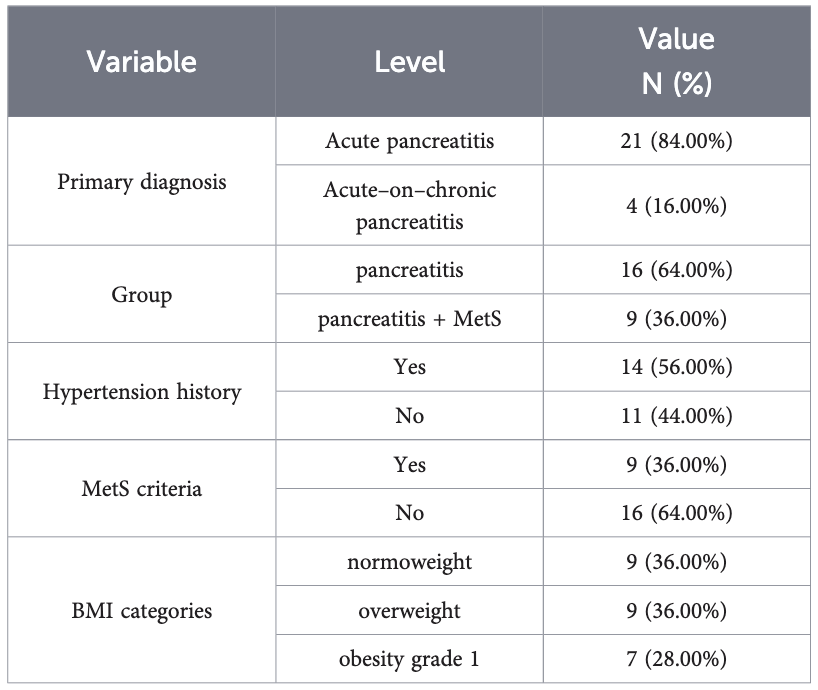
Figure 1: Baseline characteristics—categorical variables and primary diagnosis (n=25).
Acute pancreatitis is one of the most common gastrointestinal conditions requiring hospitalization. The disease occurs when pancreatic enzymes become prematurely activated within the pancreas, leading to tissue injury, inflammation, and in severe cases, systemic complications. While gallstones and alcohol remain the most common causes, metabolic conditions such as obesity, hypertriglyceridemia, and metabolic syndrome are increasingly recognized as major contributors.
Oxidative stress has long been suspected to play a key role in AP progression, but its usefulness as a diagnostic or prognostic biomarker has remained uncertain. To investigate this further, researchers analysed a broad panel of oxidative stress, antioxidant, inflammatory, and apoptosis-related markers in patients presenting with acute pancreatitis.
The team measured markers associated with protein oxidation, lipid peroxidation, antioxidant defences, inflammasome activation, and programmed cell death. These included glutathione (GSH), protein carbonyls (P-carb), catalase, total antioxidant capacity, caspase-3, IL-1β, and AIM2, alongside inflammatory indices such as CRP and systemic inflammatory ratios.
Patients were grouped according to radiologic severity using the Balthazar scoring system to determine whether these molecular signatures could distinguish between mild and more severe disease at presentation.
The findings revealed clear biological interactions between oxidative stress and inflammatory pathways. One of the strongest observations was the tight relationship between glutathione depletion and protein oxidation, suggesting that antioxidant exhaustion occurs alongside increasing cellular damage in AP.
Researchers also identified moderate but robust correlations between caspase-3, a marker of apoptosis, and both inflammatory and oxidative stress markers, supporting the idea that inflammation and programmed cell death are closely intertwined during pancreatic injury.
Interestingly, lipid peroxidation markers such as TBARS appeared to correlate less consistently with disease processes, suggesting that not all oxidative stress pathways contribute equally in AP.
Despite these mechanistic insights, the biomarkers performed poorly as standalone predictors of radiologic severity. Most markers demonstrated only modest discriminatory ability, and composite indices designed to integrate oxidative stress signatures also failed to reliably distinguish severe disease. Multivariable predictive models showed substantial overfitting after statistical correction, limiting their immediate clinical utility. The study also highlights the growing importance of innate immune signalling in pancreatitis. AP is considered a form of sterile inflammation, where tissue damage, rather than infection, drives immune activation.
Damaged pancreatic cells release danger-associated molecular patterns (DAMPs), which activate inflammasomes such as NLRP3. These complexes trigger inflammatory cytokine release, including IL-1β and IL-18, amplifying local tissue damage and systemic inflammatory responses.
Activated neutrophils and macrophages further intensify oxidative injury through the release of reactive oxygen species and cytotoxic mediators, creating a feedback loop between oxidative stress and inflammation.
Although the study suggests that oxidative stress markers are unlikely to become immediate triage tools for assessing pancreatitis severity, the findings provide important mechanistic insight into how redox imbalance, apoptosis, and innate immune signalling interact during disease progression.
Journal article: Pǎdureanu, V., et al. 2026. Evaluation of oxidative stress in acute pancreatitis. Frontiers in Immunology.
Summary by Stefan Botha