


Early diagnosis is critical for successful treatment of Lyme disease, yet current diagnostic tests often fail to detect infection during its earliest stages and cannot distinguish between an active infection and one that was successfully treated years earlier. New research that a different class of immune markers, known as anti-lipid antibodies, could overcome some of these limitations (Figure 1).
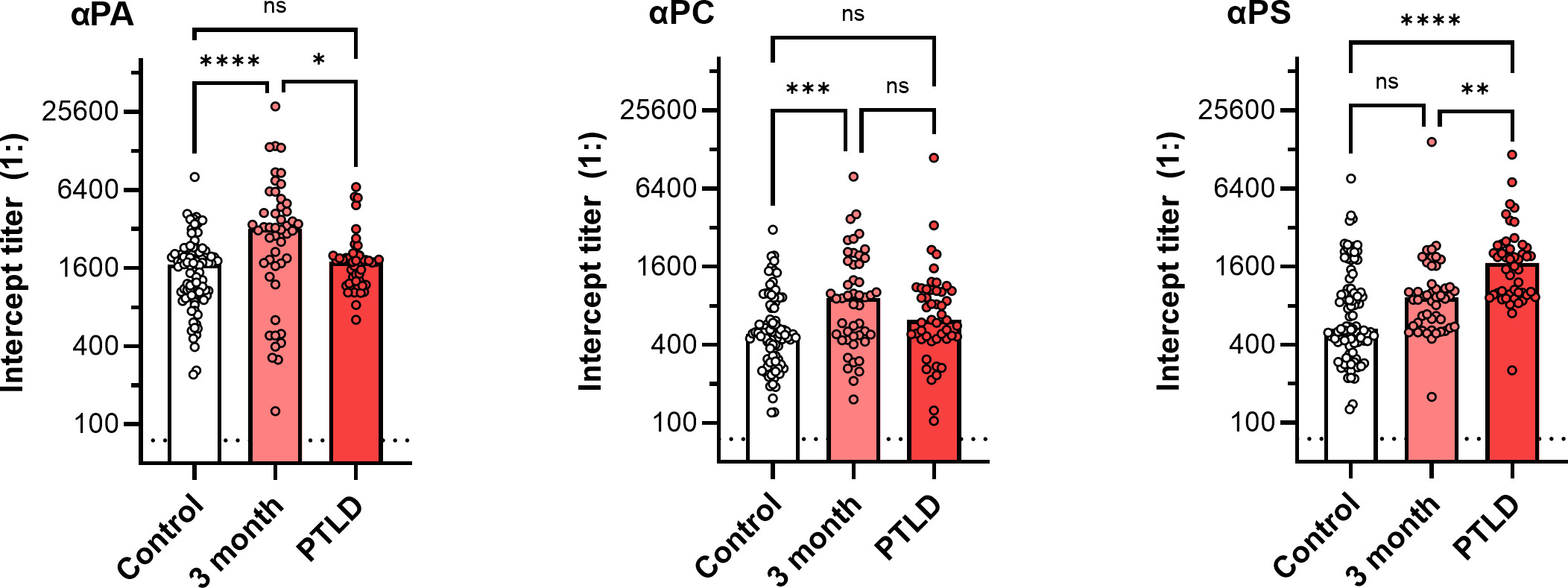
Figure 1: Titers of three IgG antiphospholipids in Lyme disease. Antiphosphatidic acid (αPA), antiphosphatidylcholine (αPC), and antiphosphatidylserine (αPS) were measured at two Lyme disease time points and in healthy controls. Lyme samples (sourced from Tufts and the LDB) were drawn from patients either 3 months after diagnosis regardless of symptoms or >1 year from diagnosis with persistent symptoms. Controls were from individuals in endemic areas (from the LDB) and non-endemic areas (Pel-Freez). n = 93 controls, 48 3 months, and 48 PTLD. Points are titers from individual patients; bars show the median. Pairwise comparisons were performed using Kruskal-Wallis tests with Dunn’s post hoc. *P < 0.05, **P < 0.01, ***P << 0.001, ****P < 0.0001. ns, not significant.
The findings raise the possibility of developing more accurate diagnostic tests that identify Lyme disease earlier, while also helping clinicians recognise patients who may be at risk of persistent symptoms after treatment.
Lyme disease is caused by the bacterium Borrelia burgdorferi, which is transmitted through the bite of infected blacklegged ticks. If left untreated, the infection can progress to cause arthritis, neurological complications and cardiac disease. Although most people recover following antibiotic treatment, approximately 10–20% continue to experience symptoms such as fatigue, pain and cognitive impairment, a condition known as post-treatment Lyme disease syndrome (PTLDS).
Current diagnostic tests detect antibodies directed against Borrelia itself. However, these antibodies often take several weeks to develop and may remain detectable long after the infection has been eliminated, limiting their usefulness for both early diagnosis and monitoring treatment success.
Previous studies from the Tufts research team showed that Lyme disease also triggers antibodies against certain host-derived lipids that are incorporated by the bacteria during infection. Unlike conventional Lyme antibodies, these anti-lipid antibodies appear soon after infection and decline following successful treatment.
To investigate their diagnostic potential, the researchers analysed blood samples from 199 people with Lyme disease, including patients who continued to experience symptoms after completing treatment. These samples were compared with those from healthy volunteers and individuals with conditions that can resemble PTLDS, including lupus, multiple sclerosis, fibromyalgia, long COVID and chronic fatigue syndrome.
The study identified three anti-lipid antibodies that were elevated during Lyme disease. Two markers, anti-phosphatidic acid (αPA) and anti-phosphatidylserine (αPS), were already increased at the time of diagnosis, including in some patients who had not yet tested positive using standard Lyme disease tests. This suggests these markers may help detect infection earlier than current diagnostic methods.
Importantly, elevated αPS levels also persisted in many patients who experienced ongoing symptoms after treatment, while remaining largely absent in people with other autoimmune and chronic conditions. This finding suggests that persistent αPS responses may be associated with post-treatment Lyme disease syndrome rather than representing a general feature of chronic inflammatory disease.
Although the findings are promising, the researchers stress that additional validation is required before anti-lipid antibodies can be used clinically. Larger prospective studies will be needed to determine how accurately these biomarkers detect early infection and predict which patients are likely to develop persistent symptoms.
Journal article: Shrestha, M, et al. 2026. Antiphospholipid antibodies in acute and post-treatment Lyme disease. Infection and Immunity.
Summary by Stefan Botha