


A study has identified a previously unrecognized subset of CD4⁺ T helper cells that may play an important role in chronic intestinal inflammation (Figure 1). The researchers describe these cells as granzyme K–expressing helper T cells, or THK cells, and provide evidence that they represent a distinct T helper lineage rather than a variation of the classical TH1, TH2, or TH17 subsets.
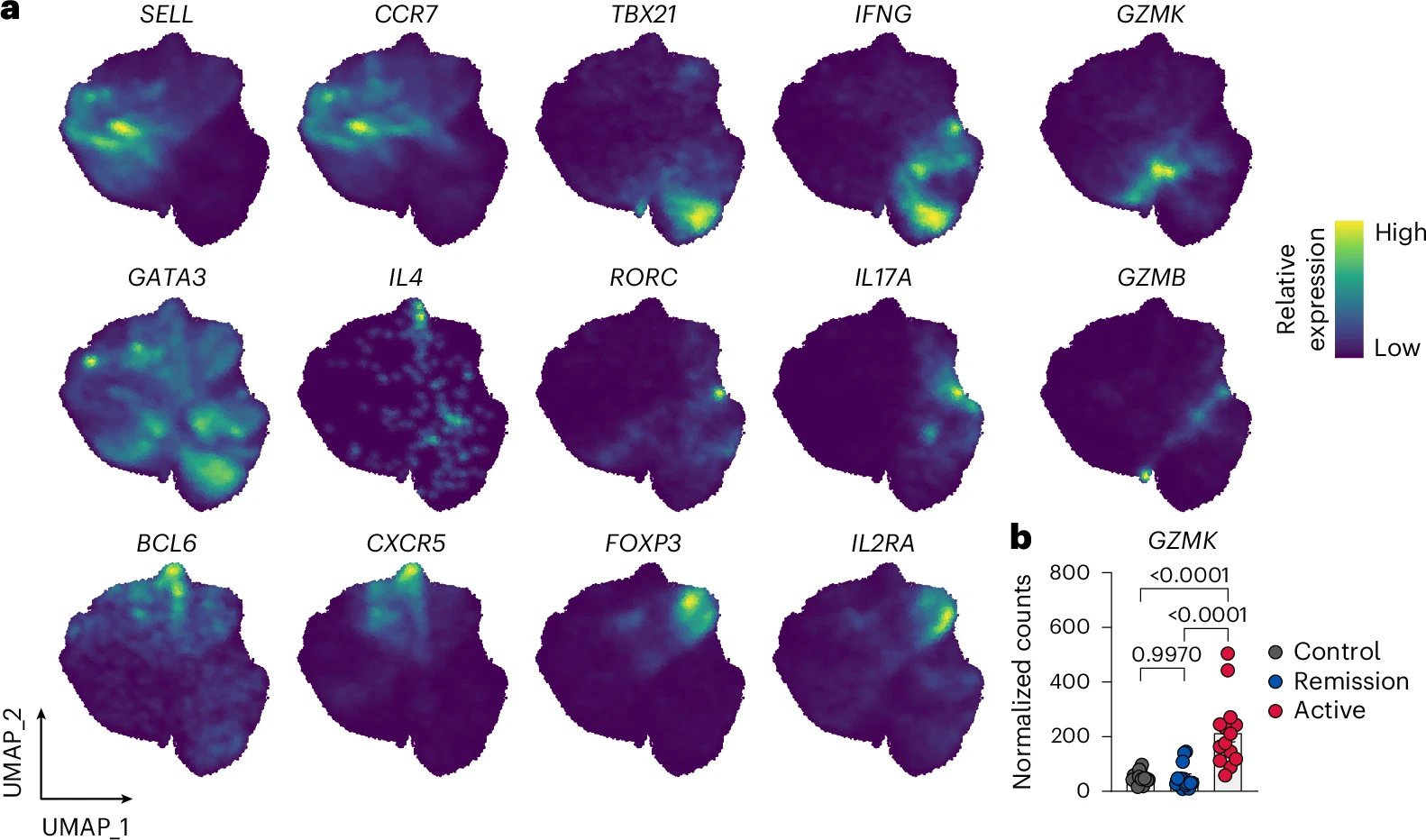
Figure 1: Identification of a GZMK-expressing CD4⁺ T cell subset in human intestinal inflammation. a, UMAP visualization of CD4⁺ T cells from an integrated scRNA-seq dataset of intestinal, peripheral blood and lymph node samples from individuals with IBD and healthy controls. Density plots show expression of the indicated genes (SELL, CCR7, TBX21, IFNG, GATA3, IL4, RORC, IL17A, BCL6, CXCR5, FOXP3, IL2RA, GZMK and GZMB). b, GZMK transcript levels in mucosal biopsies from patients with active UC (n = 14), UC in remission (n = 14) and healthy controls (n = 16) (GSE128682). Data are represented as mean ± s.e.m. Exact P values are shown in the graph. Statistical significance was determined by one-way analysis of variance (ANOVA) with Tukey’s multiple comparisons test.
For decades, CD4⁺ T helper cells have been classified into specialized populations such as TH1, TH2, TH17, and T follicular helper (TFH) cells, each defined by characteristic transcription factors and cytokines that coordinate specific immune responses. However, advances in single-cell RNA sequencing have revealed a far more complex landscape of T cell states than previously appreciated. This new study adds another layer to that complexity by identifying a conserved inflammatory T cell population present in both mice and humans with colitis.
The newly described THK cells are distinguished by high expression of granzyme K (GZMK), a molecule traditionally associated with cytotoxic lymphocytes. Unlike granzyme B, which directly induces target-cell death, granzyme K appears to function primarily as a regulator of inflammation. Previous studies have suggested that GZMK can amplify inflammatory responses by activating complement pathways and promoting cytokine production within tissues. Although GZMK-expressing CD8⁺ T cells have been recognized in several inflammatory and cancer settings, the significance of GZMK expression in CD4⁺ T cells remained largely unexplored.
Using single-cell transcriptomic profiling, the investigators found that THK cells possess a unique molecular identity. They express relatively low levels of the canonical transcription factors that define traditional helper T cell lineages, including T-bet, GATA3, and RORγt. Instead, they are characterized by high expression of the transcription factor EOMES (Eomesodermin), a regulator more commonly associated with cytotoxic lymphocytes and memory T cell differentiation.
Mechanistically, the study demonstrated that EOMES is both necessary and sufficient for THK cell development. EOMES directly binds and activates genes associated with the THK program, including Gzmk and other effector molecules. Importantly, THK cell differentiation occurred independently of TH1, TH2, and TH17 developmental pathways, supporting the conclusion that these cells constitute a distinct helper T cell lineage rather than a transitional or activated state of existing subsets.
The functional relevance of THK cells became apparent in experimental colitis models. Genetic deletion of Eomes in T cells significantly reduced intestinal inflammation and disease severity, indicating that the EOMES–THK axis actively contributes to tissue pathology. These findings suggest that THK cells are not merely biomarkers of inflammation but may serve as direct drivers of chronic immune-mediated tissue damage.
One particularly intriguing aspect of the study is the apparent conservation of the THK transcriptional program across species and disease settings. Similar GZMK⁺EOMES⁺ CD4⁺ T cells were identified not only in murine colitis but also in human inflammatory bowel disease samples and other inflammatory contexts. This suggests that THK cells may represent a broader inflammatory module utilized across multiple chronic immune disorders.
The discovery also raises important questions about how THK cells fit into the evolving framework of T cell biology. Traditional helper T cell subsets are largely defined by cytokine production and pathogen-specific responses. THK cells, by contrast, appear to occupy a distinct niche characterized by inflammatory tissue remodelling, immune activation, and potentially direct modulation of local inflammatory environments through granzyme K-mediated mechanisms.
From a translational perspective, the findings identify the EOMES–THK pathway as a potential therapeutic target in inflammatory diseases such as Inflammatory Bowel Disease. Targeting EOMES-dependent differentiation or GZMK-associated effector functions could offer a novel strategy to suppress pathogenic inflammation without broadly impairing protective immune responses.
Overall, this study expands the helper T cell landscape by defining THK cells as a distinct CD4⁺ T cell subset with a unique transcriptional identity, inflammatory function, and disease relevance.
Journal article: Xie, T., et al. 2026. A unique CD4⁺ T cell subset expressing granzyme K is regulated by transcription factor EOMES and important for T cell-mediated intestinal inflammation. Nature Immunology.
Summary by Stefan Botha