

Researchers have identified and characterized some of the first human antibodies capable of potently neutralizing measles virus, offering new hope for therapies that could protect vulnerable individuals during outbreaks (Figure 1).
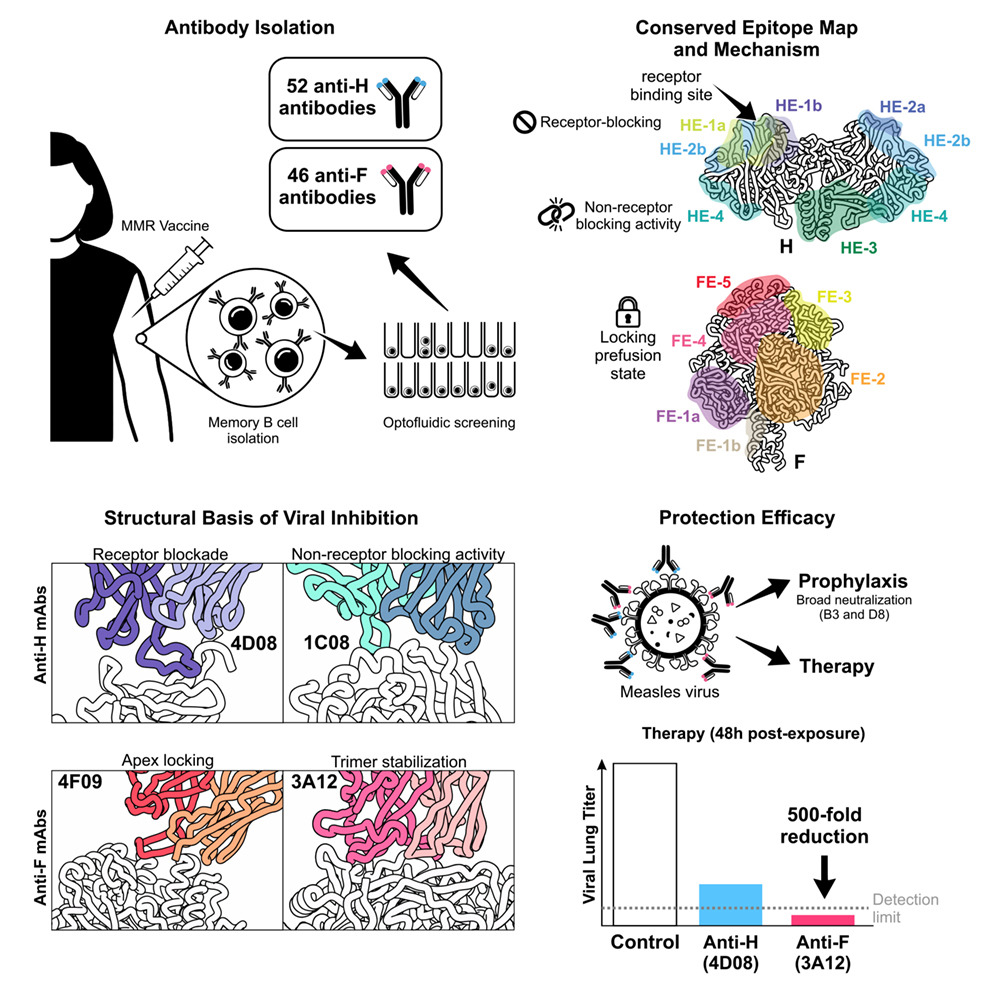
Figure 1: Graphical abstract.
The study comes at a time when declining vaccination rates have contributed to renewed measles outbreaks worldwide. Although the measles vaccine remains highly effective, not everyone can safely receive it. Infants, pregnant individuals, cancer patients undergoing chemotherapy, and people with compromised immune systems remain especially vulnerable to severe disease.
The research team isolated human antibodies from a vaccinated donor and showed that these antibodies can directly target key viral proteins required for infection. The findings provide a potential foundation for future monoclonal antibody therapies that could be used either before or shortly after measles exposure.
Measles virus infects cells using two major surface proteins: the fusion (F) protein and the hemagglutinin (H) attachment protein. The researchers discovered antibodies capable of binding both targets with remarkable potency.
Using cryo-electron microscopy, the team visualized exactly how these antibodies interact with the virus. Some antibodies locked the fusion protein into a stable configuration, preventing the structural changes required for the virus to fuse with host cells and initiate infection.
The study revealed that these antibodies were exceptionally effective at neutralizing measles virus, outperforming many previously described molecules.
To determine whether the antibodies could work in living organisms, they were tested in cotton rat models of measles infection.
The results were significant. Antibody treatment significantly reduced viral loads when administered either before infection or within 24–48 hours after exposure. One antibody, known as 3A12, reduced circulating virus to undetectable levels in some animals.
These findings suggest that antibody-based therapies could potentially serve both preventative and therapeutic roles, particularly for individuals who cannot receive live vaccines.
Currently, there are no approved measles-specific antiviral therapies. Treatment is largely supportive, leaving clinicians with limited options once infection occurs.
The researchers believe monoclonal antibody therapies could eventually help bridge this gap, particularly during outbreaks where herd immunity has declined.
Importantly, the study also provides detailed structural maps of vulnerable regions on the virus, creating a roadmap for future therapeutic development.
As measles cases continue to rise globally, the ability to rapidly deliver protective antibodies could become increasingly valuable for protecting high-risk populations and limiting severe disease outcomes.
The study highlights how advances in structural immunology and antibody engineering may help combat resurging infectious diseases that were once thought to be largely controlled through vaccination alone.
Journal article: Acciani, M., et al. 2026. Human neutralizing antibodies targeting the measles virus hemagglutinin and fusion surface proteins. Cell Host & Microbe.
Summary by Stefan Botha