


SARS-CoV-2 continues to evolve, with new variants emerging as the virus accumulates mutations that can help it evade existing antibody responses. While current vaccines provide important protection against severe disease, rapidly changing viral sequences mean that vaccine formulations may need to be updated over time.
New research from the Malaghan Institute of Medical Research suggests a different strategy: rather than continually chasing viral variants, could vaccines be designed to redirect the immune response toward regions of the virus that remain conserved across variants? (Figure 1).
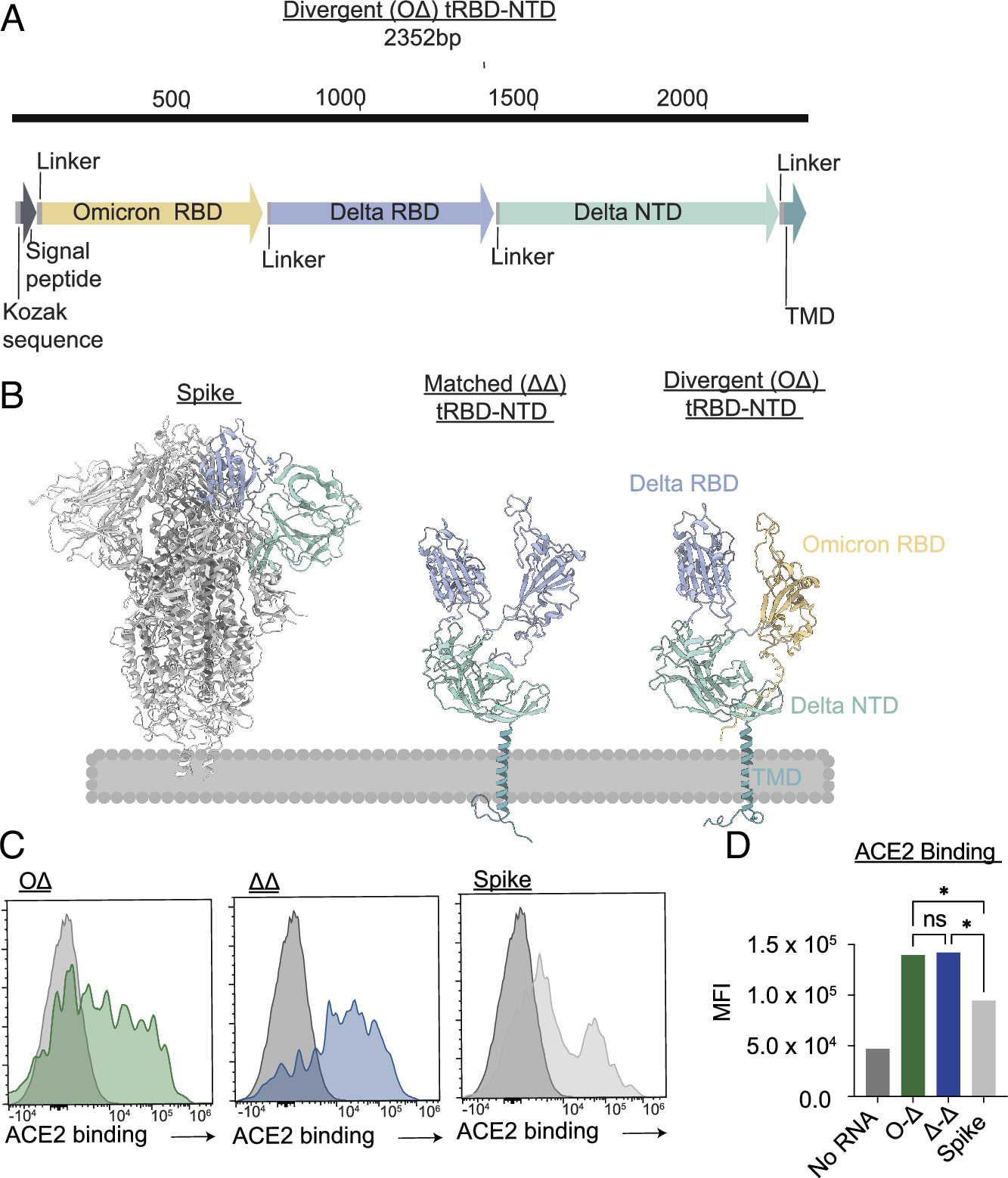
Figure 1: Design and expression of membrane-anchored tandem RBD-NTD (tRBD-NTD) mRNA immunogens. (A) Single open reading frame schematic encoding two RBDs and one NTD with a C-terminal transmembrane (TM) domain. Two pairings were tested: matched control (Δ-Δ) and divergent (O-Δ), the Omicron RBD was stabilized by removing the following mutations: S371L, S375F, K417N, N501Y. (B) AlphaFold3 models of tRBD-NTD (Δ-Δ and O-Δ) immunogens. (C) Surface expression and ACE2 accessibility of immunogens in HEK293T cells transfected with each vaccine construct and full-length spike (positive control) and stained with hACE2-Fc detected by anti-human Fc-AF488. (D) Geometric mean fluorescence intensity (GeoMFI) quantification. Bars represent geometric mean, statistical analysis using one-way ANOVA with a Fisher post test. P value * is <0.05.
Published in PNAS, researchers from the Connor Laboratory used RNA technology to explore whether exposing the immune system to highly divergent SARS-CoV-2 variants could encourage the development of broader antibody responses.
Vaccination works by presenting viral antigens to the immune system, allowing B cells to generate antibodies that recognise and respond to the pathogen.
However, this specificity can become a weakness when the virus changes. Through antigenic drift, SARS-CoV-2 can accumulate mutations in regions targeted by antibodies, allowing new variants to partially escape existing immunity. Seasonal influenza presents a similar challenge, requiring vaccine formulations to be regularly updated.
But not every part of a virus can change equally. Some viral regions are conserved because mutations in these areas would interfere with an essential viral function. Antibodies targeting these conserved regions could therefore have the potential to recognise and neutralise multiple variants.
The challenge is that these broadly protective antibody responses are often relatively rare. During infection or vaccination, the immune system generates a diverse population of B cells targeting different parts of the virus. Among these are broadly neutralising B cells, which can recognise conserved features shared across multiple viral variants.
However, these cells may represent only a small fraction of the overall response. The researchers wanted to determine whether this balance could be deliberately shifted. Using RNA technology, they designed a “divergent” vaccine containing multiple genetically distinct SARS-CoV-2 receptor-binding domains (RBDs), including sequences from both historical and more recent viral strains.
Rather than simply placing several independent vaccine components together, the approach was designed to expose the immune system to differences between variants while highlighting the features they share. In preclinical studies, the divergent vaccine encouraged the development of B-cell responses capable of recognising multiple SARS-CoV-2 variants.
The idea is based on a simple immunological principle: when the immune system repeatedly encounters different versions of a viral antigen, variant-specific regions become less consistent, while conserved regions remain common between them.
This can place greater selective pressure on B cells that recognise those shared features. Importantly, this differs from a conventional multivalent vaccine, where multiple antigenic components are combined to generate separate immune responses against each strain. A divergent approach instead aims to encourage individual B-cell populations to recognise features shared across multiple variants.
The researchers highlight RNA technology as an important part of making this strategy feasible. RNA-based platforms allow researchers to rapidly design and test different combinations of viral antigens without having to produce and optimise each protein individually.
This flexibility could make it possible to experimentally explore many different antigen combinations and identify formulations that most effectively amplify broadly neutralising B-cell responses. The long-term goal is to move from simply responding to viral evolution towards anticipating it.
The implications may extend beyond SARS-CoV-2. The same principle could potentially be applied to other rapidly evolving pathogens, including influenza, where antigenic drift continually creates new challenges for vaccine design.
Rather than attempting to predict exactly which strain will dominate next, future vaccines could aim to generate immunity against the evolutionary constraints shared by many strains.
If successful, such an approach could provide a broader baseline of protection against emerging variants, potentially slowing transmission and disease while more targeted vaccines are developed.
Instead of continually updating vaccines to chase a changing virus, researchers are exploring whether we can teach the immune system to focus on the parts of the virus that cannot afford to change.
Journal article: Montgomerie I, et al. 2026. Engineering antigenic breadth against SARS-CoV-2 by pairing divergent RBDs within a single mRNA immunogen. Proceedings of the National Academy of Sciences.
Summary by Stefan Botha