


As emerging viral threats continue to challenge global health systems, scientists are increasingly searching for immune responses that can protect against entire families of viruses rather than individual pathogens. A new study provides evidence that T cells generated by measles vaccination may recognize and respond to other highly pathogenic paramyxoviruses, including Nipah virus (Figure 1).
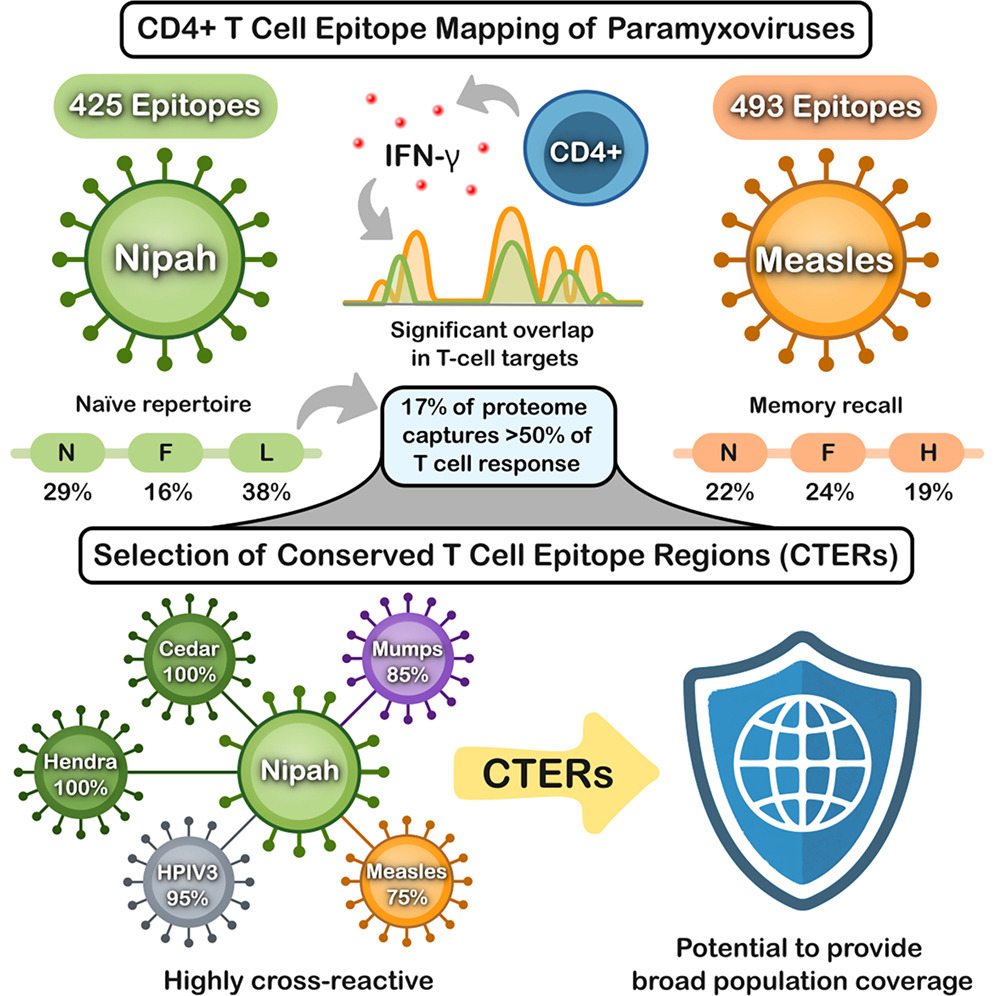
Figure 1: Graphical abstract.
Researchers have identified cross-reactive CD4⁺ T cell responses between measles virus and Nipah virus, raising the possibility that existing immunity to measles could provide at least partial protection against future outbreaks of related viruses.
Paramyxoviruses include several clinically important human pathogens such as measles virus, mumps virus, respiratory syncytial virus (RSV), and Nipah virus.
While measles remains one of the most contagious infectious diseases globally, Nipah virus poses a different challenge. Transmitted from animals, particularly bats, Nipah outbreaks occur sporadically in South and Southeast Asia and can have case fatality rates ranging from 40% to 75%.
Unlike measles, there is currently no licensed vaccine or specific treatment for Nipah virus. With growing concerns about emerging zoonotic infections, researchers are increasingly interested in identifying immune mechanisms that could provide broad protection across related viral families.
Most vaccines are designed to induce neutralizing antibodies that block viral infection. However, antibodies are often highly specific and may not recognize newly emerging viral strains. T cells offer a complementary form of protection.
By recognizing small protein fragments known as epitopes, T cells can target infected cells and coordinate broader antiviral immune responses. Importantly, some T cells can recognize conserved epitopes shared across related viruses, creating what is known as cross-reactive immunity.
During the COVID-19 pandemic, several studies demonstrated that pre-existing T cells generated by common cold coronaviruses could recognize SARS-CoV-2. Similar observations have been reported for arenaviruses and other viral families. The new study extends this concept to paramyxoviruses.
The researchers analyzed blood samples from 31 individuals who had previously received the measles-mumps-rubella (MMR) vaccine. Using advanced epitope mapping approaches, they first characterized the specific CD4⁺ T cell targets generated by measles vaccination. Despite the long history of measles vaccination, surprisingly little was known about the precise T cell epitopes recognized following immunization.
The team then examined whether these measles-specific T cells could recognize proteins from Nipah virus. Remarkably, they found that a subset of vaccine-induced T cells responded to both viruses.
These cross-reactive T cells recognized conserved regions shared between measles virus and Nipah virus, particularly within the viral fusion (F) protein, a key molecule required for viral entry into host cells.
The study also represents the first comprehensive mapping of human CD4⁺ T cell epitopes for Nipah virus.
The discovery highlights an important principle in viral immunology: while viruses can mutate extensively, some regions remain evolutionarily conserved because they are essential for viral function. These conserved regions may provide attractive targets for future vaccines designed to generate broad immunity against entire viral families. Rather than creating separate vaccines for every potential outbreak virus, researchers may be able to develop vaccines that preferentially direct immune responses toward these shared epitopes.
Such approaches could be particularly valuable for outbreak-prone pathogens where the next emerging strain is difficult to predict. The findings raise intriguing possibilities for future outbreak responses.
Because many people worldwide already possess measles-specific memory T cells through vaccination, pre-existing cross-reactive immunity could potentially influence the severity of infection with related paramyxoviruses.
Although the study does not demonstrate that measles vaccination protects against Nipah disease in humans, it suggests that vaccine-induced T cells may provide a degree of immunological readiness against related emerging pathogens.
While antibody responses often dominate discussions around vaccines, T cells can recognize deeply conserved viral features that remain stable across species and strains. By identifying these shared targets, researchers are beginning to envision vaccines that protect not just against known pathogens, but also against future viral threats.
As emerging zoonotic diseases continue to challenge global public health, broad-spectrum T cell immunity may become an increasingly important component of pandemic preparedness strategies.
Journal article: Tarke, A., et al. 2026. Comprehensive mapping of human CD4+ T cell epitopes for Nipah and measles as prototype Paramyxoviruses. Cell Reports Medicine.
Summary by Stefan Botha