


Type 1 diabetes is fundamentally an autoimmune disease: the immune system mistakenly targets the insulin-producing β cells of the pancreas. Current treatment replaces the insulin that has been lost. But what if we could instead target the immune cells responsible for the destruction, while leaving the rest of the immune system intact?
Researchers are investigating exactly this possibility using a unusual immune cell they call the “X cell.” (Figure 1).
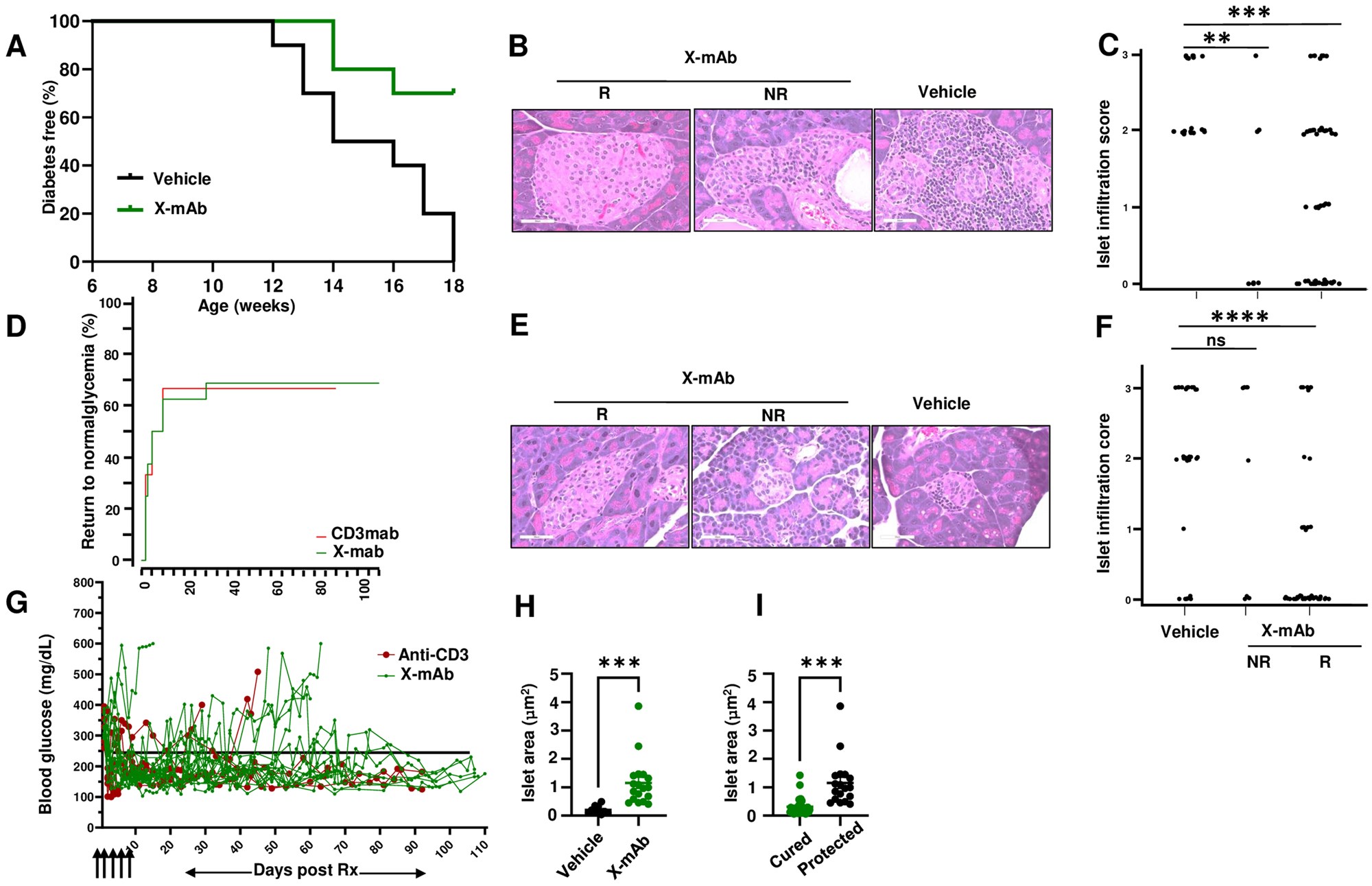
Figure 1: x-mAb prevents and reverses new-onset diabetes in NOD mice. (A–C) x-mAb prevents T1D onset. (A) Kaplan–Meier curve shows overt diabetes incidence in prediabetic NOD mice treated with x-mAb or vehicle (n = 10 per group). (B) Representative H&E-stained pancreatic sections showing islet infiltration in responder (R) or nonresponder (NR) mice compared to vehicle-treated controls. Scale bar: 50 µm. (C) Quantification of insulitis scores in x-mAb–treated responders, nonresponders, and vehicle-treated mice. (D–G) x-mAb reverses hyperglycemia in newly diabetic mice. (D) Remission rates in newly diabetic mice treated with x-mAb or anti-CD3. No vehicle-treated mice achieved remission (see Fig. S1). Data were pooled from n = 16 (x-mAb) and n = 5 (vehicle) mice. (E) Representative H&E-stained pancreatic sections showing islet infiltration in responders (R) and nonresponders (NR) compared to controls. Scale bar: 50 µm. (F) Quantification of insulitis scores in x-mAb–treated responders and nonresponders compared to controls. (G) Longitudinal blood glucose levels showing reversal of hyperglycemia in diabetic mice treated with x-mAb or anti-CD3. (H) Prophylactic treatment protects islets morphology from atrophy. Representative images show x-mAb (green) vs vehicle (black) at the study endpoint. (I) Comparison of total islet area in mice protected (prophylactic) vs cured by (therapeutic) x-mAb treatment. Data are presented as mean ± SEM, from at least 3 independent experiments with individual values plotted. Statistical significance was determined by (A) log-rank test; (C, F) Poisson and negative binomial models (fixed or mixed effects) with Tukey multiple comparison adjustment; and (H, I) unpaired Welch t-test. **P < 0.01, ***P < 0.001, ****P < 0.0001; ns, not significant.
The X cell was first identified around seven years ago while studying immune characteristics of cancer cells.
What made it unusual? The cells displayed characteristics associated with both B cells and T cells, the two major lymphocyte populations responsible for adaptive immune responses.
The researchers subsequently found evidence linking X-cell biology to type 1 diabetes, leading them to ask whether the natural antibodies produced by these cells could be harnessed therapeutically.
The latest work focuses on an X monoclonal antibody (x-mAb) – a naturally occurring IgM autoantibody associated with X cells in people with type 1 diabetes. The proposed strategy is highly selective.
Rather than broadly suppressing T-cell activity, the researchers aim to use x-mAb to identify and eliminate the relatively small population of islet-reactive, diabetogenic T cells responsible for attacking pancreatic β cells. If this specificity can be achieved, it could represent a fundamentally different approach to autoimmune therapy.
One of the biggest challenges in treating autoimmune diseases is that the immune cells causing pathology are surrounded by millions of cells performing essential protective functions.
Broadly suppressing the immune system can therefore reduce autoimmune activity, but it can also compromise normal immune surveillance.
There is already an important proof-of-concept that immunotherapy can modify the course of type 1 diabetes.
Teplizumab, an anti-CD3 antibody, can delay progression to clinical type 1 diabetes in people at high risk and can help preserve β-cell function around diagnosis. However, anti-CD3 therapy affects T cells more broadly rather than specifically eliminating the autoreactive cells responsible for β-cell destruction.
The X-cell approach therefore represents a different therapeutic philosophy:
– Teplizumab: modulate T-cell activity broadly
– x-mAb: potentially identify and eliminate disease-driving T cells
The latter could, if validated clinically, offer a more targeted form of immune intervention. In their latest study, the researchers report that x-mAb was able to target and eliminate immune cells involved in the autoimmune response in preclinical experiments.
The findings support the possibility that the antibody could interfere with the population of T cells responsible for β-cell destruction.
The critical questions now are whether the antibody can selectively target pathogenic cells in humans, whether it can preserve sufficient immune function, and whether removing these cells is enough to preserve or restore meaningful β-cell function after diagnosis.
This is where the distinction between preserving β cells and restoring β-cell mass becomes important. At diagnosis, patients can retain some functioning β cells. Eliminating the autoimmune attack could potentially preserve this remaining capacity.
But whether an immune-targeted therapy can genuinely reverse established disease will depend on how much functional β-cell mass remains and whether the pancreas can recover sufficient insulin production.
So while the researchers describe the approach as potentially capable of reversing disease progression, clinical reversal has not yet been demonstrated in humans.
The broader concept may extend beyond diabetes. Many autoimmune diseases involve relatively specific populations of pathogenic lymphocytes that attack otherwise healthy tissues.
If disease-driving immune cells can be identified and selectively eliminated, similar strategies could theoretically be explored in diseases such as:
– Graves’ disease
– Multiple sclerosis
– Other organ-specific autoimmune disorders
The challenge will be identifying the equivalent disease-driving immune populations and finding molecular targets that distinguish them from protective immune cells.
The X-cell research illustrates a broader shift in autoimmune medicine. For decades, many autoimmune therapies have worked by turning down the immune system as a whole. The emerging goal is much more precise – find the cells causing the disease and remove or reprogramme them without disabling the immune system around them.
For type 1 diabetes, that could mean moving beyond simply replacing insulin toward therapies that protect the body’s remaining insulin-producing cells by addressing the autoimmune attack itself. The most powerful autoimmune therapy may not be stronger immune suppression it may be better immune targeting. The X-cell-derived x-mAb represents an intriguing preclinical attempt to selectively eliminate diabetogenic T cells while leaving protective immunity intact.
It is still early-stage research, but if the specificity observed in preclinical models can ultimately be reproduced in humans, this approach could point towards a new generation of precision immunotherapies for type 1 diabetes and potentially other autoimmune diseases.
Journal article: Al-Hallaf R et al. 2026. Leveraging a naturally occurring IgM autoantibody to target diabetogenic T cells: a precision medicine approach to type 1 diabetes. The Journal of Immunology.
Summary by Stefan Botha