


Researchers have uncovered a mechanism by which the fungal pathogen Candida albicans evades the immune system, allowing it to cause life-threatening infections in people with weakened immunity (Figure 1). The findings reveal that the fungus suppresses a critical antimicrobial defence used by neutrophils, the body’s first line of defence against infection.
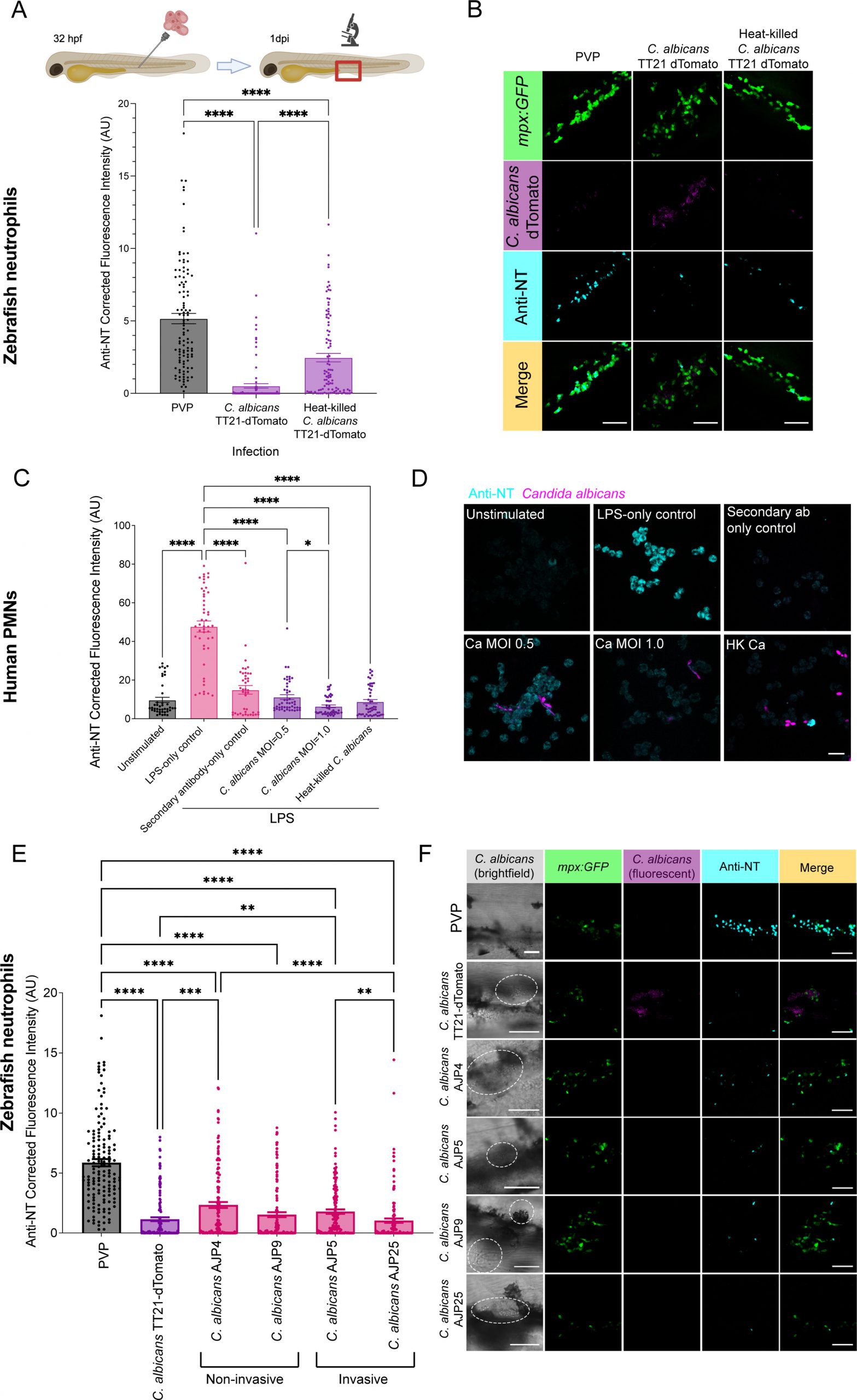
Figure 1: C. albicans suppressed neutrophil RNS production below resting levels. (A) Schematic of experiment: 1 dpf zebrafish were injected with PVP or C. albicans into the caudal vein. At 1 dpi, larvae were fixed and stained with anti-nitrotyrosine primary antibody and goat anti-rabbit Alexa-633 secondary antibody. Zebrafish were then imaged at the site of infection in the caudal hematopoietic tissue (CHT), and anti-nitrotyrosine fluorescence was quantified. The graph shows anti-nitrotyrosine fluorescence at 1 dpi following injection of PVP or 200 cfu of live C. albicans TT21-dTomato or heat-killed C. albicans TT21-dTomato into the caudal vein at 30 hpf. N = 96–108 neutrophils from 16 to 18 fish, obtained from three independent experiments. Error bars show SEM. Statistical significance determined by Kruskal-Wallis test, and then Dunn’s multiple comparisons test. P values are shown: ****P < 0.0001. (B) Representative images of PVP, C. albicans TT21-dTomato, and heat-killed C. albicans TT21-dTomato-infected zebrafish larvae at 1 dpi. Scale bars = 50 µm. (C) Corrected fluorescence intensity of PMNs fixed at 3 h post-LPS treatment and stained with anti-nitrotyrosine antibody (in arbitrary units [AU]). Non-LPS-stimulated resting neutrophils were used as unstimulated controls (gray bar). LPS-stimulated neutrophils were included as controls, either stained with primary (anti-NT antibody) and secondary antibody (goat-anti-rabbit Alexa-633) (LPS-only control), or secondary alone (Secondary antibody-only control) (pink bars). Neutrophils infected with an MOI of 0.5 and 1.0 live C. albicans and heat-killed C. albicans all show a decrease in nitrotyrosine in the presence of LPS compared to LPS-only controls (purple bars). N = 42–48 neutrophils from two independent experiments and donors. (D) Representative images of human PMNs stained with anti-nitrotyrosine (anti-NT). Scale bars = 50 µm. *P < 0.05, ****P < 0.0001. (E) Anti-nitrotyrosine fluorescence at 1 dpi following injection of PVP, C. albicans TT21-dTomato, or C. albicans clinical isolates into the caudal vein at 30 hpf. N = 144 neutrophils from 24 fish, obtained from three independent experiments. Error bars show SEM. Statistical significance determined by Kruskal-Wallis test and then Dunn’s multiple comparisons test. P values shown: **P < 0.01, ***P < 0.001, ****P < 0.0001. (F) Representative images of PVP, C. albicans TT21-dTomato, C. albicans AJP4, C. albicans AJP5, C. albicans AJP9, and C. albicans AJP25 infected zebrafish larvae at 1 dpi. White dotted circles show C. albicans. Scale bars = 50 µm.
Candida albicans commonly lives harmlessly on the skin and mucosal surfaces of healthy individuals, with an estimated 40–60% of people carrying the fungus without symptoms. However, in immunocompromised patients, the organism can enter the bloodstream and cause invasive candidiasis, a severe infection associated with mortality rates approaching 50%.
Using zebrafish infection models together with human immune cells, the researchers found that Candida actively suppresses the production of reactive nitrogen species (RNS)—highly toxic molecules generated by neutrophils to destroy invading microbes.
Rather than simply resisting these antimicrobial molecules, the fungus reduced RNS production to levels even lower than those normally present in resting immune cells, effectively dampening neutrophil function during infection and enhancing its own survival.
The researchers also observed similar immune-suppressive effects in Candida auris, an emerging multidrug-resistant fungal pathogen that has become a major global public health concern.
Both C. albicans and C. auris are classified by the World Health Organization as critical-priority fungal pathogens because of increasing antifungal resistance and the limited availability of effective treatments.
Importantly, fungal strains that were most effective at suppressing neutrophil RNS caused the most severe infections in experimental models, suggesting that immune suppression is a key determinant of fungal virulence.
The findings highlight the potential of host-directed therapies that enhance the patient’s own immune response rather than targeting the pathogen directly. Restoring neutrophil RNS production significantly improved survival in infected zebrafish, particularly when combined with existing antifungal medications.
While further studies are needed to understand exactly how Candida suppresses neutrophil function, the research suggests that boosting this natural immune defence could complement current antifungal therapies and help overcome the growing challenge of drug-resistant fungal infections.
As antifungal resistance continues to increase globally, approaches that reinforce host immunity may provide an important new avenue for protecting vulnerable patients from severe invasive fungal disease.
Journal article: Burgess, T.B., et al. 2026. Candida spp. suppress neutrophil reactive nitrogen species to evade killing. mBio.
Summary by Stefan Botha