


A new study has uncovered an unexpected mechanism controlling immune tolerance in the intestine, showing that classical costimulatory signals typically associated with T cell activation can suppress the generation of a specialized regulatory T cell population critical for maintaining gut homeostasis.
RORγt+ regulatory T (Treg) cells are a unique subset of Foxp3+ Tregs that develop in response to dietary and microbiota-derived antigens in the intestine. These cells are highly enriched within the gut lamina propria and play essential roles in suppressing inflammation, maintaining oral tolerance, and preventing inappropriate immune responses to commensal microbes and food antigens. Unlike conventional Tregs, RORγt+ Tregs depend heavily on microbial cues, IL-10 production, and cytokines such as IL-6 and IL-23 for their differentiation.
Recent work has already reshaped understanding of how these cells are generated by demonstrating that “signal one,” antigen presentation through MHC class II, is provided not by conventional dendritic cells, but instead by specialized RORγt+ antigen-presenting cells (APCs), including ILC3-like populations found in the intestine and draining lymph nodes.
In this new study, researchers turned their attention to “signal two,” the costimulatory pathways that normally enhance T cell activation (Figure 1). Surprisingly, they found that the canonical B7 costimulatory molecules CD80 and CD86 do not promote microbiota-specific RORγt+ Treg generation. Instead, B7 signalling actively restrains these tolerogenic cells.
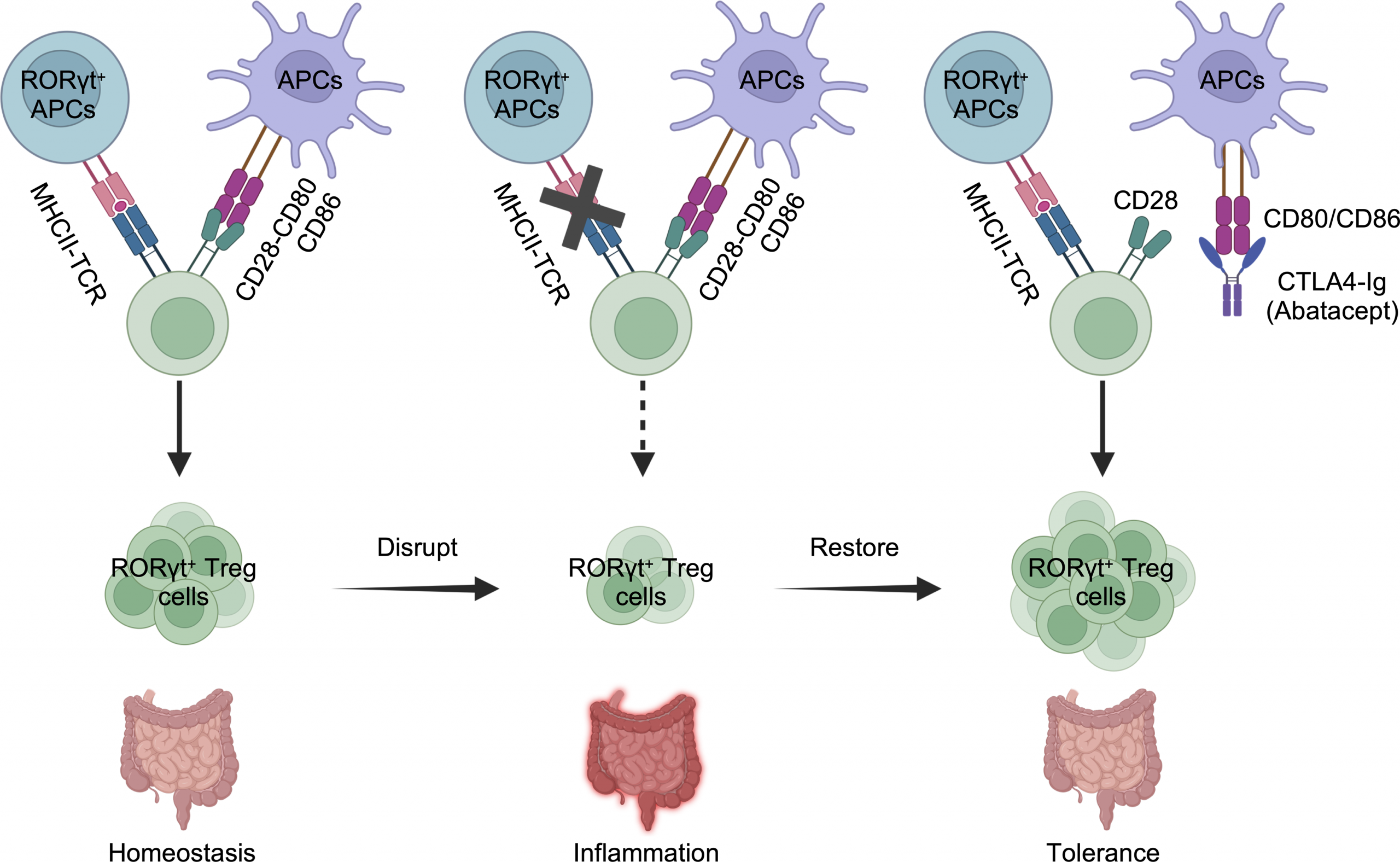
Figure 1: Graphical abstract.
The team demonstrated that manipulating the B7–CTLA-4 axis had reciprocal effects on RORγt+ Treg development. Blocking B7 costimulation using CTLA4-Ig (Abatacept), an FDA-approved immunomodulatory therapy, significantly enhanced the generation of microbiota-specific RORγt+ Tregs. Conversely, increasing B7-mediated signaling suppressed their differentiation.
Importantly, this effect did not depend on CD80 or CD86 expression by the RORγt+ APCs themselves. However, the tolerogenic response still required MHCII expression on these specialized APCs, reinforcing the idea that RORγt+ APCs provide essential antigen presentation cues while the surrounding costimulatory environment determines whether tolerance can be established.
Mechanistically, the findings suggest that conventional CD28-mediated costimulatory signalling, which normally activates PI3K-Akt, NF-κB, MAPK, and mTOR pathways to support T cell proliferation and effector differentiation, may be fundamentally incompatible with the differentiation program of microbiota-specific RORγt+ Tregs.
The biological significance of this pathway became especially apparent in a mouse model of microbiota-driven colitis induced by Helicobacter hepaticus colonization combined with IL-10 receptor blockade. This model recapitulates several features of human inflammatory bowel disease (IBD), including dysregulated responses to intestinal microbes.
Treatment with CTLA4-Ig markedly expanded RORγt+ Treg populations and provided strong protection against intestinal inflammation. However, this protection only occurred when MHCII expression on RORγt+ APCs was intact. This highlights a cooperative interaction between antigen presentation by RORγt+ APCs and suppression of B7 costimulation.
The findings challenge long-standing assumptions about costimulatory signalling in Treg biology. While conventional and thymic-derived Tregs are known to require B7-CD28 signaling for development and maintenance, microbiota-specific RORγt+ Tregs appear uniquely inhibited by this pathway.
The study therefore reveals that intestinal tolerance relies on a distinct immunological framework in which specialized APCs provide antigen-specific instruction, while excessive costimulation must be restrained to permit tolerogenic differentiation.
Together, these findings redefine how signal one and signal two cooperate in mucosal immunity and identify CTLA4-Ig–mediated enhancement of microbiota-specific RORγt+ Tregs as a promising strategy for promoting intestinal immune tolerance.
Journal article: Lyu, M., et al. 2026. B7 costimulation antagonizes RORγt+ regulatory T cells and immune tolerance in the intestine. JEM.
Summary by Stefan Botha