


Researchers uncover how chemotherapy-like strategies may selectively eliminate HIV-infected immune cells (Figure 1).
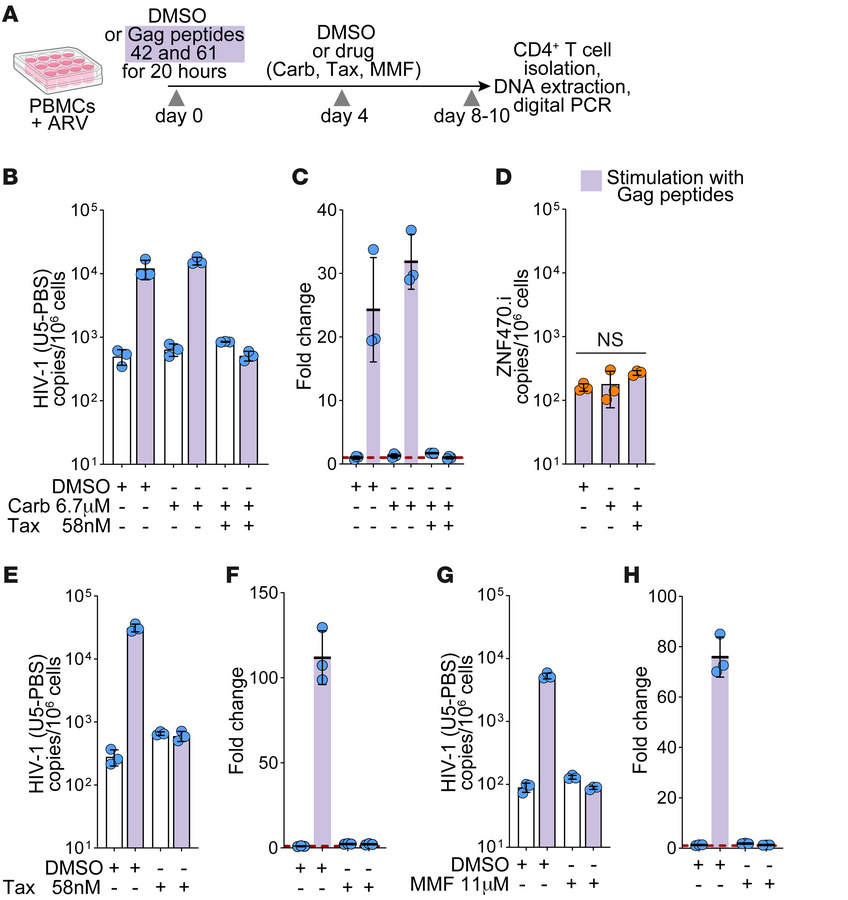
Figure 1: Antiproliferative drugs abrogate the proliferation of HIV-1–infected cells reactive to Gag peptides. (A) Schematic representation of the culture experiments. ARV, antiretroviral drugs. (B, E, and G) Impact of carboplatin (Carb), paclitaxel (Tax), and MMF on the proliferation of the ZNF721i clone carrying an intact HIV-1 provirus. Data are shown as the mean ± SD; each symbol indicates a replicate well. All measurements were obtained at the end of culture. (D) The ZNF470i clone, nonreactive to Gag peptides, is not affected by treatment with Tax. One-way ANOVA; P value = 0.153. (C, F, and H) Fold increase in HIV-1 DNA copies relative to unstimulated cells treated with DMSO. Colored bars indicate conditions in which cells were stimulated with Gag peptides. Empty bars indicate conditions without Gag peptide stimulation.
Thanks to antiretroviral therapy (ART), people living with HIV today can expect long healthy lives with the virus suppressed to undetectable and nontransmissible levels. Yet a true cure, completely removing HIV from the body remains elusive. The main obstacle is a hidden viral reservoir: CD4⁺ T cells harbouring dormant HIV DNA, or proviruses, that can reignite infection if treatment stops.
Now, researchers report a promising new insight that could help dismantle this reservoir. In a study, they show that HIV-infected T cells may be uniquely vulnerable to drugs that block cell proliferation, opening a potential path toward a more practical cure strategy.
HIV persists because its genetic material integrates into the DNA of CD4⁺ T cells. When these infected cells divide, they pass the provirus on to daughter cells, a process known as clonal expansion. Over time, this leads to growing populations of infected immune cells that can lie dormant for years.
The study focused on a rare clinical observation: a patient living with HIV who underwent chemotherapy for metastatic lung cancer showed a marked reduction in clonally expanded, HIV-infected CD4⁺ T cells. The patient had been treated with paclitaxel and carboplatin, two commonly used chemotherapeutic agents.
This raised a critical question: Were HIV-infected T cells especially sensitive to these drugs?
To find out, the researchers isolated an HIV-infected CD4⁺ T cell clone from the patient, a cell carrying a replication-competent provirus. They activated the cell using its specific HIV peptide (a signal that normally triggers proliferation), then treated it with either:
- Paclitaxel and carboplatin,
- Mycophenolate mofetil (an antiproliferative drug), or
- No treatment (control).
The results were striking. While untreated infected cells continued to proliferate, drug-treated infected cells failed to expand.
Unlike many cure strategies that must overcome multiple viral escape mechanisms, this approach targets a fundamental weakness: HIV-infected T cells depend on frequent division to persist.
Because this finding comes from a single patient, the researchers emphasize the need for further studies in larger and more diverse groups of people living with HIV. If confirmed, this approach could inform therapies designed to selectively eliminate infected cells without needing risky bone marrow transplants or lifelong immune suppression.
Journal article: Filippo Dragoni et al, 2025. Selective targeting of HIV-infected clones by cognate peptide stimulation and antiproliferative drugs, Journal of Clinical Investigation.
Summary by Stefan Botha