

AI-based protein design is rapidly expanding the toolkit for cancer immunotherapy, but designing a protein that binds its target is only the beginning.
A new study developed an AI-to-experiment workflow to create small synthetic proteins, called minibinders, against cancer-associated surface proteins including PD-L1, B7-H3 and B7-H4 (Figure 1).
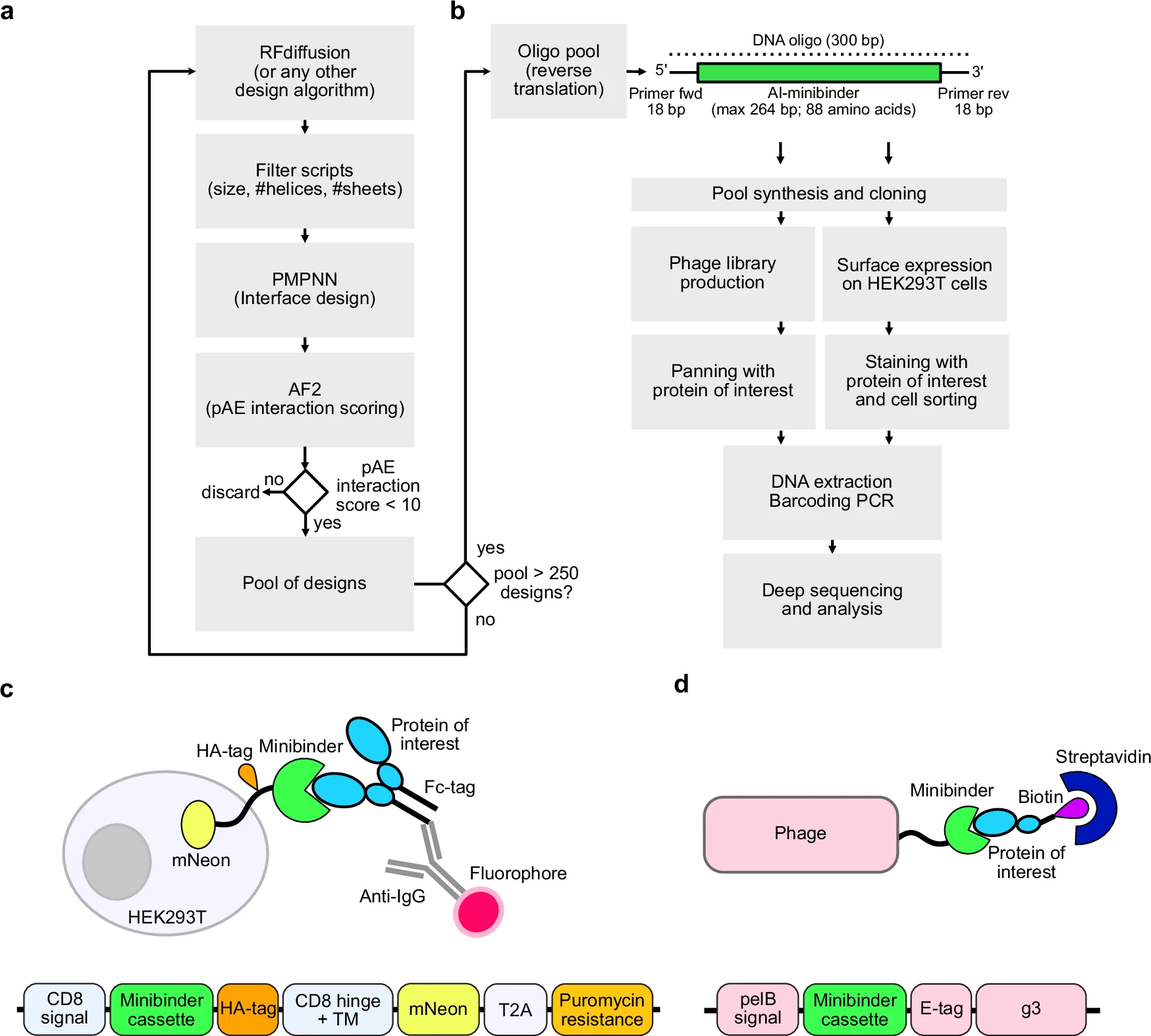
Figure 1: Computational design and functional screening strategy for AI-designed protein minibinders. a Outline of the RFdiffusion-based design pipeline with structural filtering steps. b Outline of the functional screening pipelines. c Scheme illustrating the principle of mammalian cell-surface display and the construct used for AI-minibinder presentation. d Scheme illustrating the principle of phage display and the construct used for AI-minibinder presentation. Schemes were generated using Affinity Publisher 2.
Thousands of AI-designed proteins were screened directly on mammalian cells. The results showed that success was highly target-dependent, with many more effective binders identified against PD-L1 than B7-H3 or B7-H4.Some minibinders could recognise their targets as well as conventional antibodies, but when incorporated into CAR T cells, several failed to reach the cell surface or function effectively.
Researchers therefore used a genetic algorithm to redesign regions outside the binding interface. This revealed an optimal isoelectric point (pI) range that improved CAR expression and enhanced selective tumour-cell killing.
AI can design the binding interface, but successful therapeutic proteins also need the right biophysical properties, cellular trafficking and functional behaviour.
The study highlights an important step in translating AI-designed proteins from computational predictions into working cancer immunotherapies.
Journal article: Broske, B., et al. 2026. AI-enabled discovery and biochemical optimization of minibinders targeting cancer cell-surface proteins. Nature Communications.
Summary by Stefan Botha