


Researchers have uncovered how combinations of antibodies can work together to block Plasmodium falciparum invasion of red blood cells, providing important insights for the development of next-generation blood-stage malaria vaccines (Figure 1). Published in Immunity, the study demonstrates that antibodies targeting different regions of a key parasite protein can act synergistically, even when individual antibodies show little protective activity on their own.
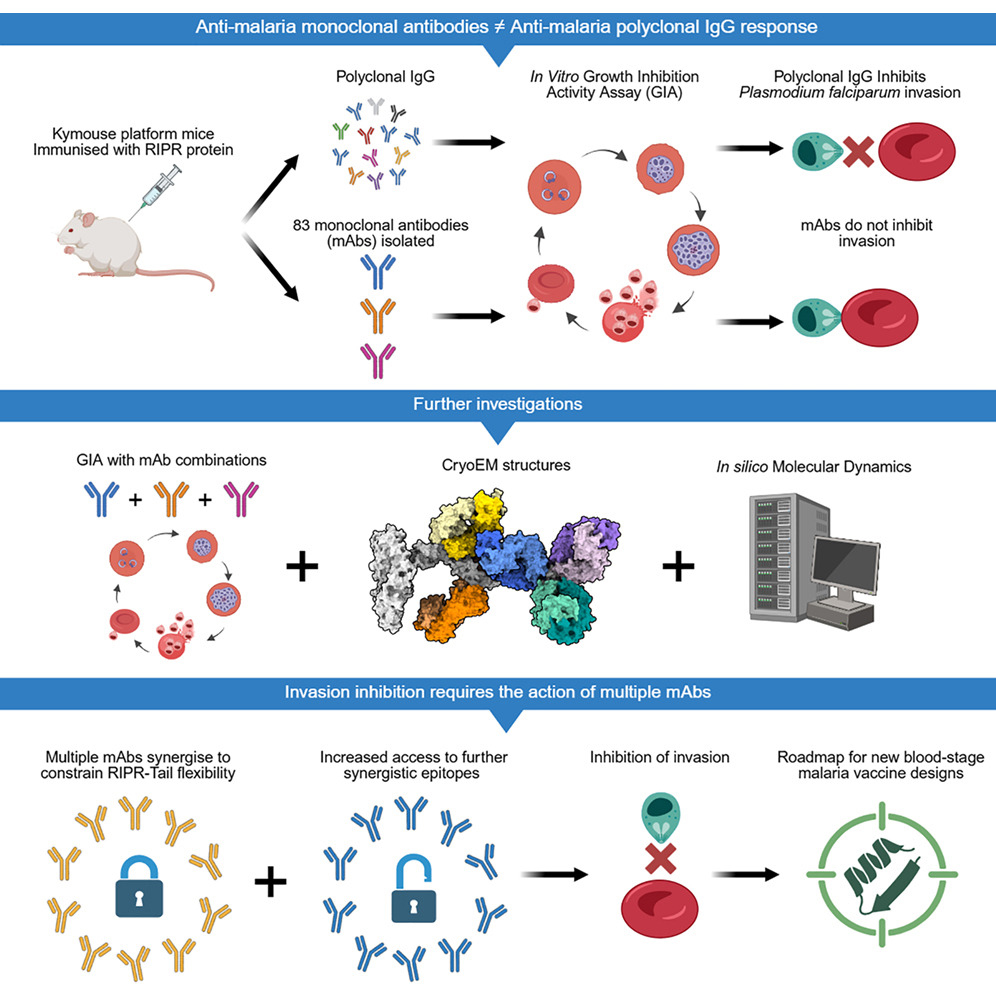
Figure 1: Graphical abstract.
The findings suggest that future malaria vaccines could be designed to elicit complementary antibody responses that more effectively prevent parasite invasion.
A leading target for blood-stage malaria vaccines is the RH5-interacting protein (RIPR), an essential component of the PTRAMP–CSS–RIPR–CyRPA–RH5 (PCRCR) complex. This multi-protein assembly enables P. falciparum merozoites to invade red blood cells, making it an attractive target for vaccines aimed at preventing symptomatic malaria.
Although antibodies against RIPR have previously been shown to inhibit parasite invasion, exactly how they exert their protective effects has remained unclear.
To investigate this, researchers generated and characterised 83 human monoclonal antibodies against RIPR using the Kymouse® platform, a transgenic mouse model capable of producing fully human antibodies.
Most individual antibodies displayed only weak parasite-neutralising activity. However, when specific antibodies targeting the tail region of RIPR were combined, they produced a dramatic increase in parasite growth inhibition.
Structural studies and molecular dynamics simulations revealed that antibodies recognising epidermal growth factor (EGF)-like domains 6–8 acted cooperatively to stabilise the shape of the RIPR tail. This conformational change disrupted interactions between RIPR and its binding partners PTRAMP and CSS, exposing additional regions of the protein that could then be recognised by other antibodies.
Rather than competing for the same binding site, these antibodies worked sequentially, allowing multiple antibodies to engage the invasion complex simultaneously and greatly enhancing their collective ability to block parasite entry into red blood cells.
The researchers also tested whether these synergistic antibodies could improve responses generated by an existing experimental malaria vaccine targeting R78C, a fusion protein containing RIPR and CyRPA components.
Adding the newly identified antibodies significantly increased parasite growth inhibition mediated by vaccine-induced human antibodies, suggesting that current RIPR-based vaccine designs do not fully exploit the most protective antibody responses.
These findings indicate that future vaccine formulations could be optimised by presenting RIPR in ways that preferentially stimulate antibodies targeting synergistic epitopes, rather than simply maximising the quantity of antibodies produced.
Unlike vaccines that aim to prevent mosquito transmission or liver infection, blood-stage vaccines seek to stop parasites from invading red blood cells, thereby reducing disease severity and transmission.
By revealing how antibodies cooperate to disrupt a critical invasion complex, this study provides a molecular framework for designing vaccines capable of eliciting stronger functional immunity against P. falciparum.
As malaria continues to cause hundreds of thousands of deaths each year, particularly among young children in sub-Saharan Africa, these findings offer valuable guidance for improving one of the field’s most promising blood-stage vaccine targets.
Journal article: Williams, B.G, et al. 2026. Analysis of monoclonal antibodies against the malaria invasion complex protein RIPR reveals the structural basis for synergistic antibody protection. Immunity.
Summary by Stefan Botha