


CAR T cell therapy has transformed the treatment of B-cell cancers, but one major challenge remains: not all CAR T cells are equally fit. Some expand, persist, and maintain tumor control, while others disappear early. A new study published in Cell shows that the differentiation state of infused T cells may be decisive (Figure 1).
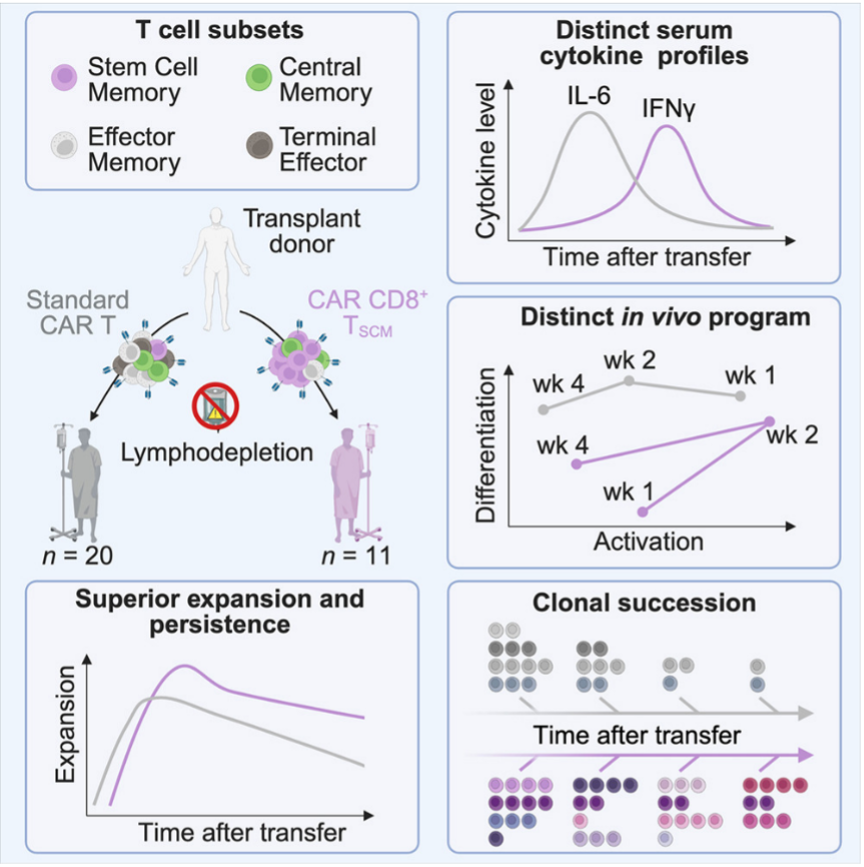
Figure 1: Graphical abstract.
Gattinoni and colleagues tested donor-derived CD19 CAR T cells enriched for stem cell memory T cells, or TSCM cells, in patients whose B-cell malignancies had relapsed after allogeneic hematopoietic stem cell transplantation. This is a difficult clinical setting. Donor lymphocyte infusion can provide graft-versus-leukemia activity, but its benefits are limited by low response rates and graft-versus-host disease. Conventional donor-derived CAR T cells improve tumor targeting, yet often show weak engraftment, limited expansion, and poor persistence without lymphodepleting chemotherapy.
The researchers compared conventional donor-derived CD19 CAR T cells with a highly defined CAR TSCM product. Standard CAR T cells were generated from peripheral blood mononuclear cells using anti-CD3 stimulation and IL-2. The TSCM product was manufactured from enriched naïve CD8+ T cells using CD3/CD28 stimulation, IL-7, IL-21, and the GSK-3β inhibitor TWS119 to preserve stemness-associated programs. This produced an almost exclusively CD8+ population and increased the median TSCM frequency from 8.4% in standard products to 78.4%.
Despite receiving a much lower median cell dose, patients treated with CAR TSCM cells achieved an overall response rate comparable to those receiving standard CAR T cells. At doses below 3 × 10^8 cells, complete responses occurred in 5 of 11 CAR TSCM recipients compared with 1 of 10 standard CAR T recipients. CAR TSCM cells also showed greater expansion and persistence per infused cell. Their expansion peaked during the second week after infusion, whereas standard CAR T cells peaked during the first week.
Importantly, stronger expansion did not translate into greater toxicity. No graft-versus-host disease was reported in the CAR TSCM cohort, and severe cytokine release syndrome was uncommon. No grade 4 events occurred, and only one patient developed grade 3 cytokine release syndrome. In contrast, 28.6% of patients receiving standard CAR T cells experienced grade 3–4 toxicity. The cytokine profiles were also distinct: standard products were associated with an early IL-6-dominated response, whereas CAR TSCM cells produced a later IFN-γ peak matching their delayed expansion.
Deep immune monitoring revealed that the two products followed different paths after infusion. Standard CAR T cells rapidly progressed toward effector states. CAR TSCM cells differentiated more slowly, produced effector progeny, and later regenerated the TSCM compartment. By approximately one month, standard CAR T cells were enriched in late effector populations, while CAR TSCM cells maintained stem-like and early proliferative populations.
Longitudinal tracking of retroviral integration sites revealed another key feature: CAR TSCM persistence was maintained through clonal succession. Standard CAR T cell persistence mainly reflected early-expanded clones that were maintained or contracted. In the TSCM cohort, later persistence came from newly expanding clones that were not dominant during the initial response. This resembles hematopoietic stem cell behavior, where long-term tissue maintenance is achieved through successive waves of different clones rather than continuous dominance by one clone.
The study also clarified why CAR TSCM therapy sometimes failed. In the standard cohort, poor outcomes were associated with weak CAR T expansion. In the TSCM cohort, expansion was generally strong even in non-responders, suggesting that resistance had shifted from intrinsic T cell fitness to tumor- and host-related factors. These included low or lost CD19 expression, elevated immunosuppressive cytokines such as IL-10, and antibodies against the mouse-derived FMC63 CAR binder. Anti-CAR antibodies were detected in 35% of patients and appeared to impair repeat infusions.
This study supports a broader idea in cellular therapy: improving the cell state may be as important as improving the receptor. A defined CD8+ CAR TSCM product showed stronger expansion, better persistence, complete responses at lower doses, and a favorable safety profile without lymphodepletion. The findings may also be relevant beyond post-transplant relapse, including autologous CAR T therapy and solid tumors, where exhaustion and poor persistence remain major barriers.
The study has important limitations. It was an early-phase, non-randomized trial with a small and clinically heterogeneous cohort. Comparisons between the two products should therefore be considered exploratory. The absence of lymphodepletion may also have promoted anti-CAR immune responses and limited durability. Larger randomized studies using humanized CAR constructs, lymphodepletion, and potentially a defined CD4+ component will be needed.
Even with these caveats, the message is clear: stemness is not merely a phenotypic marker of a better CAR T product. It may be a functional driver of expansion, persistence, and safer antitumor activity.
Journal article: Gattinoni L, et al. 2026. Distinct in vivo dynamics of donor-derived stem cell memory CAR T cells post-allogeneic HSCT relapse.Cell.
Summary by Gaurang Telang