


Major histocompatibility complex molecules are central to how the immune system recognizes infected or abnormal cells. Traditionally, Major Histocompatibility Complex Class I (MHC I) molecules are known for presenting antigens to CD8+ T cells, while Major Histocompatibility Complex Class II (MHC II) molecules present antigens to CD4+ T cells.
However, new research suggests that MHC class I molecules may play a broader and previously unrecognized role in regulating immune responses (Figure 1).
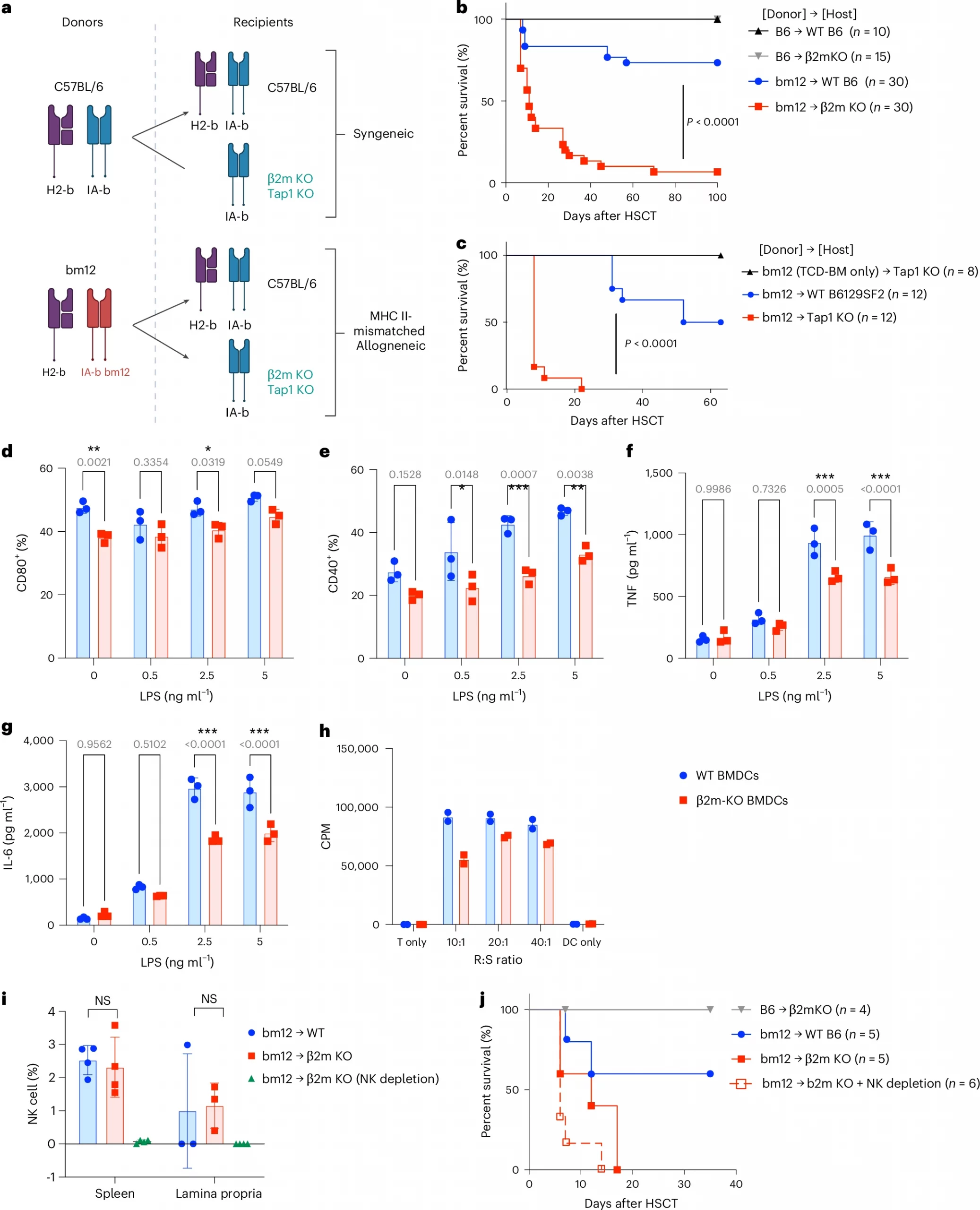
Figure 1: MHC I-deficient mice are more susceptible to CD4+ T cell attack. a–c, WT B6, β2m-KO and Tap1-KO mice received 10 Gy of TBI followed by transplantation of 2 × 10⁶–2.5 × 10⁶ T cells and 5 × 10⁶ BM cells from either syngeneic B6 WT or MHC II-mismatched bm12 donors (a). Survival (b, P = 7.4 × 10⁻⁸; c, P = 1.7 × 10⁻⁵) was monitored after HSCT. d–g, BMDCs from WT and β2m-KO mice were stimulated with LPS for 16 h. The surface expression of costimulatory molecules (d,e) and cytokine secretion (f,g) were measured (f, P = 6.2 × 10⁻⁵; g, P = 1 × 10⁻⁶ and 1.5 × 10⁻⁵). Data are the mean ± s.d. of n = 3 technical replicates from one representative experiment of three independent biological replicates. h, bm12 T cell proliferation was measured with 3H-thymidine 16 h after coculture with LPS-stimulated WT or β2m-KO BMDCs. Data are the mean ± s.d. of n = 2 technical replicates from one representative experiment of three independent biological replicates. i, NK cell frequency was measured by flow cytometry in the spleen and intestinal lamina propria of allogeneic recipients 5 days after HSCT. Recipients were pretreated 1 day before transplantation with either anti-NK1.1 antibody or IgG isotype control. Data are the mean ± s.d. of n = 3–4 biological replicates. NS, not significant. j, Survival of WT B6 and β2m-KO mice receiving either anti-NK1.1 antibody or IgG isotype control was monitored after HSCT. Statistical significance was determined using a log-rank (Mantel–Cox) test (b,c,j), two-way analysis of variance (ANOVA) with Šidák’s post hoc test (d–g) or one-way ANOVA with Tukey’s post hoc test (i).
In experimental models of cancer and transplant-related immune reactions, researchers found that target cells lacking MHC class I became far more vulnerable to destruction by CD4+ T cells. This was unexpected, as CD4+ T cells are typically thought to rely on antigen presentation through MHC class II molecules.
The findings suggest that the presence of MHC class I on target cells can influence how effectively CD4+ T cells carry out cytotoxic immune responses.
Further transcriptomic and functional analyses revealed a potential explanation. Cells missing MHC class I appeared more sensitive to Ferroptosis, a form of regulated cell death driven by iron-dependent lipid damage.
This increased susceptibility to ferroptosis may make target cells easier for CD4+ T cells to eliminate, enhancing immune-mediated destruction in both tumour and transplant contexts.
Researchers also examined large-scale human genomic and transcriptomic datasets. Their analysis suggested that CD4+ T cells may contribute to improved responses to Immune Checkpoint Inhibitors in patients with cancers that have reduced MHC class I expression.
This effect was particularly evident in cancers such as Melanoma and Mismatch Repair–Deficient Colorectal Cancer, where tumours sometimes evade immune attack by lowering MHC class I levels.
For decades, MHC class I has been primarily associated with activating CD8+ T cells and regulating responses by Natural Killer Cells. These new findings expand that framework by revealing that MHC class I also influences CD4+ T cell–mediated immunity.
The discovery suggests that immune responses in cancer and transplant settings may be more interconnected than previously understood. Understanding how MHC class I shapes CD4+ T cell activity could open new avenues for improving immunotherapy strategies and enhancing immune responses against tumours.
Journal article: Lauder, E., et al. 2026. MHC class I on target cells regulates CD4+ T cell-mediated immunity. Nature Immunology.
Summary by Stefan Botha