


Researchers have uncovered new evidence that a major malaria-transmitting mosquito in South America is genetically evolving, potentially making the disease harder to control.
In a new study, scientists analysed the genomes of more than 1,000 mosquitoes from the species Anopheles darlingi, the primary malaria vector across tropical Latin America (Figure 1).
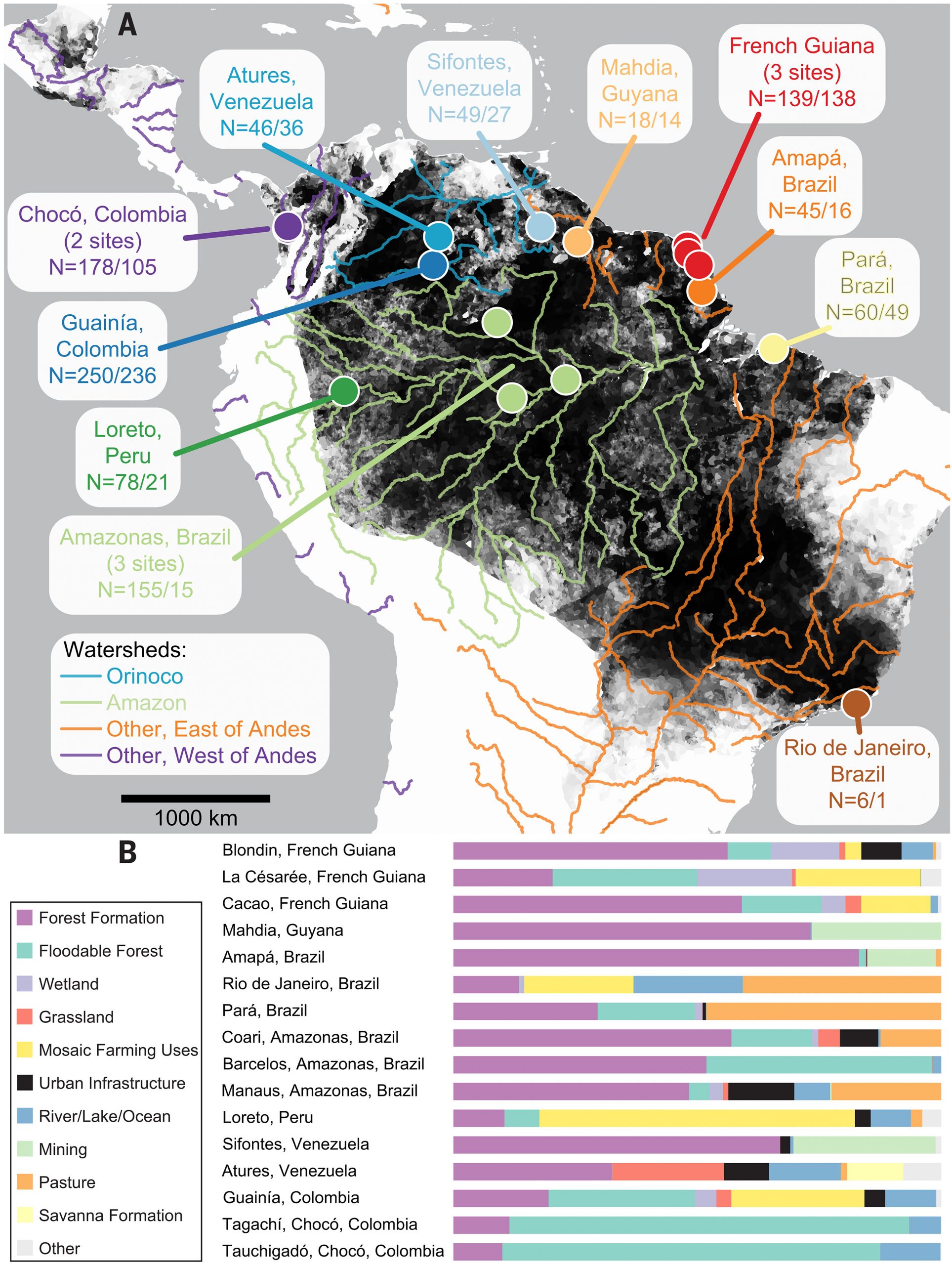
Figure 1: Collection sites. (A) Collection localities with counts of usable specimens (coverage ≥2x/coverage ≥14x) in six countries. Gray scale shading shows predicted distribution of An. darlingi (probability of presence from white = 0 to black = 1). Major rivers are colored by watershed. (B) Proportion of land cover and land use type in the surrounding 5-km area for all collection sites.
Malaria continues to affect hundreds of thousands of people in the region each year, particularly in countries such as Brazil, Colombia, and Venezuela. Understanding how mosquito populations evolve is essential for improving strategies to control the disease.
To investigate this, researchers sequenced the complete genomes of 1,094 female mosquitoes collected from 16 locations across six countries, including forests, agricultural zones, wetlands, and urban environments. This large-scale genomic dataset allowed the team to examine how mosquito populations vary genetically across the continent.
One important finding was evidence that the mosquitoes are evolving genes associated with resistance to insecticides. These changes were detected in multiple regions, suggesting that the species may be adapting to chemical exposure in its environment. They suggest that agricultural insecticides, rather than those used directly for mosquito control, may be contributing to this evolutionary pressure.
The study also revealed substantial genetic differences between mosquito populations from different countries. Such diversity indicates that the species has a strong capacity to adapt to new environmental conditions, which could influence how malaria spreads in different regions.
By providing a detailed view of mosquito genetic variation across South America, the study offers a foundation for future research into how vector populations evolve and how disease transmission might be reduced. Further studies will be needed before the results can directly inform public health policies or malaria control programs.
Ultimately, insights from mosquito genomics could help scientists develop more effective strategies to combat malaria, particularly as vectors continue to evolve in response to environmental and chemical pressures.
Journal article: Tennessen, J.A., et al. 2026. Population genomics of Anopheles darlingi, the principal South American malaria vector mosquito. Science.
Summary by Stefan Botha