


Researchers have uncovered new evidence linking Epstein–Barr virus (EBV) to the immune dysfunction seen in multiple sclerosis (MS) (Figure 1). The study points to an unexpected role for CD8+ “killer” T cells in the disease.
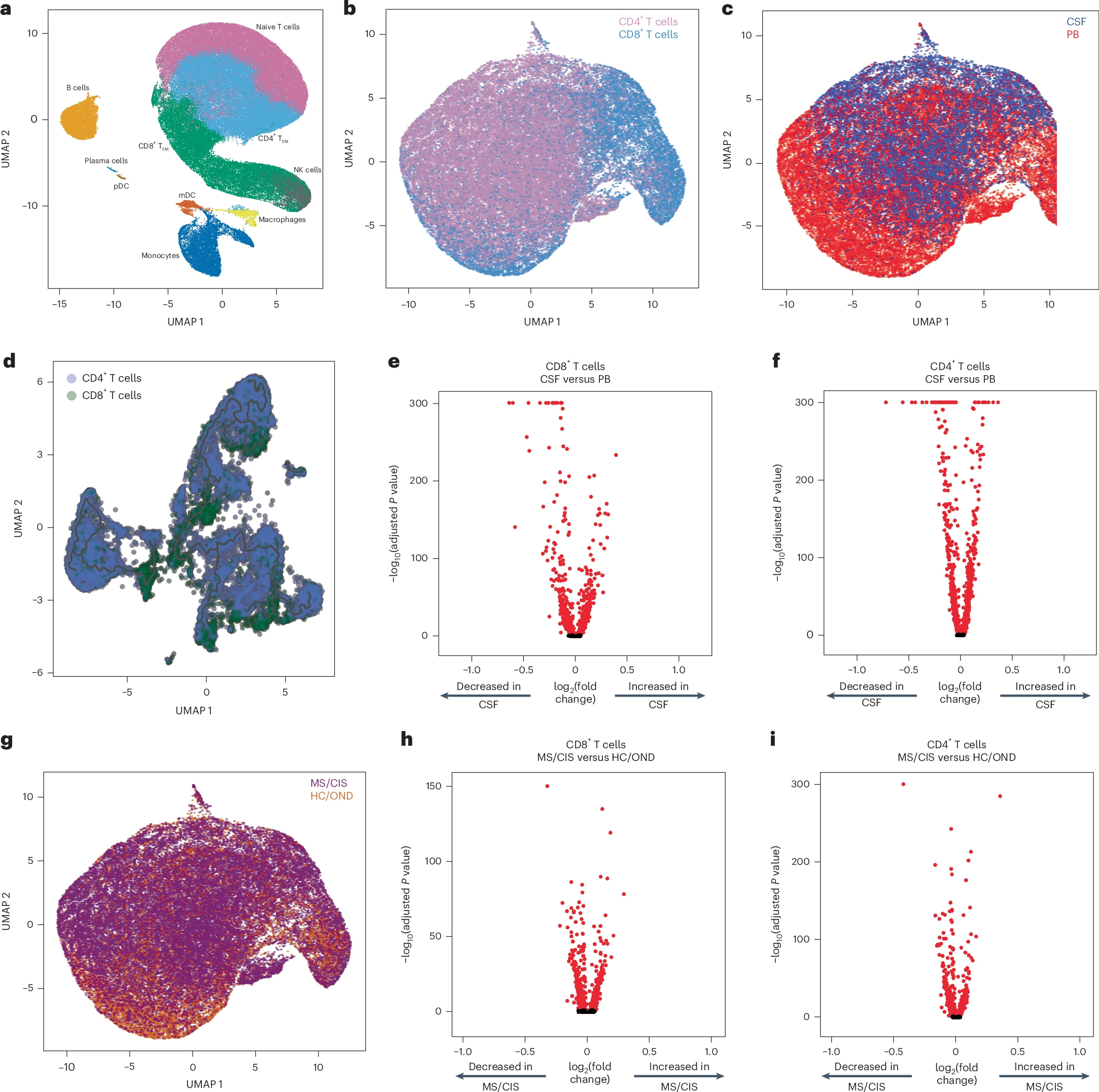
Figure 1: Single-cell-sequencing analysis of T cells in blood and cerebrospinal fluid. a, Major immune cell subsets from combined blood and CSF of all patients were identified by scRNA-seq. mDC, myeloid dendritic cells; NK, natural killer cells; pDC, plasmacytoid dendritic cells; TEM, effector memory cells. b,c,g, T cells were defined after integration of the scRNA-seq and scTCR-seq data, allowing segregation of T cells by CD4/CD8 status (b), compartment (CSF; c) and disease status (g). d, Pseudotime trajectory analysis of CD4+ and CD8+ T cells in CSF and peripheral blood (PB). e,f,h, Analysis of differential gene expression between CSF-derived and PB-derived CD8+ (e) and CD4+ (f) T cells as well as between MS/CIS-derived and HC/OND-derived CD8+ (h) and CD4+ (i) T cells. Differential gene expression comparisons were performed using a two-sided Wilcoxon ranked-sum test with Bonferroni correction (adjusted P). Genes with adjusted P < 0.05 are indicated in red. UMAP, uniform manifold approximation and projection.
While MS research has traditionally focused on CD4+ T cells, this study examined CD8+ T cells directly in people with MS. By analysing blood and cerebrospinal fluid from patients with MS or early disease signs, the researchers found that certain CD8+ T cells were dramatically enriched in the central nervous system. In some cases, these cells were up to 100 times more abundant in cerebrospinal fluid than in blood, indicating a localized immune response within the brain and spinal cord.
Importantly, many of these expanded killer T cells recognized EBV-related proteins. Although EBV was detected in most participants regardless of MS status, a specific viral gene was active only in people with MS, suggesting that EBV may trigger or sustain the harmful immune response.
Together, the findings strengthen the idea that EBV is not just associated with MS but may actively shape the immune attack that damages myelin. The results also highlight CD8+ T cells as key players in MS pathology and point to new directions for understanding, and potentially targeting, the disease.
Journal article: Hayashi, F., et al. 2026. Antigen specificity of clonally enriched CD8+ T cells in multiple sclerosis. Nature Immunology.
Summary by Stefan Botha