


A new study suggests that specific inflammatory proteins in the blood could enhance the diagnosis of Alzheimer’s disease and shed light on how genetic risk factors drive disease biology (Figure 1).
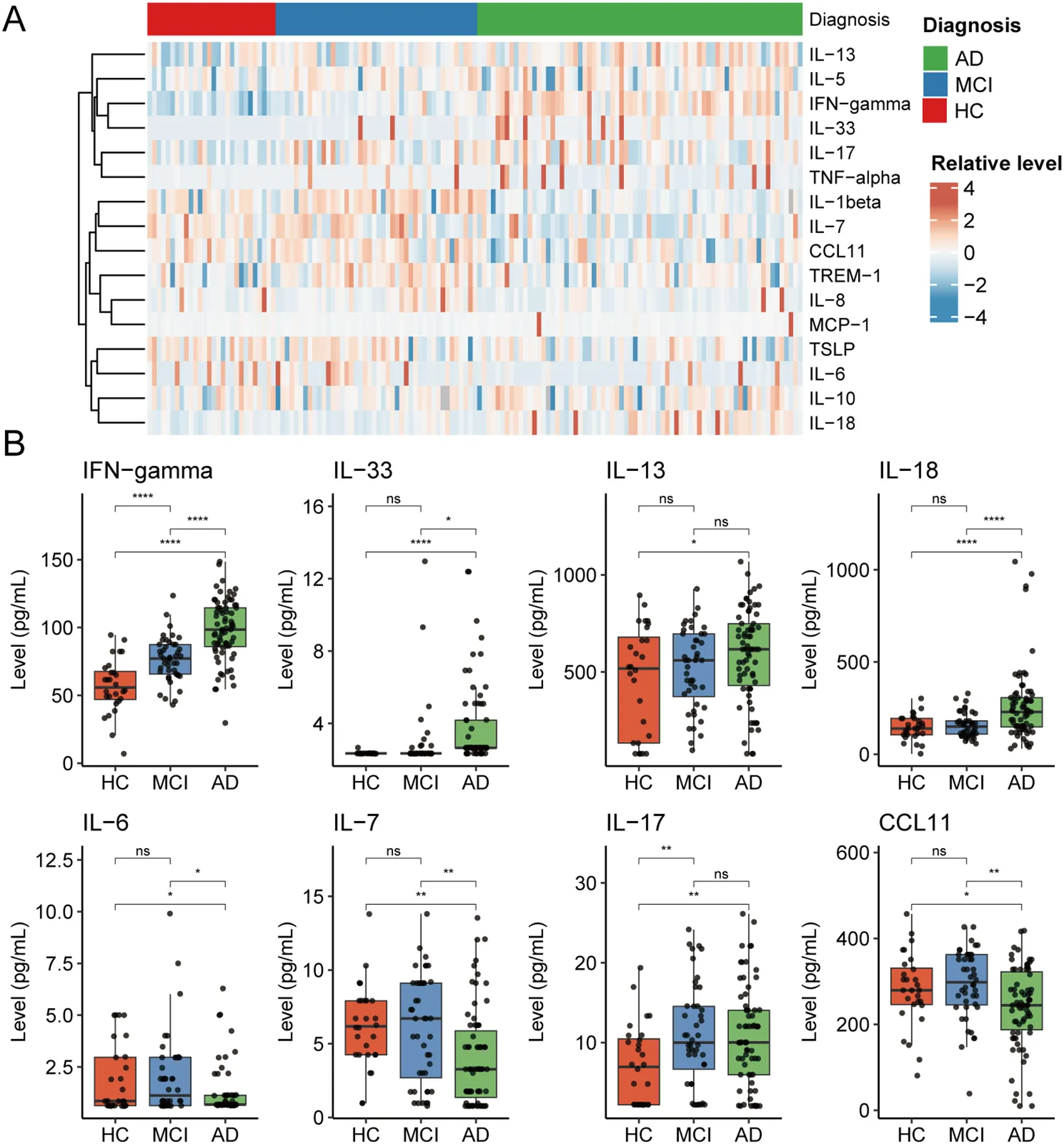
Figure 1: Differential expression of plasma inflammatory proteins among AD, MCI, and HC groups. (A) Heatmap showing the relative expression levels of 16 plasma inflammatory markers in individuals with Alzheimer’s disease (AD), mild cognitive impairment (MCI), and healthy controls (HC). (B) Box plots comparing the plasma levels of eight significantly differentially expressed inflammatory markers among the AD, MCI, and HC groups, including IFN-γ, IL-33, IL-13, IL-18, IL-6, IL-7, IL-17, and CCL11. ns, not significant; *P < 0.05; **P < 0.01; ****P < 0.0001.
Researchers analysed plasma samples from 141 individuals, including patients with Alzheimer’s disease, people with mild cognitive impairment, and cognitively healthy controls. Sixteen inflammatory proteins were measured alongside APOE genotyping, a key genetic risk factor for Alzheimer’s.
Patients with Alzheimer’s showed distinct inflammatory changes, including higher levels of interferon-gamma (IFN-γ), IL-33, and IL-18, and lower levels of IL-7 and CCL11. When these inflammatory markers were combined with clinical data and APOE genotype, diagnostic accuracy improved substantially, increasing the predictive performance of the model from strong to near-excellent discrimination between Alzheimer’s patients and healthy controls.
Among all markers, IFN-γ emerged as the strongest predictor. Levels were particularly elevated in patients carrying the APOE ε4 allele, the most well-established genetic risk factor for Alzheimer’s. Further analysis of single-cell sequencing data revealed heightened IFN-γ signalling in a specific subset of microglia associated with APOE4, known as lipid droplet–accumulating microglia. Laboratory experiments showed that IFN-γ directly increased expression of ACSL1, a gene linked to this pathogenic microglial state, especially in cells expressing APOE4.
Together, the findings suggest that circulating inflammatory markers, particularly IFN-γ, may serve as accessible diagnostic indicators while also revealing a biological pathway connecting immune signalling and genetic risk in Alzheimer’s disease.
Journal article: Huang, R., et al. 2026. Identification of plasma inflammatory biomarkers for Alzheimer’s disease reveals IFN-γ as a regulator of ACSL1-mediated microglia phenotype. Frontiers in Immunology.
Summary by Stefan Botha