


Researchers have identified a critical enzyme that controls how long-lived tissue-resident macrophages develop and function across the body (Figure 1). These immune cells are essential for maintaining organ health, clearing damaged cells, and supporting tissue repair, and their dysfunction is linked to chronic inflammation, disease, and aging.
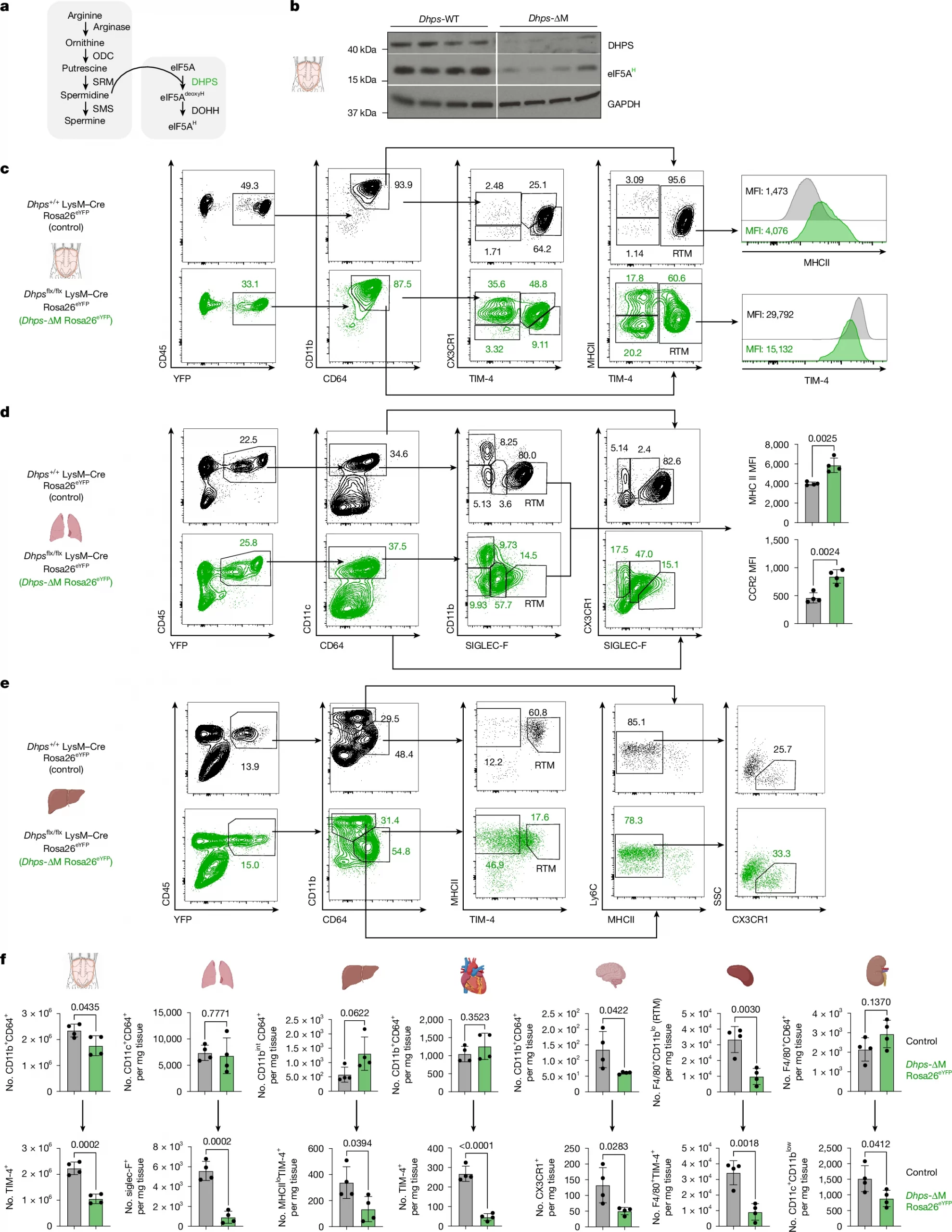
Figure 1: Dhps-ΔM mice have a defect in RTMs. a, Polyamine biosynthesis and eIF5a hypusination pathways. b, Immunoblot of indicated proteins on FACS-sorted F4/80hiCD11b+ peritoneal macrophages from Dhps-WT and Dhps-ΔM mice. c–e, Representative flow cytometry plots of macrophage subpopulations in peritoneal cavity (c), lungs (d) and liver (e) in Dhps+/+ Rosa26eYFP (control) or Dhps-ΔM Rosa26eYFP reporter mice. CD45+YFP+ cells were gated on singlets and live cells. f, Absolute numbers of macrophages and RTMs across tissues from Dhps+/+ Rosa26eYFP (control) or Dhps-ΔM Rosa26eYFP reporter mice. Images reflect peritoneal cavity, lung, liver, heart, brain, spleen and kidney. Representative plots and graphs summarize results of at least two independent experiments. Data are mean ± s.d., representative of n = 4 biological replicates. Statistical analyses were performed using two-tailed t-tests; P values are shown. DOHH, deoxyhypusine hydroxylase. Illustrations in b–f were created using BioRender (https://biorender.com).
The study reveals that the enzyme deoxyhypusine synthase (DHPS) is required for monocytes to successfully mature into tissue-resident macrophages after entering organs. When DHPS was selectively removed from myeloid cells in mice, macrophages across multiple tissues failed to fully mature, leading to persistent but ineffective recruitment of new immune cells and impaired tissue maintenance.
Molecular analyses showed that DHPS-deficient macrophages were blocked at a key differentiation stage and had defects in cell adhesion, signalling, and interactions with surrounding tissue. These problems stemmed from disrupted protein translation, as DHPS is required to modify a translation factor needed for efficient production of specific proteins involved in macrophage function.
As a result, macrophages lacking DHPS showed abnormal shape, poor tissue integration, and reduced ability to perform core tasks such as clearing dead cells. Together, the findings position DHPS as a central regulator of the pathway that enables macrophages to become stable, functional residents of tissues.
Because tissue-resident macrophages influence cancer, fibrosis, wound healing, inflammatory disease, and age-related tissue decline, this pathway may offer new opportunities for therapeutic intervention. Future work will focus on defining the full network of DHPS-dependent proteins and determining how this mechanism contributes to disease and aging.
Journal article: Carrizo, G.E., et al. 2026. The transition from monocyte to tissue-resident macrophage requires DHPS. Nature.
Summary by Stefan Botha