


When the immune system encounters a virus, the B cells that recognise it can form long-lived memory B cells. When a related virus is encountered years later, these pre-existing clones can influence, or even dominate, the new antibody response. This phenomenon is known as antibody imprinting.
A new study of people who experienced sequential infection with SARS-CoV-1 and SARS-CoV-2 reveals just how remarkably persistent this imprinting can be and how a later infection can redirect these decades-old immune responses towards conserved viral regions (Figure 1).
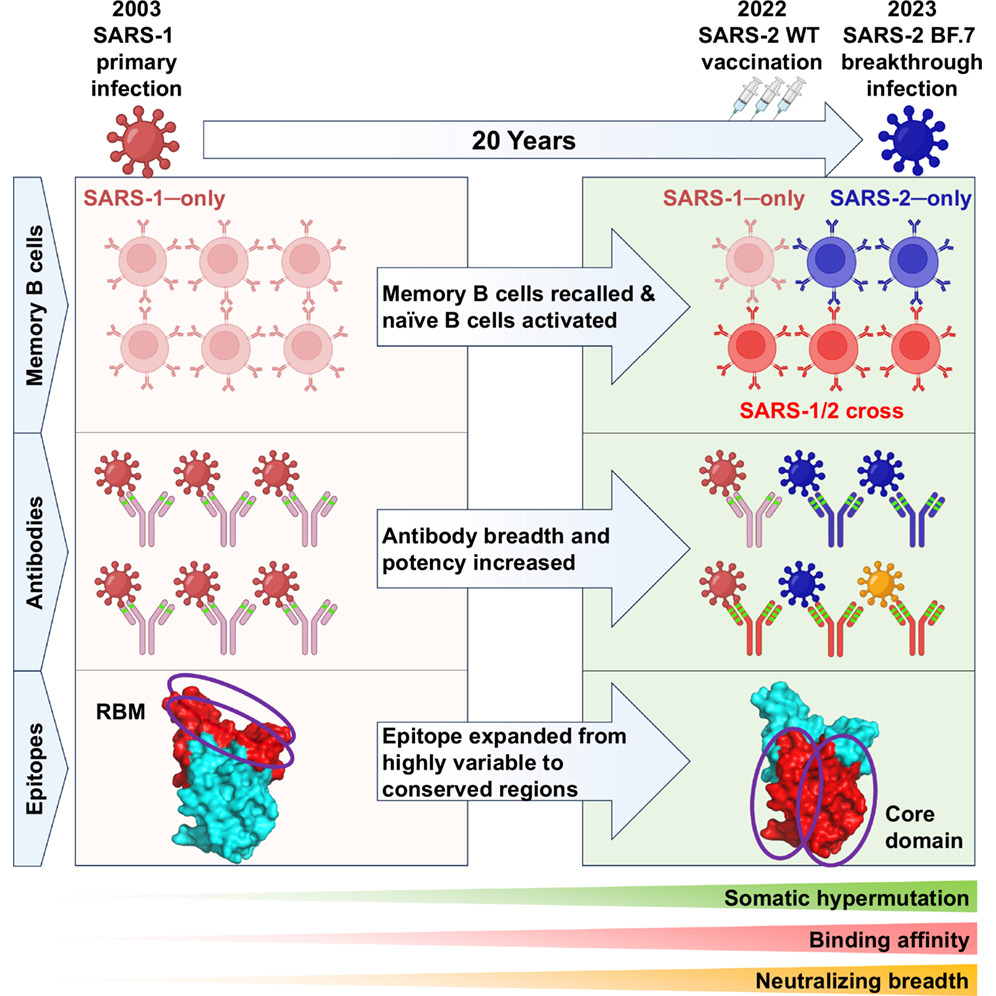
Figure 1: Graphical abstract.
SARS-CoV-1 caused the original SARS outbreak in 2002–2003. More than two decades later, the researchers examined people who had previously been infected with SARS-CoV-1 and subsequently experienced SARS-CoV-2 breakthrough infection.
SARS-CoV-1-specific memory B cells were still detectable and functional more than 20 years after the original infection.
Some antibodies retained remarkably germline-like features and continued to recognise and neutralise viral targets decades after SARS-CoV-1 infection. That is an extraordinary example of the longevity of human B-cell memory.
SARS-CoV-1 and SARS-CoV-2 share substantial structural similarities, particularly within the spike protein. This creates an interesting immunological situation. When SARS-CoV-2 was encountered, the immune system did not start from scratch. Instead, pre-existing SARS-CoV-1 memory B cells could be recalled and expanded.
The researchers found that approximately 60% of the monoclonal antibodies they isolated were SARS-CoV-1-imprinted.
Importantly, many of these antibodies recognised conserved regions of the receptor-binding domain (RBD), regions shared between the two viruses.
This is potentially beneficial because conserved epitopes are less likely to change dramatically between viral variants.
The immune system wasn’t completely locked into its original response.
Around 37% of the antibodies analysed escaped the SARS-CoV-1 imprint and instead recognised the SARS-CoV-2 receptor-binding motif, including regions overlapping the ACE2-binding site.
So antibody imprinting isn’t necessarily a biological dead end. The immune system can reshape an existing memory response.
The researchers found that SARS-CoV-1 imprinting was particularly associated with two antibody heavy-chain germline genes:
IGHV1-8
IGHV4-39
These germline genes appear to provide B-cell receptors capable of recognising conserved sarbecovirus structures. Some of these antibodies retained relatively little somatic mutation even after two decades, suggesting that certain B-cell clones can remain remarkably stable over time.
One particularly interesting antibody was THZ937. This highly imprinted broadly neutralising antibody recognised conserved features shared across sarbecoviruses. And importantly, the researchers didn’t just demonstrate binding in a laboratory assay.
In hamster experiments, THZ937 provided protection against both contact and airborne transmission of the Omicron EG.5.1 variant. That provides evidence that these exceptionally durable, SARS-CoV-1-imprinted antibodies can remain functionally relevant against much later SARS-CoV-2 variants.
Antibodies that target highly variable regions can lose effectiveness as mutations accumulate. But antibodies targeting conserved epitopes may retain activity across multiple viral variants and potentially across different viruses within the same viral family.
This is one of the central challenges in developing pan-sarbecovirus vaccines.
Rather than designing vaccines around the most prominent variable regions of one circulating virus, researchers are increasingly interested in directing B-cell responses towards the structural features that different sarbecoviruses have difficulty changing.
This study offers an important clue for that strategy.
If SARS-CoV-1 infection can generate memory B cells that persist for more than 20 years and recognise conserved sarbecovirus epitopes, then vaccination might potentially be designed to deliberately establish similar long-lived B-cell populations.
The challenge is that immunodominance can work against this goal.
The immune system naturally tends to focus on highly accessible and immunogenic epitopes some of which may be variable.
Future vaccine strategies could therefore aim to:
– Focus B-cell responses on conserved epitopes
– Recruit broadly neutralising antibody lineages
– Sequentially expose the immune system to related antigens
– Build durable immunity across multiple sarbecoviruses
This study highlights something fundamental about adaptive immunity:
The antibody response generated by a new infection is not necessarily determined only by the pathogen we encounter today. It can be shaped by infections and vaccinations from years — or even decades earlier.
But importantly, immune memory is not completely fixed.
A related pathogen can recall old B-cell clones while simultaneously recruiting new ones and redirecting antibody specificity towards previously unseen or conserved epitopes.
That balance between immune memory and immune adaptation could be one of the keys to designing vaccines that provide broader and longer-lasting protection.
More than 20 years after SARS-CoV-1 infection, some memory B cells can still produce functional antibodies against conserved sarbecovirus targets.
When these individuals later encountered SARS-CoV-2, their immune response was strongly shaped by this historical exposure but it was also capable of expanding beyond the original imprint.
The findings provide a fascinating demonstration of the longevity, flexibility and evolutionary memory of the B-cell response, while offering potential principles for developing pan-sarbecovirus vaccines capable of preparing us for viruses we haven’t encountered yet.
Journal article: Zhang, Q., et al. 2026. Twenty-year persistence of SARS-CoV-1 immune imprinting shapes antibody responses to SARS-CoV-2 infection. Immunity.
Summary by Stefan Botha