


Around one-quarter of the world’s population is estimated to have been infected with Mycobacterium tuberculosis, yet only a minority of infected people develop active TB.
So what determines whether infection is contained or progresses to disease?
New research provides an important clue: the earliest immune response in the lungs may help determine the outcome (Figure 1).
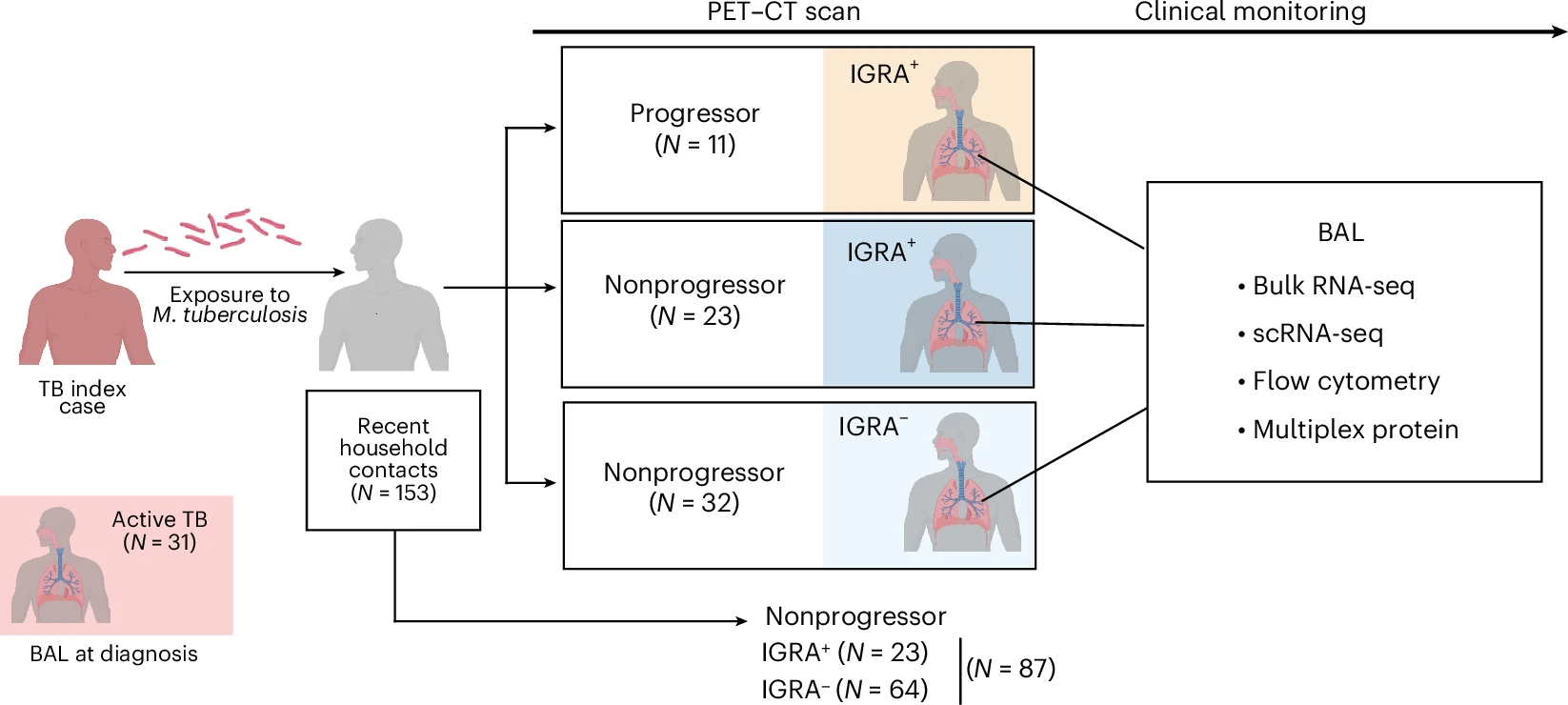
Figure 1: Schematic of the study on patients with TB and their household contacts. A total of 153 recent household contacts of active pulmonary TB patients were recruited, of whom 11 progressed to TB disease (progressors). Bronchoalveolar lavage (BAL) was sampled from the 11 progressors and 55 contacts who did not progress (nonprogressors). Further details are available in the Methods, Extended Data Fig. 1a,b and Supplementary Tables 1,a–c. Illustration created in BioRender; Branchett, W. https://biorender.com/uhc5llr (2026).
The study reveals an important difference between people who controlled infection and those who progressed to active TB, involving the balance between inflammatory neutrophils and protective T cells.
Much of what we know about TB immunity comes from analysing blood. But M. tuberculosis enters through the respiratory tract, establishes infection in the lungs, and interacts with immune cells within the airway and lung tissue. The researchers therefore looked directly at the local immune response.
They analysed bronchoalveolar lavage (BAL) samples from recent household contacts of people with pulmonary TB, providing an early snapshot of what was happening in the airways following exposure.
they could examine both which immune cells were present and what those cells were doing. Among individuals who went on to develop active TB, the airways were dominated by neutrophils.
Neutrophils are essential first responders, but excessive or persistent neutrophil recruitment can contribute to inflammatory tissue damage. The researchers found that around half of these neutrophils showed activation of type I interferon-associated gene programmes.
At the same time, the neutrophils expressed high levels of CXCL8 (IL-8), a chemokine that recruits additional neutrophils.
The researchers found that the T-cell compartment looked very different in people with high neutrophil numbers.
These T cells showed evidence of:
- Exhaustion
- Increased cell death
- Reduced capacity to maintain effective antimicrobial responses
In other words, an immune response intended to control infection may become too inflammatory to remain protective. This is particularly important in TB because effective control requires coordinated interactions between T cells and macrophages.
T cells help activate infected macrophages and coordinate cellular immunity capable of restricting M. tuberculosis. An inflammatory environment that disrupts these interactions could therefore favour bacterial persistence and disease progression.
People who controlled infection showed a markedly different immune landscape. Their T cells were not excessively activated, but they also did not display the strong exhaustion and cell-death signatures seen in progressive disease.
Instead, they expressed genes associated with:
– Immune regulation
– A more stem-like state
– Long-term cellular persistence
Rather than requiring an overwhelming T-cell response, effective TB control may depend on maintaining a population of durable, adaptable T cells that can persist and respond when needed.
The researchers observed similar immune patterns in datasets from non-human primates and mouse models, strengthening the possibility that these responses reflect a conserved feature of TB immunity.
Perhaps the most important message is that protection from TB appears to involve immune balance. Too little inflammation may fail to control the bacteria.
But excessive inflammation may recruit large numbers of neutrophils, damage the lung environment and impair the T-cell–macrophage interactions needed for bacterial control. The immune system has to control the pathogen without destroying the tissue it is trying to protect.
Type I interferons are classically associated with antiviral immunity, but their role in TB is much more complicated. Previous work identified a type I interferon signature in people with active TB, challenging the idea that active disease simply reflects an inadequate immune response.
The emerging picture suggests that, in TB, strong type I interferon activity can be associated with an inflammatory programme that may actually undermine effective antibacterial immunity.
The researchers’ recent work suggests that type I interferon signalling can promote neutrophil swarming in the lungs, potentially limiting the interactions between T cells and macrophages that are important for controlling M. tuberculosis.
One of the biggest challenges in TB is that current diagnostic approaches cannot reliably tell us which infected individuals are most likely to progress to active disease.
These airway immune signatures raise the possibility of developing biomarkers that identify people entering a disease-promoting immune state before overt TB develops. That could eventually allow treatment to be targeted according to an individual’s risk and immune profile.
The findings also open an interesting therapeutic avenue: rather than targeting the bacterium alone, could we modify the host immune response to improve bacterial control?
One possibility would be reducing excessive neutrophil recruitment. For example, CXCR2 inhibitors can interfere with chemokine-driven neutrophil trafficking and are already being investigated in other inflammatory lung diseases.
Another possibility is vaccination strategies designed not simply to generate a strong immune response, but to promote durable, stem-like T-cell states capable of maintaining long-term protection. These approaches remain experimental in the context of TB, but they illustrate the potential of host-directed therapy.
TB is often framed as a battle between the immune system and M. tuberculosis.
This study suggests something more nuanced. The outcome may depend on how the immune system responds to the bacteria and whether that response remains functionally coordinated over time.
The same inflammatory mechanisms that initially respond to infection can, when dysregulated, create an environment that favours disease. Understanding that tipping point could help researchers move from simply treating established TB towards predicting and preventing progression.
Successful TB immunity may not require the strongest immune response but the right one. A lung environment dominated by inflammatory neutrophils and type I interferon-associated programmes was associated with disease progression, while individuals who controlled infection maintained T cells with more regulated and stem-like characteristics.
The challenge now is to determine whether these signatures can be translated into early biomarkers and host-directed interventions that help keep TB contained before active disease takes hold. In TB, the key to protection may be finding the balance between inflammation and immune control.
Journal article: Branchett W.J. et al. 2026. Airway immune signatures of protection and disease progression in recent human tuberculosis household contacts. Nature Immunology.
Summary by Stefan Botha