


Inflammatory bowel disease (IBD), including Crohn’s disease and ulcerative colitis, is driven by complex interactions between the immune system, intestinal microbes and the gut environment. While much attention has focused on bacterial dysbiosis, growing evidence suggests that fungi, the gut mycobiome, may also influence intestinal inflammation and treatment response.
Now, researchers have reported preliminary evidence that reducing intestinal fungal overgrowth may help restore a healthier gut microbial ecosystem in a subset of people with IBD.
The study investigated whether antifungal treatment could alter the gut microbiome and clinical disease activity in patients with mild-to-moderate IBD who also had oral thrush (Figure 1).
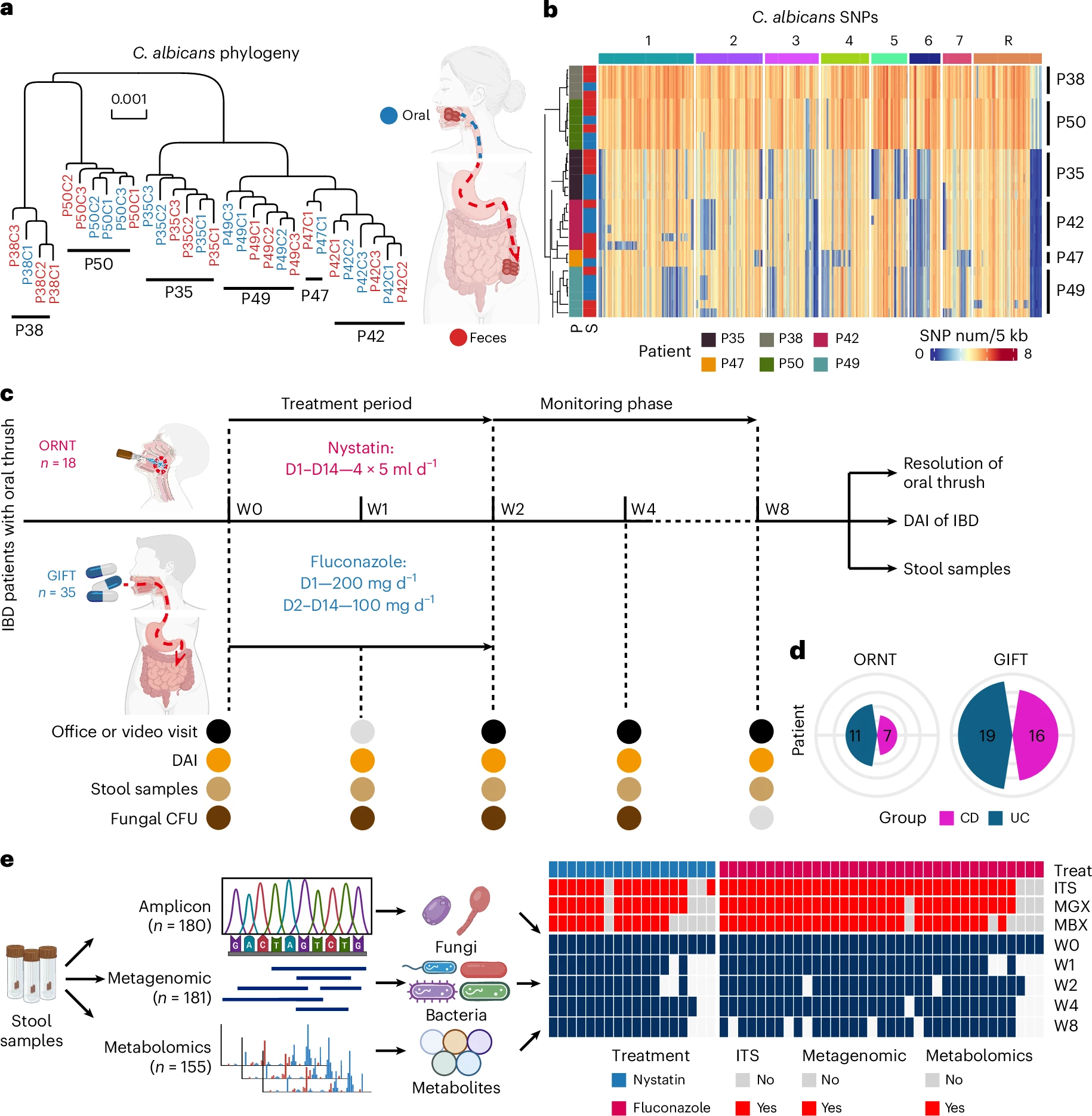
Figure 1: Study design and multi-omics overview of patients with IBD with oral thrush. a, Phylogenetic tree of 30 C. albicans strains isolated from paired oral and fecal samples in six patients at W0 time point. Blue and red labels indicate oral-derived and gut-derived isolates, respectively. Sample codes include the patient ID and colony number, with numerical suffixes denoting distinct colonies from the same sample. Right, scheme plot indicating fungal strain transmission from the mouth to the gut. b, Heatmap of SNP distribution across C. albicans genomes from representative patients. Rows represent isolates, columns represent chromosomal regions and SNP density (per 5 kb) is shown on a color scale (n = 30). C. albicans isolates recovered from paired oral and fecal samples from six participants. c, Study design. The 53 patients with IBD with clinically diagnosed oral thrush were treated with either topical nystatin (ORNT group, n = 18) or fluconazole (GIFT group, n = 35). Samples were collected at W0 (pretreatment), W2 and W4 (post-treatment) and W8 (LTM). Stool samples, DAIs and fungal CFUs were assessed longitudinally. Here n denotes the number of participants. d, Distribution of patients by treatment group (ORNT versus GIFT) and disease type (UC versus CD). The ORNT group included n = 11 participants with UC and n = 7 participants with CD, whereas the GIFT group included n = 19 participants with UC and n = 16 participants with CD. e, Multi-omics profiling workflow. Fecal samples were analyzed by fungal ITS amplicon sequencing (n = 180), bacterial metagenomics (n = 181) and untargeted stool metabolomics (n = 155). Data integration across fungi, bacteria and metabolites was used to evaluate longitudinal host–microbiome–metabolome dynamics. Here n denotes the number of biological fecal samples collected at distinct participant–time-point combinations; longitudinal samples collected from the same participant at different time points are counted separately.
Previous work from the researchers has implicated Candida albicans in intestinal inflammation. Some C. albicans strains can produce candidalysin, a fungal toxin that damages intestinal epithelial cells and can activate inflammatory immune responses.
In the context of IBD, fungal overgrowth may therefore contribute to a cycle of epithelial damage, immune activation and intestinal inflammation.
The researchers also found that genetically related Candida strains were frequently present in both the mouth and gastrointestinal tract of the same patient. This provided an intriguing possibility: could a simple cheek swab provide a window into intestinal fungal colonisation?
The prospective IVAN study followed 53 people with mild-to-moderate Crohn’s disease or ulcerative colitis and oral thrush, who were already receiving standard IBD treatment.
Participants received either:
- Nystatin – an antifungal mouthwash that primarily acts locally in the oral cavity
- Fluconazole – a systemic antifungal capable of reaching the gastrointestinal tract
Both treatments successfully resolved oral thrush. But the effects on the gut were different. Only fluconazole substantially reduced intestinal Candida burden and produced broad changes in the gut microbial community.
Following fluconazole treatment, researchers observed increased bacterial diversity alongside changes in the fungal community. Importantly, these changes were accompanied by increased production of butyrate, a microbial metabolite with important roles in intestinal health, including supporting epithelial function and influencing immune regulation. The microbiome changes also persisted for several weeks after the two-week antifungal treatment period.
Patients receiving fluconazole were additionally more likely to show improvements in clinical disease activity and had a lower probability of disease progression during the eight-week follow-up.
The findings support a model in which fungal overgrowth can influence the wider intestinal ecosystem. Rather than fungi acting independently, changes in Candida abundance may alter the bacterial community and the metabolites produced within the gut.
One of the most interesting aspects of the study is its potential for precision medicine. Not every person with IBD is likely to have the same fungal dysbiosis, meaning that antifungal treatment may not benefit everyone.
Instead, identifying patients with specific fungal signatures, potentially using relatively accessible biomarkers such as oral Candida detection, could allow treatment to be targeted towards individuals most likely to benefit.
The findings are promising, but this was a preliminary prospective observational study, not a randomised, placebo-controlled clinical trial designed to establish antifungal efficacy. The study involved a relatively small number of patients, all of whom had oral thrush, and participants were already receiving standard IBD therapies.
A larger multicentre, placebo-controlled trial will therefore be needed to determine whether targeting intestinal fungal dysbiosis can genuinely improve IBD outcomes and which patient populations are most likely to respond.
IBD has traditionally been viewed largely through the lens of bacterial dysbiosis and abnormal immune responses. This study adds another layer to that picture by highlighting the potential role of the fungal microbiome in shaping intestinal immunity and microbial metabolism.
If validated in larger studies, fungal-targeted therapies could eventually become an additional tool for selected patients with IBD, not necessarily replacing immunomodulatory treatments, but potentially complementing them by addressing an underlying microbial driver of inflammation.
Journal article: Pan X, et al. 2026. Antifungal therapy improves microbiome dynamics in inflammatory bowel disease. Nature Medicine.
Summary by Stefan Botha